
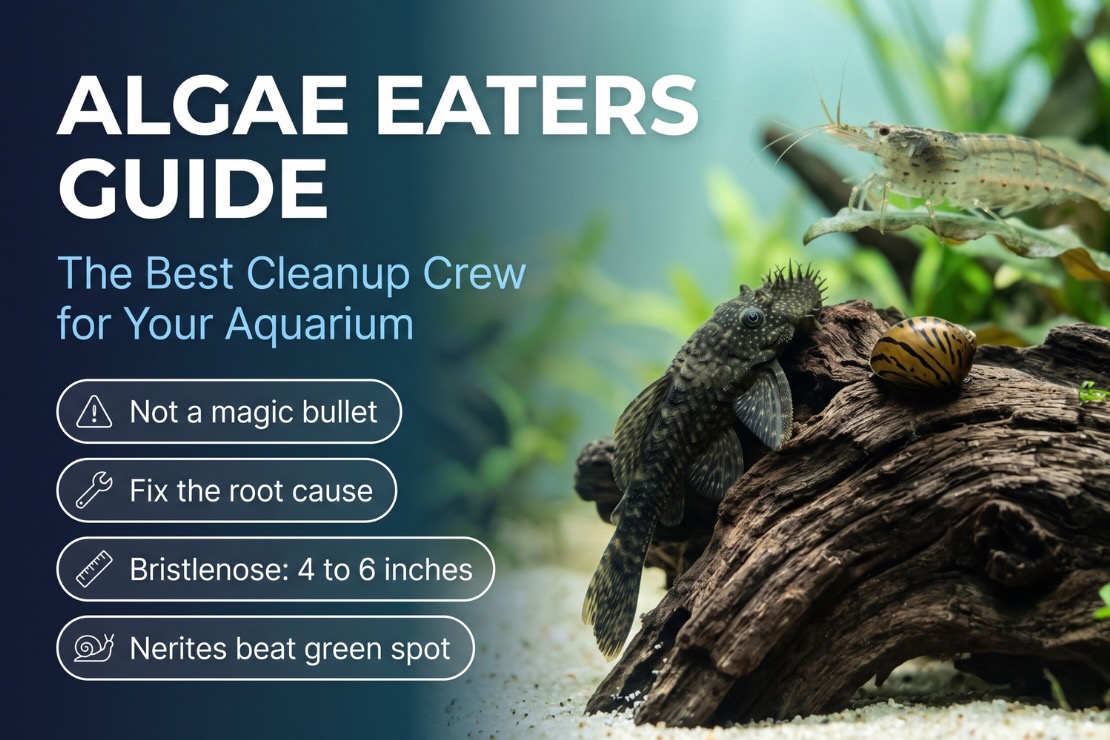
It’s the green menace, the brown scourge, the unwelcome guest that can turn a crystal-clear aquarium into a fuzzy, green mess: Algae. Consequently, for many hobbyists, the first line of defense is to hire a “cleanup crew.” However, not all algae eaters are created equal. Some are specialists, others are generalists, and some are impostors that stop working once they get big. Therefore, this guide will be your roster, helping you identify your specific algae problem and choose the perfect special operative to solve it.
My First “Special Ops” Algae Eaters
I remember my first significant algae outbreak. It was a stubborn, fuzzy green algae that was slowly taking over my beautiful driftwood. My first thought, like many beginners, was, “I need a Pleco!” So, I went to the store, bought what I was told was a great algae eater, and proudly introduced it to the tank.
But the plan failed. Weeks went by, and the algae continued to thrive while my “algae eater” grew bigger and lazier, preferring to eat the expensive sinking pellets I fed my Corydoras. It was a frustrating failure. That’s when I had my epiphany: algae eaters aren’t janitors you hire to clean the whole building; they are a special ops team, and you need to deploy the right specialist for the right mission. Therefore, this guide is your roster for that team.
The real heroes of the story, however, were two horned nerite snails. They cleaned one 10-gallon tank at a time. Later,when I finally decided bladder and ramshorn snails are not really pests, I was amazed. Ultimately, they did an amazing job at keeping the glass always shiny.
Before You Start: An Algae Eater is Not a Magic Bullet
It is critical to understand that algae is a symptom of an imbalance in your tank, usually too much light, too many nutrients (from overfeeding), or inconsistent CO2. While an algae-eating crew is a fantastic, natural way to manage the problem, remember that the only way to truly solve it is to address the root cause of the imbalance.
The Catfish Crew: The Bottom-Dwelling Algae Eaters
The Bristlenose Pleco (Ancistrus sp.)
- What algae does it eat? A fantastic generalist. Specifically, they are excellent at cleaning biofilm, soft green algae, and brown diatom algae, especially off of driftwood and flat surfaces.
- Important Note: Because of its utility, the Bristlenose Pleco is the best choice for most tanks. Crucially, unlike the “Common” Pleco, which grows into a two-foot-long monster that stops being an algae eater, the Bristlenose stays a manageable 4-6 inches.
The Otocinclus Catfish (Otocinclus vittatus)
- What algae does it eat? These tiny catfish are specialists that are fantastic algae eaters. Specifically, they are great at clearing soft green algae and brown diatom algae, especially from plant leaves.
- Important Note: However, Otos are very sensitive. Therefore, they must be introduced to a mature, stable aquarium in a group of 6 or more.
The Invertebrate Division: The Tireless Specialists
The Nerite Snail (Neritina natalensis)
- What algae does it eat? They are the undisputed champions against the toughest algae. They specialize in eating hard green spot algae, brown diatoms, and even the dreaded Black Beard Algae.
- Important Note: They will lay small, hard white eggs, but these will not hatch in freshwater, so they will never overpopulate your tank.
The Amano Shrimp (Caridina multidentata)
- What algae does it eat? Amanos are the legendary workhorses of the shrimp world. They are famous for devouring all types of hair algae, string algae, and fuzz algae. They will also relentlessly pick at Black Beard Algae.
- Important Note: They are opportunistic and will steal fish food if given the chance. Keep them in a group of 3 or more.
The “Pest” Snails (Ramshorn & Bladder)
- What algae do they eat? They are generalist scavengers that will eat soft algae and leftover food.
- Important Note: They breed prolifically. Their population size is a direct indicator of how much you are overfeeding your tank.
The Fin-Powered Squadron: Other Fishy Algae Eaters
The Siamese Algae Eater (Crossocheilus oblongus)
- What algae does it eat? The “true” Siamese Algae Eater is one of the only fish in the hobby that is famous for reliably eating Black Beard Algae (BBA). They are also great at eating hair algae.
- Important Note: Be careful of impostors! The “Chinese” Algae Eater looks similar as a juvenile but grows into a large, aggressive fish that stops eating algae. A true SAE has a black stripe that runs all the way through its tail fin.
The Florida Flagfish (Jordanella floridae)
- What algae does it eat? This North American native is a little-known secret weapon. They have a voracious appetite for all types of hair algae and are known to pick at Black Beard Algae.
- Important Note: They can be semi-aggressive and may nip at slow-moving, long-finned tank mates.
The Molly (Poecilia sphenops)
- What algae does it eat? Mollies are fantastic grazers of soft green algae that grows on surfaces and plants.
- Important Note: They prefer hard, alkaline water and will constantly graze, making them a great preventative measure.
Aquarium Algea Eaters FAQ
A Common Pleco is not an effective long-term algae eater. As juveniles they graze on algae, but they grow into two-foot fish that prefer sinking pellets over cleaning duties. A Bristlenose Pleco stays at 4–6 inches and actively eats biofilm and green algae throughout its entire life.
The true Siamese Algae Eater (Crossocheilus oblongus) and the Amano Shrimp are the most effective algae eaters against Black Beard Algae. Nerite Snails are also known to pick at it consistently. No single species eliminates Black Beard Algae alone — addressing the root cause, usually inconsistent CO₂, is equally required.
A true Siamese Algae Eater has a black stripe that runs all the way through its tail fin. The common Chinese Algae Eater impostor has a similar stripe as a juvenile but grows large and aggressive and stops eating algae entirely. Checking whether the stripe extends into the tail is the definitive identification test.
Algae eaters manage and reduce algae growth but cannot solve an algae outbreak on their own. Algae is a symptom of an underlying tank imbalance, typically excess light, overfeeding, or inconsistent CO₂ levels. Addressing the root cause is the only way to permanently resolve an outbreak — algae eaters then maintain the result.
Otocinclus Catfish are the best algae eaters for a planted aquarium, as they clean soft green algae and brown diatoms directly from plant leaves without causing damage. Amano Shrimp are equally valuable for controlling hair and fuzz algae throughout the tank. Both species are small, peaceful, and safe for all delicate plant species.
Nerite Snails are the undisputed best algae eaters for hard green spot algae on glass and hardscape surfaces. No other commonly kept species matches their ability to remove this particularly tough algae type. They will never overpopulate a freshwater tank because their eggs cannot hatch without a saltwater environment, making them a permanently manageable addition.
Ramshorn and Bladder Snails are effective scavengers of soft algae and leftover food on tank surfaces. Their population size directly reflects how much food is available in the tank, making them a useful overfeeding indicator. Reducing feeding consistently reduces their numbers, transforming what most keepers consider a pest into a practical management tool.
Sources
- Aquarium Co-Op
https://www.aquariumco-op.com/blogs/aquarium/best-algae-eaters - The Spruce Pets
https://www.thesprucepets.com/algae-eaters-for-freshwater-aquariums-1378393 - Fishkeeping World
https://www.fishkeepingworld.com/10-best-algae-eaters/ - Practical Fishkeeping
https://www.practicalfishkeeping.co.uk/features/the-best-algae-eating-fish/ - BuilYourAquarium.com
https://www.buildyouraquarium.com/algae-eaters/
Leave a Reply
You must be logged in to post a comment.