
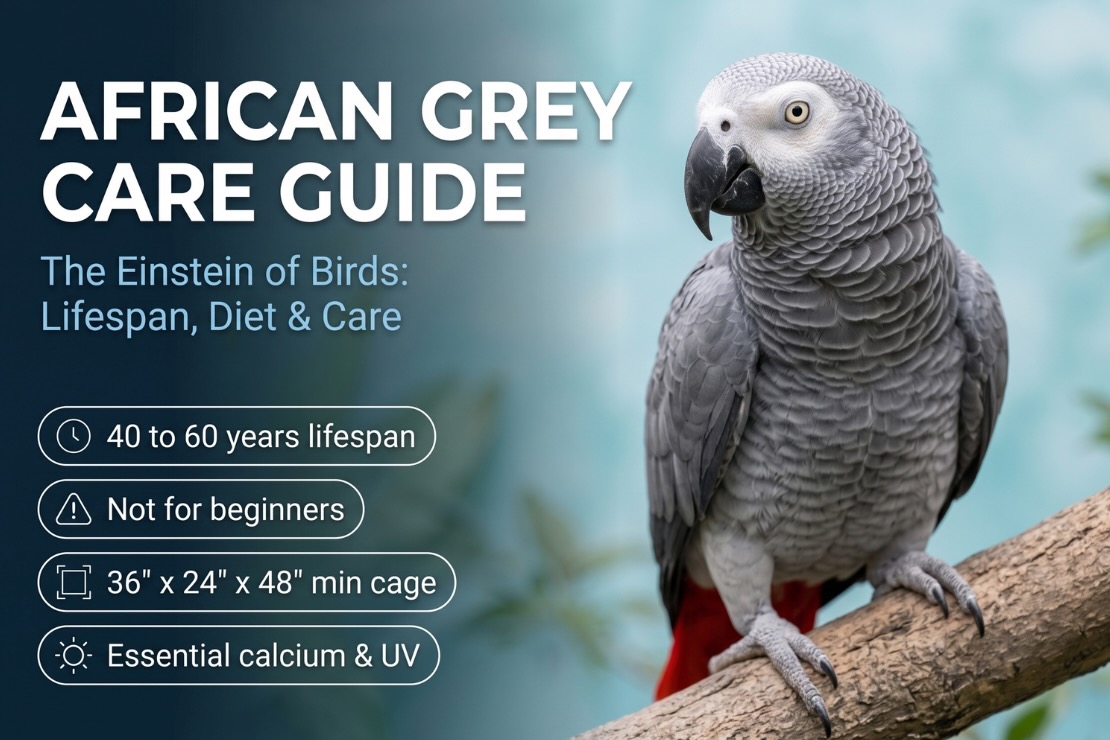
African Grey Parrots (Psittacus erithacus) are legendary for their cognitive feats. However, these geniuses possess incredible emotional complexity. In fact, this complexity links them to deep feelings. Therefore, you must not view them as talking decorations. Furthermore, they are demanding and profoundly rewarding companions. Specifically, they represent a lifelong commitment for any owner.
Are African Grey Parrots Good Pets for Beginners?
No, African Greys are not for beginners. In fact, experts do not recommend them for new bird owners. This is because they possess extreme intelligence. Furthermore, they have high emotional sensitivity. Consequently, they require a stable and experienced owner. Specifically, owners must manage stress-related behaviors like feather plucking. These “toddlers with wings” demand your full attention.
African Grey Parrots Average Lifespan
An African Grey represents a multi-generational commitment. In fact, these birds live 40 to 60 years in captivity on average. Consequently, owners must plan for their bird’s care in their legal will. Therefore, you should prepare for the bird outliving its first guardian. Furthermore, this longevity requires lifelong financial planning. Specifically, the bird’s future security depends on your foresight.
African Grey Parrots Temperament and Social Interaction
African Greys show incredible empathy toward their human companions. Specifically, they form powerful bonds with their owners. In fact, these birds often enjoy head scratches and staying close to you. However, they are also highly sensitive creatures. Furthermore, they only bite as a last resort when boundaries vanish or fear strikes. Consequently, you must respect their personal space to avoid such incidents. Regarding noise, they favor mimicry of common household sounds. As a result, you will hear microwaves, smoke alarms, and telephones frequently. Therefore, while not as loud as Macaws, they remain very vocal pets.
African Grey Parrots Intelligence and Communication
Their intelligence is their defining characteristic. Research, most notably with Alex the Parrot, confirms they possess the cognitive and emotional capabilities of a 2- to 5-year-old human child. They do not just mimic; they understand abstract concepts like “same,” “different,” shapes, and colors. They are widely regarded as the premier talkers of the avian world.
Bonding Patterns
African Greys have a strong tendency to bond with a single individual. While they can be socialized to tolerate a family unit, they will almost always have a “favorite.” Without careful management, this can lead to jealousy or aggression toward other family members.
Environmental Sensitivity
These birds are cautious and introverted—often contrasted with the more extroverted Amazon Parrot. As creatures of habit, they can be significantly stressed by sudden changes in routine or environment.
African Grey Parrots Legal and Ethical Acquisition
Due to their CITES Appendix I status, the sale of wild-caught African Greys is illegal. You must purchase from a reputable breeder who provides captive-bred documentation. Alternatively, adoption is highly encouraged, as many of these complex birds end up in rescues when owners are unprepared for their needs.
African Grey Parrots Minimum Cage Requirements
A spacious, durable environment is non-negotiable. The absolute minimum dimensions are 36″ W x 24″ D x 48″ H. Furthermore, the cage requires a high-quality lock, as these birds are adept at solving latches.
- Temperature: Stable household temperatures are ideal.
- Humidity: They benefit from higher humidity levels. Regular bathing and the use of a humidifier are recommended to maintain skin and feather health.
African Grey Parrots Enrichment and Mental Stimulation
Their minds must stay occupied to prevent self-destructive behaviors. Focus on the following:
Foraging Toys: These mimic natural behaviors by making the bird work for food.
Puzzle Toys: These specifically challenge their cognitive problem-solving skills.
Destructible Toys: Wood and paper toys satisfy the instinctive urge to chew.
African Grey Parrots Out-of-Cage Time
A sedentary life is detrimental to their health. They require a minimum of 3–5 hours of supervised, interactive time outside of their cage daily.
African Grey Parrots Diet and Nutrition
A balanced diet is the cornerstone of a long life. Nutritional deficiencies are the leading cause of health issues in captive Greys.
| Food Category | Percentage of Diet | Notes |
| High-Quality Pellets | 60–70% | Provides the baseline of balanced nutrition. |
| Fresh Vegetables | 20–30% | “Chop” rich in Vitamin A (leafy greens, orange veg). |
| Nuts, Seeds, & Fruit | 10% | Reserved primarily as high-value training rewards. |
African Greys are uniquely susceptible to hypocalcemia (calcium deficiency), which can lead to life-threatening seizures.
Important: Their diet must include calcium-rich foods like kale, almonds, and broccoli. Additionally, access to UV light is essential, as they require Vitamin D3 to metabolize calcium effectively.
African Grey Parrots Common Health Concerns
- Feather Plucking: Often a psychological response to boredom, stress, or routine changes.
- Respiratory Infections: Generally caused by poor ventilation or hygiene.
- PBFD: Psittacine Beak and Feather Disease is a serious viral concern.
Handling Biting
If a Grey bites, do not punish them. Stay calm and evaluate the trigger. Biting indicates the bird feels overwhelmed or threatened. Success lies in reading their subtle body language and building a foundation of trust.
Comparing Subspecies: Congo vs. Timneh
While closely related, the two main types of African Greys offer distinct experiences.
Congo African Grey (CAG): Larger, featuring light grey feathers, a black beak, and a bright red tail. They are often viewed as more high-strung and prone to anxiety-related plucking.
Timneh African Grey (TAG): Smaller and darker with a horn-colored upper beak and a maroon tail. They are generally considered more resilient and adaptable to new environments.
African Grey Parrots Family Suitability and Development
Family Environment: The Timneh is often cited as the better “family bird” due to its more outgoing nature and lower likelihood of becoming a strict one-person bird.
Maturity: Timnehs mature faster than Congos, often hitting their “adolescent” phase earlier.
Speech: Both are exceptional talkers. While the Congo may have a larger potential vocabulary, the Timneh often begins talking at a younger age.
African Grey Parrots Daily Engagement Blueprint
To keep a bird with the mind of a toddler and the instincts of a wild animal healthy, structure is your best friend. This schedule balances nutritional needs, social bonding, and the “quiet time” these introverted birds crave.
| Time of Day | Activity | Purpose |
| 7:00 AM – 8:00 AM | The Morning Wake-up | Uncover the cage and provide a fresh “chop” of vegetables. This mimics the peak foraging time in the wild. |
| 8:00 AM – 9:30 AM | Passive Interaction | Allow the bird out on a play stand while you get ready. They observe your routine, which builds trust and “flock” cohesion. |
| 9:30 AM – 12:30 PM | Independent Foraging | Place the bird back in the cage with fresh foraging toys. This prevents “Velcro bird” syndrome and teaches them to self-entertain. |
| 12:30 PM – 1:30 PM | Training & Interaction | A 15-minute focused training session (using positive reinforcement) followed by some head scratches or flight time. |
| 1:30 PM – 4:00 PM | The Afternoon Siesta | African Greys appreciate a quieter environment in the afternoon. Offer a new destructible toy (cardboard or soft wood) to shred. |
| 4:00 PM – 6:00 PM | Family Social Hour | Out-of-cage time in the main living area. This is when most Greys are most vocal and likely to practice their vocabulary. |
| 6:00 PM – 7:00 PM | Evening Meal & Clean-up | Provide their pellet-based dinner. Clean the cage tray to maintain the respiratory health of the bird. |
| 7:00 PM – 7:30 PM | Wind Down | Lower the lights. Softly whistling or talking to your bird during this time helps reinforce your bond before bed. |
| 7:30 PM | Bedtime (10-12 hours) | Cover the cage. Deep, uninterrupted sleep is critical to prevent irritability and feather plucking. |
African Grey Parrots Critical Considerations for Success
- UV Exposure: Ensure your bird gets at least 2–4 hours of specialized avian UV lighting daily. Without this, their body cannot synthesize Vitamin D3, rendering their calcium-rich diet useless and leading to hypocalcemia.
- The “Rule of Three”: When introducing a new toy or person, move slowly. African Greys are naturally neophobic (afraid of new things). Place a new toy near the cage for a few days before putting it inside.
- Consistency is Key: If you deviate from the schedule significantly, expect your Grey to tell you about it. They are masters of the “grumble” and may show their displeasure through vocalizing or becoming withdrawn.
African Grey Parrot FAQ
No — they are strictly for experienced bird owners. Their extreme intelligence, emotional sensitivity, and tendency toward stress-related feather plucking require a stable, knowledgeable keeper. An unprepared owner is the primary reason so many African Greys end up in rescues.
40 to 60 years in captivity — making them a multi-generational commitment. Many outlive their first owner. Before acquiring one, you must legally plan for the bird’s care in your will.
The Congo is larger with light grey feathers and a bright red tail — but is more anxious and prone to plucking. The Timneh is smaller, darker, and significantly more adaptable. The Timneh is the better choice for families and first-time Grey owners.
Feather plucking is almost always psychological — caused by boredom, loneliness, routine disruption, or insufficient out-of-cage time. It is not a phase. Address the root cause immediately and consult an avian vet, as it becomes a compulsive habit if ignored.
A minimum of 3–5 hours of supervised, interactive time outside the cage every day. A sedentary African Grey will develop serious behavioural and physical health problems. This is non-negotiable — it is not optional enrichment.
Sources
- The Alex Foundation
https://alexfoundation.org/about-us/alex-the-parrot/ - Lafeber Company (Congo African Grey Profile)
https://lafeber.com/pet-birds/species/congo-african-grey-parrot/ - CITES (Legal Status)
https://cites.org/eng/news/pr/african_grey_parrots_get_highest_level_of_protection_at_cites_cop17_02102016 - VCA Animal Hospitals (Health)
https://vcahospitals.com/know-your-pet/african-grey-parrots-feeding - BirdLife International (Taxonomy)
http://datazone.birdlife.org/species/factsheet/timneh-parrot-psittacus-timneh
Leave a Reply
You must be logged in to post a comment.