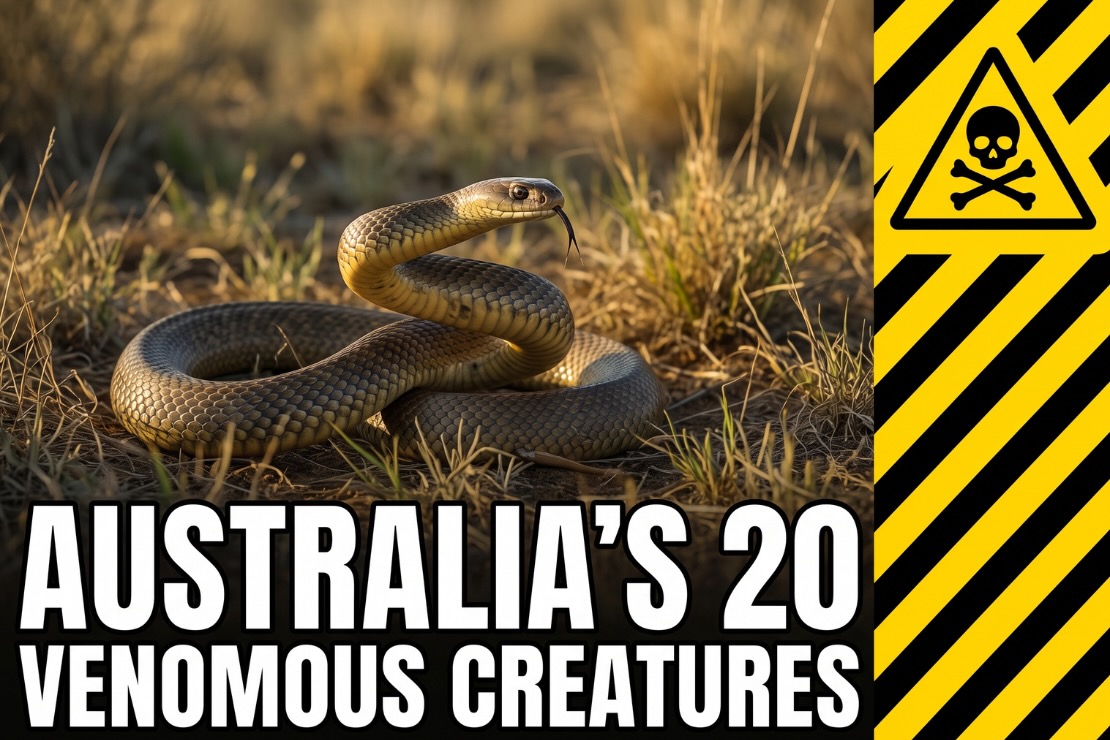
To begin with, the name “Australia” typically conjures images of vast, sun-baked outbacks, kangaroos hopping across plains, and the unparalleled wonderland of the Great Barrier Reef. Beyond these scenic vistas, it is a continent defined by truly unique and iconic wildlife. However, it is also famously a land where it would seem a committee of the world’s most venomous creatures held a conference and decided to settle down.
Admittedly, while its reputation for being a “death trap” is largely exaggerated, Australia nonetheless remains home to an astonishing number of animals that have perfected the art of venom. Because of this, it is vital to be prepared. Consequently, this guide serves as your essential safety manual. Ultimately, it is designed to help you respectfully and safely navigate the beautiful, and occasionally “bitey,” wonders of the Land Down Under.
Which Snakes are the Most Venomous in Australia?
Australia is the only continent where venomous snakes outnumber non-venomous ones.
Inland Taipan (Oxyuranus microlepidotus)

Widely considered the world’s most venomous snake based on the toxicity of its venom. Fortunately, it is incredibly shy and lives in remote, arid regions, so encounters are extremely rare.
- Where You’ll Find It: Restricted to the semi-arid channel country where Queensland, South Australia, and New South Wales meet, specifically the Cooper Creek and Coongie Lakes region. It rarely overlaps with populated areas.
- If You Encounter One: Back away slowly without sudden movement. Do not attempt to identify or photograph it up close. Call 000 immediately if bitten, apply a pressure immobilisation bandage, and stay still.
- Interesting Fact: A single bite carries enough venom to theoretically kill over 100 adult humans, yet there are zero confirmed human fatalities on record, its remote habitat keeps encounters almost nonexistent.
Eastern Brown Snake (Pseudonaja textilis)

Fast, aggressive when provoked, and responsible for the most snakebite fatalities in Australia. They thrive in populated areas, leading to more frequent human encounters.
- Where You’ll Find It: Nearly all of eastern and central Australia, including farmland, grasslands, and suburban backyards from Queensland down through Victoria and into South Australia.
- If You Encounter One: Freeze, then retreat the way you came. This species will pursue if it feels cornered, so give it a clear escape route rather than blocking it.
- Interesting Fact: It causes the most snakebite deaths in Australia not because its venom is the strongest, but because it lives everywhere humans do.
Coastal Taipan (Oxyuranus scutellatus)

The third most venomous snake in the world. It is much more nervous than the Inland Taipan and will defend itself vigorously if surprised.
- Where You’ll Find It: Coastal and near-coastal regions of Queensland, the Northern Territory’s Top End, and northern Western Australia, particularly in sugar cane fields and woodland edges.
- If You Encounter One: Move away immediately and calmly. Unlike the Inland Taipan, this species will strike repeatedly if it feels threatened, so distance is your only real defense.
- Interesting Fact: Before antivenom existed, a bite from this species was close to 100% fatal, making it the most medically significant snake in the country before the 1950s.
Tiger Snake (Notechis scutatus)

Highly variable in color and pattern, they are common in southern Australia. Their venom is a potent mix of neurotoxins, coagulants, and myotoxins.
- Where You’ll Find It: Southern Australia, including Victoria, Tasmania, and coastal South Australia often near wetlands, dams, and riverbanks.
- If You Encounter One: Stay still until it moves away on its own. Tiger snakes will often flatten their neck and hiss as a warning before striking, so treat that display as your cue to retreat.
- Interesting Fact: Tiger snakes can survive prolonged submersion and are excellent swimmers, which is why they’re commonly found near water rather than in dry scrub.
Death Adder (Acanthophis antarcticus)

A master of ambush. It buries itself in sand or leaf litter and uses a lure on its tail to attract prey. It has the fastest strike of any snake in Australia.
- Where You’ll Find It: Scattered across mainland Australia in leaf litter, sandy soil, and dense ground cover, it rarely moves once settled, which is exactly the problem.
- If You Encounter One: Do not step near loose leaf litter without checking first in known habitat areas. If you spot one, step back rather than around it, since it won’t flee like most snakes.
- Interesting Fact: It has the fastest strike of any Australian snake, closing the distance in roughly 0.15 seconds faster than a human can react.
Red-bellied Black Snake (Pseudechis porphyriacus)

A beautiful, glossy black snake with a striking red belly. While its venom is not as potent as the others, a bite is a serious medical emergency.
- Where You’ll Find It: Eastern Australia, from Queensland through New South Wales into Victoria, usually near creeks, swamps, and damp forest floors.
- If You Encounter One: Give it space and let it pass. This species generally prefers to escape into water rather than confront a threat.
- Interesting Fact: It’s largely immune to the venom of other elapids, meaning it can safely eat other venomous snakes, including juvenile brown snakes.
What Are the Dangers in the Ocean?
The beautiful coastal waters hold some of the planet’s most formidable venomous creatures.
Box Jellyfish (Chironex fleckeri)

The most venomous marine creature in the world. Its nearly invisible tentacles are covered in stinging cells that deliver an excruciatingly painful, and often fatal, venom that can cause cardiac arrest.
- Where You’ll Find It: Northern Australian coastal waters, particularly Queensland and the Northern Territory, during the warmer months from October to May.
- If You Encounter One: Exit the water immediately if you see one. If stung, douse the area in vinegar for at least 30 seconds to neutralize unfired stinging cells, then call 000, do not rub the sting.
- Interesting Fact: It has 24 eyes, some capable of forming images, despite having no centralized brain.
Irukandji Jellyfish (Carukia barnesi)

A tiny, thimble-sized jellyfish whose sting causes a severe and delayed reaction known as “Irukandji Syndrome,” characterized by horrific pain, vomiting, and psychological distress.
- Where You’ll Find It: Tropical waters off northern Queensland, typically well offshore but occasionally drifting close to popular beaches during the stinger season.
- If You Encounter One: You likely won’t see it before being stung, since it’s nearly transparent and thimble-sized. If symptoms develop 20–30 minutes after any ocean contact, treat it as a medical emergency and call 000.
- Interesting Fact: Its sting causes Irukandji syndrome, a delayed reaction involving severe pain and a documented sense of impending doom, even though the initial sting itself often goes unnoticed.
Blue-ringed Octopus (Hapalochlaena maculosa)

One of the most deadly animals in the ocean. This tiny, golf-ball-sized octopus is docile but its painless bite contains a powerful neurotoxin that can cause paralysis and respiratory failure. Their bright blue rings are a warning that only appears when they are threatened. Found in shallow tidal pools.
- Where You’ll Find It: Shallow tide pools and rock pools along the southern and eastern coastlines, often hiding in shells or debris.
- If You Encounter One: Never pick it up or provoke it. Its rings only flash blue when threatened, so a calm octopus gives no visual warning. If bitten, apply pressure immobilisation and call 000, since the bite itself is painless and easy to miss.
- Interesting Fact: Its venom, tetrodotoxin, has no known antivenom, treatment relies entirely on life support until the paralysis wears off.
Stonefish (Synanceia verrucosa)

The ultimate master of camouflage, looking exactly like a rock. Stepping on its dorsal spines injects a potent neurotoxin that causes legendary, excruciating pain and can be fatal.
- Where You’ll Find It: Shallow tropical and subtropical waters across northern Australia, often resting motionless on reef flats or in tide pools.
- If You Encounter One: Never walk barefoot in known stonefish habitat. If stung, immerse the area in hot water (as hot as can be tolerated safely) to break down the venom, and seek medical help immediately.
- Interesting Fact: It can survive out of water for up to 24 hours, which is why it sometimes gets stepped on even at low tide, far from any visible water.
Cone snail (Conus geographus)

These beautiful, patterned shells hide a venomous harpoon that can be fatal to humans. Never pick up a cone-shaped shell in Australian waters.
- Where You’ll Find It: Tropical reef and sand flat areas along the Great Barrier Reef and northern Australian coastline.
- If You Encounter One: Never handle a live cone-shaped shell, even one that appears empty. If stung, apply pressure immobilisation to the limb and call 000, since symptoms can progress to respiratory failure.
- Interesting Fact: It fires a venomous, harpoon-like tooth fast enough that victims often never see the strike coming.
Stingrays

The infamous cause of a tragic and high-profile death. The venomous barb on their tail is a defensive weapon that can inflict a deep and incredibly painful wound.
- Where You’ll Find It: Shallow sandy bays and estuaries around most of the Australian coastline, often partially buried in sand.
- If You Encounter One: Shuffle your feet rather than taking normal steps when wading in shallow sandy water, this warns the ray of your approach instead of stepping directly on it. If stung, rinse with hot water and seek medical attention for barb removal.
- Interesting Fact: The barb isn’t a stinger in the traditional sense, it’s a modified, venom-coated scale used purely in defense, not for hunting.
Sea Snakes

Many species inhabit Australian waters, all possessing potent venom. They are generally not aggressive towards divers but must be respected and given space.
- Where You’ll Find It: Tropical waters off northern Australia, particularly around coral reefs and seagrass beds.
- If You Encounter One: Do not touch or chase it. Most bites occur when divers or fishers handle sea snakes directly, so simply maintaining distance eliminates nearly all risk.
- Interesting Fact: Some species can absorb oxygen through their skin, allowing dives lasting up to two hours without surfacing.
Venomous Spiders and Insects of Australia
Sydney Funnel-web Spider (Atrax robustus)

The world’s most dangerous spider. The male’s venom is a powerful neurotoxin that is fast-acting and incredibly dangerous. They are ground-dwelling and build their webs in burrows or crevices.
- Where You’ll Find It: A roughly 100-kilometer radius around Sydney, New South Wales, favoring moist, sheltered burrows in gardens and bushland.
- If You Encounter One: Do not attempt to trap or move it yourself. If bitten, apply pressure immobilisation immediately and call 000, this is one of the few spider bites in the world considered a genuine medical emergency.
- Interesting Fact: Only male funnel-webs are considered dangerous to humans, since their venom is roughly six times more potent than the female’s.
Redback Spider (Latrodectus hasselti)

Australia’s version of the Black Widow. The female’s bite is medically significant, causing severe pain. They build messy webs in dark, dry, sheltered places.
- Where You’ll Find It: Nationwide, especially in dry, sheltered spots like sheds, mailboxes, and outdoor furniture.
- If You Encounter One: Avoid reaching blindly into dark, undisturbed spaces such as under outdoor furniture. If bitten, apply a cold pack for pain relief and seek medical care, antivenom is rarely needed but pain management often is.
- Interesting Fact: Female redbacks sometimes eat the male during mating, and the male appears to assist the process by positioning himself over her fangs.
Bull Ant / Jack Jumper Ant (Myrmecia genus)

Large, aggressive ants known for their excellent vision and a sting that is famously painful. Some people can have severe, anaphylactic reactions.
- Where You’ll Find It: Widespread across Australia, with Jack Jumpers concentrated in Tasmania and southeastern mainland regions, nesting in soil mounds.
- If You Encounter One: Avoid disturbing visible nest mounds. If stung and you have a known allergy, seek emergency care immediately, since Jack Jumper stings cause a disproportionate share of Australia’s insect-sting anaphylaxis deaths.
- Interesting Fact: Bull ants have some of the best eyesight of any insect and can visually track a threat from several meters away.
Giant Centipede (Ethmostigmus rubripes)

Australia is home to several species of large centipedes that can deliver an intensely painful venomous bite with their front forcipules.
- Where You’ll Find It: Across northern and eastern Australia, typically under logs, bark, and rocks in humid environments.
- If You Encounter One: Avoid handling it, and use gloves when moving debris in known habitat. A bite causes intense localized pain but is rarely medically dangerous, treat with cold compress and pain relief.
- Interesting Fact: It delivers venom through modified front legs called forcipules, not through its mouth or a stinger.
Stinging Tree (Gympie-Gympie – Dendrocnide moroides)

Not an animal, but a plant you must not touch. Its leaves and stems are covered in fine, silica hairs that inject an agonizing neurotoxin, causing a pain that can last for months.
- Where You’ll Find It: Rainforest areas of northeastern Queensland and northern New South Wales, often along walking trails and forest clearings.
- If You Encounter One: Do not touch any part of the plant, including fallen leaves. If stung, apply hair-removal wax strips to pull out the embedded hairs, then seek medical attention if pain is severe or persistent.
- Interesting Fact: The pain from contact has been documented to resurface intermittently for months, especially when the affected area gets wet.
Australia Final Two: The Venomous Mammal and Fish
Platypus (Ornithorhynchus anatinus)

A unique and beloved icon. The male platypus has a sharp, venomous spur on its hind legs. While not fatal to humans, a sting causes excruciating, long-lasting pain.
- Where You’ll Find It: Freshwater rivers and streams along eastern Australia, from Queensland down through Tasmania.
- If You Encounter One: Never attempt to handle a wild platypus, even a calm-looking one. A spur strike requires medical pain management, since standard painkillers are often ineffective against the venom.
- Interesting Fact: It’s one of only five living mammal species that lay eggs, and males are the only venomous mammals in Australia.
Rabbitfish (Siganus fuscescens)

The Rabbitfish is a common reef fish. In fact, the spines of its dorsal fin are venomous. Furthermore, they can deliver a very painful sting to an unwary fisherman or diver. Consequently, you must exercise extreme caution when handling this species in the wild.
- Where You’ll Find It: Coastal reef and estuary systems around eastern and northern Australia, often mistaken for harmless reef grazers.
- If You Encounter One: Avoid handling it directly, even when landed while fishing. If stung by a dorsal spine, immerse the wound in hot water to reduce pain, and monitor for signs of infection.
- Interesting Fact: Despite the venomous spines, the flesh is edible and commonly eaten once the fish is properly cleaned.
What Should I Do in Case of a Venomous Bite or Sting?
Specifically, you must stay calm and remain as still as possible. In fact, you should limit movement to the absolute minimum to slow the spread of toxins. Furthermore, you must call emergency services immediately by dialing 000. This is a critical medical emergency. As a result, if the bite is from a snake, you must apply a firm Pressure Immobilisation Bandage. Specifically, wrap the bandage over the bite and continue up the entire limb. Consequently, this slows the movement of venom through the lymphatic system. Therefore, do not wash the wound, as traces of venom are needed for identification.
Read our article on
Costa Rica’s Field Manual for the Jungle
Sources
- Australian Museum
https://australian.museum/learn/animals/snakes/inland-taipan/ - Billabong Sanctuary
https://www.billabongsanctuary.com.au/eastern-brown-snake/ - Australian Institute of Marine Science
https://www.aims.gov.au/docs/projectnet/box-jellyfish.html - HealthDirect Australia
https://www.healthdirect.gov.au/snake-bites - The University of Melbourne
https://biomedicalsciences.unimelb.edu.au/departments/pharmacology/engage/avru/discover/spiders/funnel-web-spiders
Leave a Reply
You must be logged in to post a comment.