
The Pull Toward Unloved Animals
Why do some people feel a stronger bond with the creatures everyone else avoids?
Some people gravitate toward unloved animals because these creatures feel refreshingly real. Snakes, lizards, and turtles do not perform affection. They simply exist as themselves. Edward O. Wilson gave this pull a name: biophilia. He described it as an innate human tendency to focus on life and lifelike processes. The word literally means “love of life.” Interestingly, the psychoanalyst Erich Fromm coined the term first, calling it a passionate love of life and of all that is alive. Wilson then turned the idea into a serious scientific hypothesis in 1984.
Biophilia is not a soft metaphor, either. Wilson argued the trait is likely under complex genetic control, shaped by the action of many genes. In other words, our attraction to living things may be written into us, not simply taught. The evidence keeps stacking up, too. A 2022 meta-analysis pooled 49 studies and 3,201 participants, finding that exposure to natural environments had a medium-to-large effect on raising positive emotion and easing negative emotion. One famous study makes the effect almost comically concrete. In 1984, Roger Ulrich reviewed records of surgery patients in a Pennsylvania hospital. Patients with a window view of trees recovered faster, needed fewer strong painkillers, and drew fewer negative notes from nurses than patients facing a brick wall. The tree-view group went home about a day sooner. A row of trees, quietly doing the work of a mild painkiller.

So why does any of this happen?
Here is where evolution earns its keep. For most of human history, paying attention to life was not a hobby. It was survival. Our ancestors who read animals well found food and avoided becoming it. They learned which plants healed and which ones killed. Above all, they tracked the honest signals of predators and prey, because misreading one ended the bloodline. Consequently, the brains that obsessed over living things passed their genes forward. We are their descendants, and we inherited the obsession. Therefore, the bond with unloved animals is not strange or broken. It is ancient hardware running its original program. A snake holds our gaze because, for a hundred thousand years, ignoring one was often fatal. The fascination and the fear simply grew from the same root.
Honesty Is Built Into Animal Behavior
What does it actually mean to call a snake “honest”?
An honest animal signals its true intentions without elaborate deception. A snake bites for two reasons only: fear or hunger. There is no grudge and no quiet agenda. You learn the warning posture, you respect the distance, and the encounter becomes predictable. In fact, predictability is the entire point. A snake gains nothing by lying to a predator about its own danger. A bluff that fails once gets the bluffer eaten. Consequently, natural selection filters out the cheaters and keeps the signals reliable. Researchers explain this stability through cost. Amotz Zahavi argued that a signal stays honest when it is too expensive for a weak individual to fake. In short, honesty survives because dishonesty does not pay. The signal a snake sends today is the same one its ancestors sent across thousands of generations.
The snake is not being noble, though. Nobility requires a choice, and the snake never had one. It simply lacks the machinery for social theater. Reputation management, flattery, and the careful editing of a self-image are luxuries of a particular kind of brain. Humans built that brain, and we run the theater constantly. We rehearse, we soften, we perform. Most of the time, we are not even aware we are doing it.
How humans break the pattern
The research here is genuinely unflattering. In a 2002 study, psychologist Robert Feldman recorded strangers chatting for ten minutes. Sixty percent of people lied at least once, and most told two or three lies in that short window. More striking still, many did not even realize they had lied until they watched the tape back. Most of these lies simply helped the speaker appear more likable or competent. These were not villains. They were ordinary people, quietly greasing a first conversation. Furthermore, Feldman found that convincing lying actually tracks with good social skills, and the most popular students were often the best liars. In humans, deception is not a glitch. It is a social tool, polished by practice.
So the contrast is not snake-evil versus human-good, or the reverse. It is simply two different operating systems. A snake cannot pretend, so it never does. A person can pretend with remarkable skill, so we do, often kindly and often without noticing. That, in the end, is why some keepers find the company of unloved animals so restful. With a snake, what you see is the entire message. There is no subtext to decode and no mask to read behind.
The Science of Honest Signals in Nature
Do animals really advertise their own danger on purpose?
Yes, and biologists have a name for it: aposematism. The word describes the use of bold warning signals to advertise a genuine defense. Bright colors, stark patterns, loud rattles, and foul odors all tell a predator the same thing: not worth it. Researchers call these displays honest signals, because warning coloration reliably indicates that the prey is toxic or otherwise unprofitable. Nature leans on the strategy everywhere.
The monarch butterfly wears orange and black after storing toxins from milkweed. Poison dart frogs glow across the rainforest floor in colors that mean “do not touch.” The skunk paints itself black and white long before it lifts its tail. Among reptiles, the Gila monster, Heloderma suspectum, carries a beaded warning pattern that matches its venom. The strawberry poison frog, Oophaga pumilio, shows the logic most clearly. More toxic populations tend to wear brighter, more conspicuous colors.
This connects directly to Amotz Zahavi’s handicap principle. Zahavi argued that a costly signal stays honest because only strong or well-defended individuals can afford to produce it. A weak faker cannot pay the bill, so the warning keeps its meaning. Furthermore, this ancient system still runs today, exactly as it ran millions of years ago. A rattlesnake rattles. A coral snake wears its bands in the open. These are not bluffs. They are evolved promises, written in color and sound, and backed by venom.
Why Human Ignorance Gets Harmless Snakes Killed
What happens when people lose the ability to read these signals?
Here is the uncomfortable modern twist. Most people now live in cities, far from the animals that shaped this whole system. They never learn to read the signals, so fear quietly fills the gap. As a result, harmless snakes die for the crime of resembling dangerous ones.
The numbers make the panic look strange. Of roughly 3,900 snake species worldwide, only about 17 percent are venomous, and only around 200 are considered dangerous to humans. Globally, about 85 to 90 percent of snake species are non-venomous, and most bite only in defense. Meanwhile, these animals earn their keep daily. Snakes act as free pest control, keeping rodent populations in check so they do not overrun food-rich environments. Some even disperse seeds across wide ranges, which supports plant diversity and ecological balance. Killing one on sight removes a quiet, efficient piece of the ecosystem.
Batesian Mimicry
Do harmless animals ever fake the warning to survive?
Yes, and the con has a name: Batesian mimicry. The naturalist Henry Bates proposed the idea in 1862, after studying Amazonian butterflies. In Batesian mimicry, a harmless species copies the warning signals of a genuinely dangerous one to borrow its reputation. The coral snake is the textbook model. It is imitated by at least 150 snake species, including the scarlet kingsnake and the Sonoran mountain kingsnake. An old field rhyme tries to keep people safe: red touches yellow, kill a fellow; red touches black, venom lack. The trick only works near the real thing, though. Field experiments using plasticine snake replicas found that predators attacked the harmless mimics more often where the venomous coral snake was absent. Other animals run the same hustle. Hoverflies copy both the look and the buzz of wasps and bees, despite carrying no sting at all.

There is also an honest version of the strategy. In Müllerian mimicry, several genuinely defended species share one warning look, as many wasps and bees do with their yellow and black. So nature does keep a few forgers on the payroll. Even so, the underlying signal stays honest, because faking it has limits. Mimicry only pays where the dangerous model is present and common enough to keep predators cautious. In short, the warning still works precisely because most of the animals wearing it are telling the truth.
The Hardwired Fear of Unloved Animals
Why does the sight of a snake make most people freeze?
People freeze at snakes because the human brain evolved to spot them first. Lynne Isbell’s snake detection theory proposes that snakes reshaped the primate visual system. It favored ancestors who noticed them quickly. The evidence is not subtle. Show a three-year-old a grid of eight photos with one snake among seven caterpillars, and the child finds the snake fast. Non-human primates detect snakes more quickly than other stimuli too, which points to a deep evolutionary basis. So the fast reaction is not a personal failing. It is ancient wiring.

Detection is not the same as fear
Here is the part that changes everything, though. That wiring detects snakes. It does not actually decide to fear them. People who do not fear snakes spot them just as quickly as people who do. Detection and dread are two separate systems. In fact, the fear itself appears to be learned, not inherited. Infants and young children usually do not show fear of snakes, and often respond with interest or approach instead. In one study, babies did not react fearfully to snakes at all, suggesting we are born ready to learn the fear rather than born already carrying it.
This idea has a name: biological preparedness. Researchers proposed that humans acquire snake fear unusually fast, and that such fears resist extinction once they form. Notice the key word, though. Prepared is not the same as doomed. A fear that gets learned can also be understood, softened, and re-learned. Rhesus monkeys, for example, learn to fear snakes by watching another monkey react, yet they never pick up the same fear toward flowers or rabbits. The lesson is clear. The alarm is flexible, and experience writes most of the script.
So what actually pulls the trigger?
Movement, mostly. LoBue and DeLoache suspect the distinctive writhing motion of snakes is what truly sets people off. Posture matters as well. People detect snakes even faster when the animal is shown in a striking pose rather than resting. This is exactly where the keeper gains an edge. The keeper learns to read those same cues as plain information. A tight S-coil means give it space. A slow glide across a warm branch means the animal is calm. A hiss or a vibrating tail is a request, not a threat. Consequently, the ancient alarm still fires, but it now arrives with subtitles. The keeper has not switched the alarm off. They have simply learned the language it was shouting in all along.
The Uncomfortable Truth About Human Honesty
Are people really more trustworthy than a snake?
The honest answer is mixed, and that is the interesting part. Decades of diary research, beginning with Bella DePaulo, put everyday lying at a couple of fibs a day. More recent work estimates that most people lie roughly zero to two times per day. Those numbers still sound damning. However, the distribution flips the picture in a reassuring way.
A national survey of 1,000 adults found that 60 percent reported telling no lies at all in a given 24-hour period. In fact, almost half of all the lies came from just 5 percent of people. Most of us, it turns out, stay honest most of the time. A small pool of prolific liars simply drags the average upward. The heaviest liars, roughly the top 1 percent, report telling more than fifteen lies a day. Furthermore, when ordinary people do lie, about 90 percent of those lies are small white ones. So the species is not rotten. It is mostly honest, with a loud dishonest minority.
Where lying actually comes from
Here is the genuinely fascinating part, though. Deception is not a flaw we absorb from a hard world. It is a skill that switches on as the mind matures. Developmental psychologist Kang Lee tracked exactly when this happens. About 30 percent of verbal two-year-olds will lie, rising to half of three-year-olds and 80 percent of four-year-olds. Lee treats this as a milestone, not a red flag. He argues that successful lying needs two ingredients: theory of mind and self-control. Theory of mind is the ability to model what another person knows and believes. Notice the catch here. That is the very same skill that powers empathy.
This is the quiet irony at the heart of human social life. The brain that helps us sense another person’s feelings is the brain that helps us manage them. Children who score higher on theory-of-mind tasks tend to be the better liars. In one experiment, preschoolers taught to deceive even outperformed their peers on tests of self-control and perspective-taking. Empathy and manipulation are not opposites at all. They share the same wiring. A snake never had access to that machinery, so it never learned the trick. Plenty of people master it before their morning coffee. None of this is an attack on humanity. It is simply the awkward reason some keepers find a quiet tank of fish more restful than a crowded dinner party.
Awe, Respect, and the Keepers of Unloved Animals
How does caring for feared creatures change the way a person sees the world?
Caring for feared animals tends to grow respect, not just affection. Psychologist Paul Piff and colleagues studied awe across five studies with 2,078 participants. They found that awe shrinks the sense of self and nudges people toward generosity. Watching a chameleon track prey or a turtle haul out to bask delivers small, daily doses of that awe. To see why this matters, though, it helps to compare two very different kinds of animal bond.
The first kind is the cuddle bond, and dogs are its champions. Researchers found that mutual gazing raises oxytocin in both dogs and their owners, while wolves show no such effect. The effect runs deep enough that scientists describe dogs as plugging straight into our own bonding chemistry. Cats tap a milder version of the same circuit. One study reported partial oxytocin co-modulation between cats and their people. My own dog proves the rule daily. Rosie, my young griffon mix, runs the entire chemical routine on command. Kooki, my mother’s orange Persian, ran it faithfully for eighteen years.
What Kind of Bond Do Exotic Pet Keepers Actually Build?
If it is not cuddles, then what holds the relationship together?
Keepers of unloved animals build something quieter, and arguably more honest. Reptiles do not run the oxytocin gaze loop at all. They do not bond emotionally the way dogs and cats do, yet they clearly recognize familiar people and routines. The recognition is real, not wishful thinking. Red-footed tortoises can tell human faces apart, which points to genuine cognitive ability. Furthermore, reptiles are far from simple machines. Monitor lizards solve puzzles, tortoises learn mazes, and tegus recognize their keepers. A university veterinarian adds that some reptiles do seem to enjoy human contact, especially around feeding, and many prefer certain people over others. So the bond is genuine. It simply speaks a different language than a wagging tail.
This is where respect quietly replaces flattery. An Italian study of turtle and tortoise keepers found something telling. Nearly half described their bond using words like love, fascination, or affection, yet most still saw their reptiles as less attached to them than a dog or cat would be. The keepers loved the animals without pretending the feeling was identical in return. Those same owners valued their reptiles most for their uniqueness and the fascination they inspired. The healthiest approach, as one review framed it, is to appreciate these animals on their own terms, rather than expecting them to show affection like a mammal. That shift, from demanding affection to offering respect, is the entire craft of exotic keeping.

Living with unloved animals
My own collection makes the contrast concrete. My red-eared sliders, Trachemys scripta elegans, are named Mike and Frida. I got them as coin-sized hatchlings, back when I could not even tell their genders apart. Their personalities split almost immediately, though. Mike was the curious one. He let me pat his head with a finger and tolerated the occasional nose boop. Frida was his opposite. She panicked at every passing shadow, sometimes smacking into the glass as she bolted across the tank.
So Frida challenged me from the very first day. I wanted her trust, and I stayed patient about earning it. It took two full years. Now she swims straight to me, blip-blopping at the surface, reaching up with her little hands for food. This week, I hand-fed her dried shrimp for the first time. Any keeper will understand exactly what that milestone means. She finally recognizes me and trusts me, just like Mike, and just like Cosmo. Today I confirmed it almost by accident. I ran a water change while both turtles lounged on their basking dock. Neither one flinched. They simply watched me work, calm as guests waiting on room service.
Cosmo, and the quiet rest of the tank
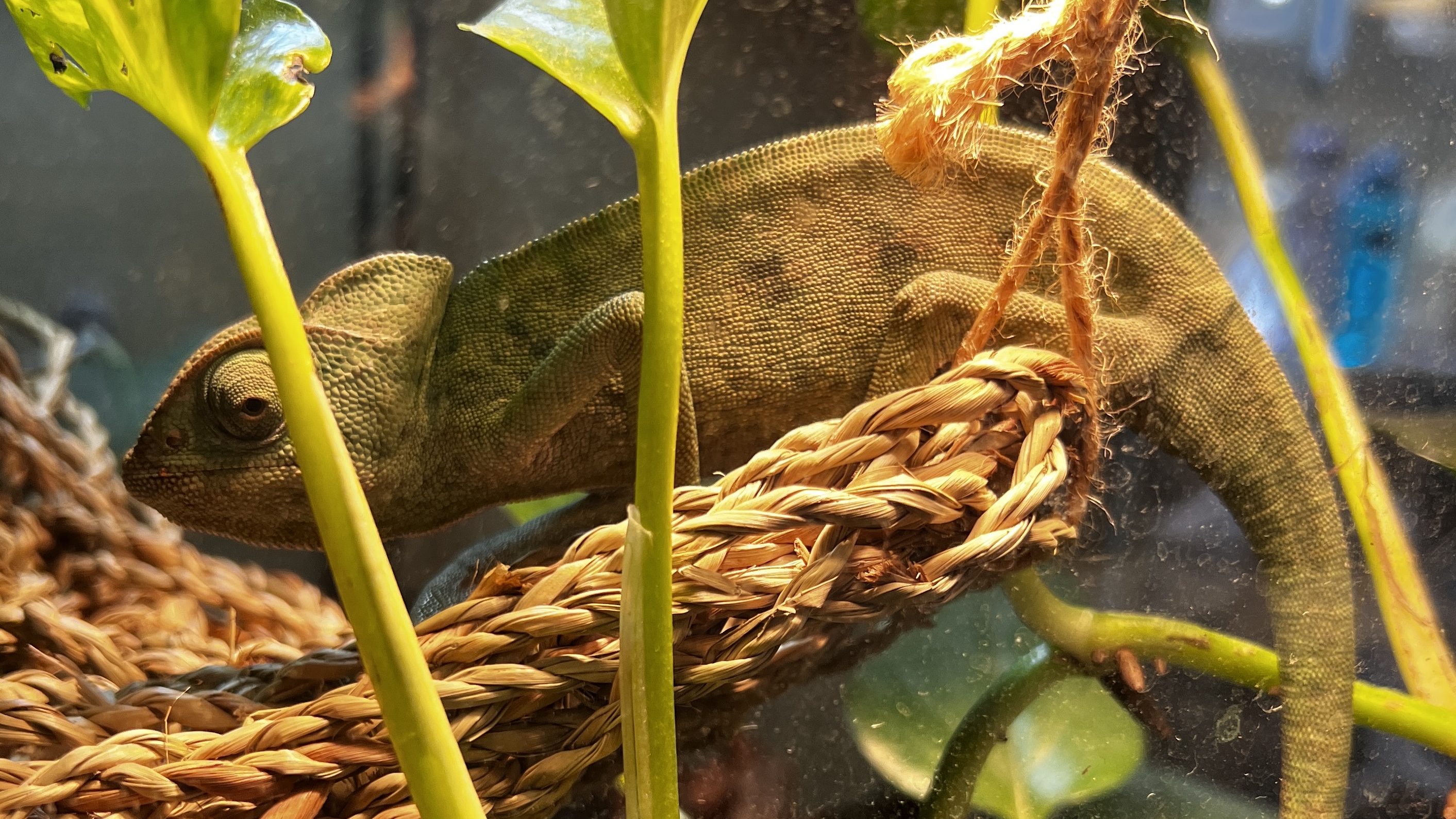
Cosmo, my African chameleon, Chamaeleo africanus, tells a similar story. I have kept him roughly as long as the turtles, and I got him very young as well. His trust formed faster, within just a few months. Two days ago, I lifted his lid to feed him roaches with tweezers, exactly as I always do. He climbed all the way up his branches and came right to the edge of his enclosure. Then he simply waited, patient, for me to hold each roach steady. He did not bolt once. He ate his fill, then strolled calmly back into his home.
Moments like that land heavily in a keeper’s heart. Cosmo did not merely register me as harmless. He told me, in his own quiet way, that his home is good and his needs are met. That is the deeper message every keeper hopes for: you are doing something right, and I am safe here. Even my fish play a gentler version of this game. Sky, my betta, and the common pleco in my largest planted tank live openly while I watch and learn. None of them performs love for my benefit, and I would not want them to.
This is exactly why the science matters so much to me. These animals do not run on the cuddle chemistry of cats and dogs. So when a turtle finally swims to your hand, or a chameleon waits calmly for his food, it is not flattery. It is earned, it is deliberate, and it is honest. And respect, unlike flattery, never needs to be propped up with a single lie.
The People Who Keep Unloved Animals
Is there a personality behind loving the unlovable?
Honestly, the research is thinner than the stereotypes, so I will not invent a tidy profile. The lazy assumption is that exotic keepers are attention seeking oddballs. Researchers actually put a version of that idea to the test. Psychologist Jennifer Vonk’s team examined whether narcissistic and borderline personality traits predicted attachment to unconventional pets like snakes, tarantulas, and rats. The simple “you must be a narcissist” story did not survive contact with the data. People lower in vulnerable narcissism tended to be more attached to their non traditional pets, not less. Meanwhile, a survey of more than 300 keepers across 33 countries found something almost boring in its decency. Their leading motivations were relational: caring about the animal, learning, and genuine passion for the species. So much for insanity.
The real social cost
The social cost, however, is very real. Anthrozoologist Hal Herzog notes that owners of unconventional pets often pay a quiet social cost, and some rat keepers were embarrassed enough to keep the hobby hidden. I understand that instinct. I simply refuse to obey it. Take Cosmo’s diet. He eats roaches, which means I keep a roach colony. To a certain kind of person, that single sentence is proof of derangement. They hear “I have insects in my home” and their face collapses into theatrical horror.
Here is where I stop being polite. I have no quarrel with fear. Fear of a snake or a roach is ancient, biological, and completely valid. I will never mock anyone for flinching. Disgust dressed up as moral judgment, though, is a different animal entirely. When someone decides I am disturbed for feeding my chameleon correctly, they are not reporting a fact about me. They are advertising the narrow edges of their own curiosity. That sneer is not insight. It is incuriosity with an attitude, and it deserves exactly none of my energy.
So I carry the hobby openly, roach colony and all. This is not bravado. It is a filter, and an efficient one. People who recoil in honest fear are welcome to stay, ask questions, and watch from a comfortable distance. People who curl their lip in contempt tend to remove themselves, which saves me the trouble. Loving unloved animals can feel lonely at times. Even so, the keepers who last all share one quiet trait, and it is not a thick skin. It is patience, the same patience that earns a terrified turtle’s trust across two long years.
My Experience With the Unloved Animals in My Home
What have years of keeping reptiles and “ugly” fish actually taught me?
After more than twenty years of keeping animals, I have reached one blunt conclusion. The unloved animals everyone calls cold taught me more about honesty than most people ever will. My turtles and my chameleon already made that case earlier. They do not flatter, they do not pretend, and they do not soften the truth to spare my feelings. People, by contrast, have built an entire civilization on doing precisely that.
Think about how strange that really is. A frightened turtle took two years to trust me, and never once faked the process to seem polite. Humans run the opposite script daily. We hand out warmth we do not feel, then quietly withdraw the warmth we do. We beam at people we cannot stand. Then we say “we should catch up” and silently pray it never happens. An animal would never waste energy on such elaborate theater. It simply shows you where it stands and lets you adjust accordingly.
Then there are the dogs
Then there are the dogs, which complicate the story in the best possible way. Vhagar arrived in 2017, already eight years old, with a broken leg and no obvious future. We expected to give an old dog a soft place to die. Instead he stayed eight more years and decided, without consulting me, that I was his to guard. For the first time, the care ran in both directions. That feeling was not something I invented. Researchers Zilcha-Mano, Mikulincer, and Shaver studied this directly. They found that pets can act as a genuine safe haven and secure base, and that a pet’s presence even lowered owners’ blood pressure during a distressing task. Vhagar was exactly that, right up until he left us in 2025.

Rosie carries the role differently now. She is a four-month-old comedian in a small fluffy body, and she depends on me for everything. With her, I am the keeper again, not the kept. Here is the part worth noticing, though. Neither dog ever performed loyalty for an audience. A dog does not love you harder because guests are watching. It cannot lie about its affection, which is exactly why the affection means something. Humans, meanwhile, will perform devotion all afternoon and forget your name by Friday.
What the unloved animals taught me
So this is where I land, and I will not dress it up to be likable. I do not love animals despite their inability to deceive. I love them because of it. My reptiles trade only in honest signals. My fish ignore me with total sincerity. And my dogs guard me and depend on me without a flicker of pretense. Every one of them tells the truth as a default setting, which is the one skill our clever, talking, world-building species treats as optional. Knowing people did not make me give up on connection. It taught me to recognize the real thing when it finally appeared. Sometimes it appeared scaled, sometimes finned, sometimes on four legs. Not one of them ever lied to me, and I have stopped expecting that same basic courtesy from anything that can.
FAQ
People bond with unloved animals because these creatures communicate honestly and never perform affection. Snakes and reptiles signal their needs through clear, predictable behavior. The biophilia hypothesis suggests humans carry an innate pull toward living things, which extends to scaled, feared, and misunderstood species.
Animals are more honest than humans in a behavioral sense. A snake bites only from fear or hunger, never spite or deception. Most human lies are small white ones, and people still average up to two lies on a typical day.
Aposematism is the use of bold warning signals, such as bright colors or loud rattles, to advertise a real defense. Many unloved animals rely on it, including coral snakes and poison frogs. These honest signals persist because faking a costly defense rarely pays off for weak imposters.
Harmless snakes are extremely important to healthy ecosystems. They control rodent populations, limit the diseases rodents spread, and help disperse seeds across wide areas. About 85 to 90 percent of snake species are non-venomous, and many still die yearly from fear and mistaken identity.
Fear of snakes appears to be learned rather than innate. Human brains detect snakes quickly. Infants and young children still show curiosity instead of fear, which suggests the dread is a learned response that keepers can gradually soften and reverse.
Reptiles do not bond emotionally the way dogs and cats do. Many still recognize familiar keepers, routines, and even human faces. The relationship rests on trust, recognition, and respect rather than cuddles, which makes it slower to build and genuinely rewarding.
Keepers face judgment because unfamiliarity often masquerades as disgust. Feeding a chameleon roaches or housing a snake strikes some people as bizarre. Research confirms exotic pet owners pay a real social cost, with motivations usually centered on care, learning, and respect.
Sources
- PubMed (DePaulo et al., 1996)
https://pubmed.ncbi.nlm.nih.gov/8656340/ - Scientific American
https://www.scientificamerican.com/article/people-lie-1-08-times-a-day/ - Britannica (Biophilia Hypothesis)
https://www.britannica.com/science/biophilia-hypothesis - PMC (Biophilia Meta-Analysis)
https://pmc.ncbi.nlm.nih.gov/articles/PMC9186521/ - Current Biology (Aposematism)
https://www.cell.com/current-biology/fulltext/S0960-9822(15)00153-0 - Wiley Online Library (Are Aposematic Signals Honest? A Review)
https://onlinelibrary.wiley.com/doi/10.1111/jeb.12676 - Frontiers in Human Neuroscience (Snake Detection / EPN)
https://www.frontiersin.org/journals/human-neuroscience/articles/10.3389/fnhum.2014.00691/full - Frontiers in Psychology (Fear and Beauty of Snakes)
https://www.frontiersin.org/journals/psychology/articles/10.3389/fpsyg.2018.00333/full - PubMed (Awe, the Small Self, and Prosocial Behavior)
https://pubmed.ncbi.nlm.nih.gov/25984788/ - IAABC Foundation Journal (Snake Ownership Study)
https://journal.iaabcfoundation.org/24830/ - Psychology Today (Narcissism and Exotic Pets)
https://www.psychologytoday.com/us/blog/animals-and-us/201610/narcissism-and-exotic-pets-is-there-connection


Leave a Reply
You must be logged in to post a comment.