
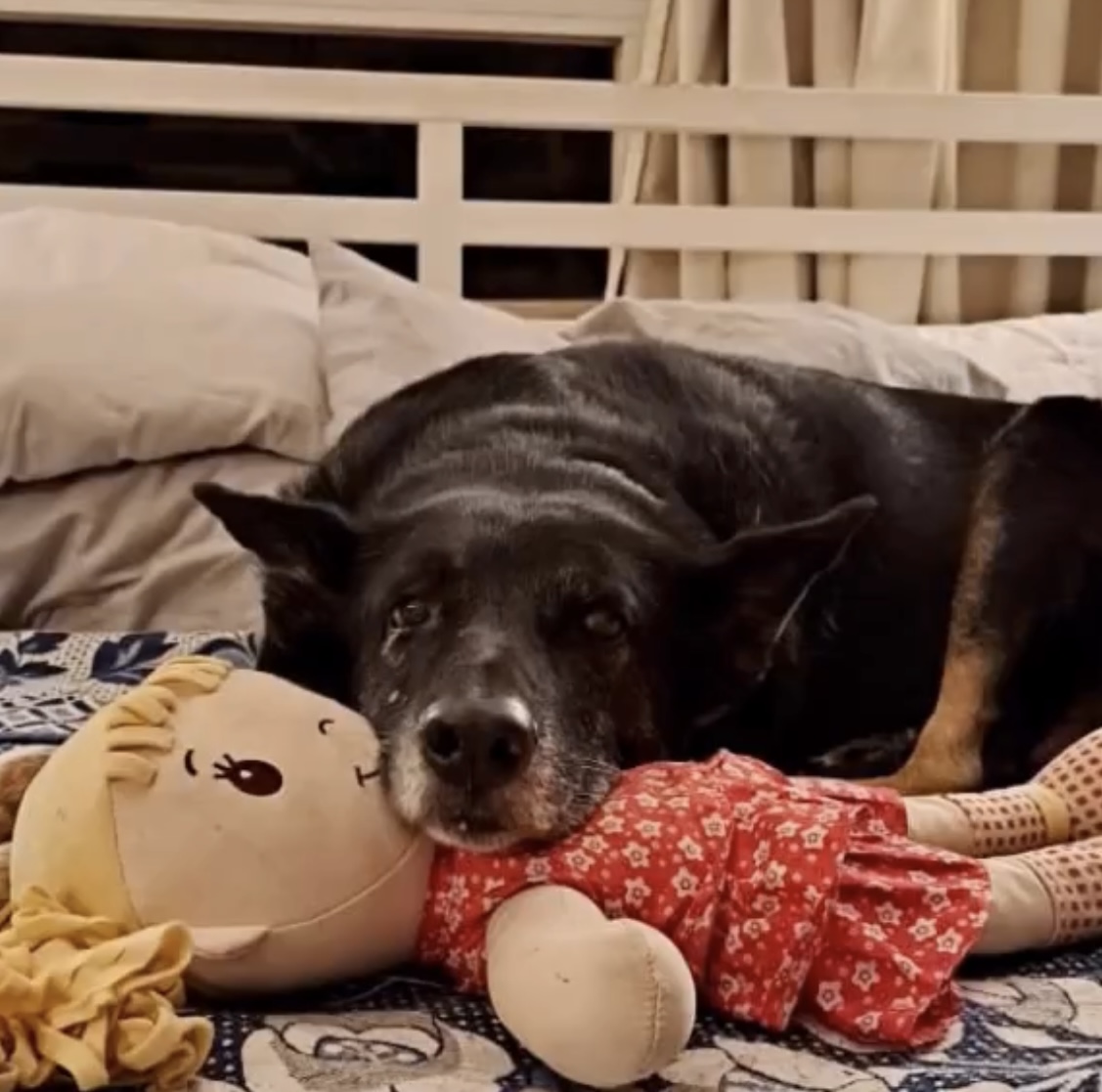
Vhagar has been on my mind all day. He came to us in July 2017, already eight years old. A big black baladi dog mixed with German Shepherd, carrying a leg he had broken jumping from somewhere too high. My husband and I took him to the vet expecting to hand an old dog a few soft, final years. He stayed with us until October 2025. Eight more years. And somewhere inside those years, a thing I had believed about loving an animal turned itself quietly inside out.

I never planned to write about this. But today the missing piece of it became too loud to ignore.
Why did it feel different with Vhagar than with my other animals?
Because for the first time, the care did not flow in only one direction.

I have loved animals my whole life. Stupy, my first dog, lived thirteen years with me. My cats each arrived with their own strange, vivid personality. But in every case, I was the keeper. I fed, I protected, I worried, I provided. They received. That arrangement felt natural, even sacred they were my babies, and I was the one holding the world steady for them.
Vhagar broke that pattern. It did not take long before I noticed that he was holding something steady for me, too. When he was near, I felt safe in a way I had not consciously asked for. I felt watched over. I felt the specific, animal certainty that someone in the room would notice if anything went wrong.
That feeling is not sentiment I invented. Researchers Zilcha-Mano, Mikulincer, and Shaver demonstrated that pets can serve the two core functions of an attachment figure for their owner a “safe haven” to retreat to in distress, and a “secure base” that makes the world feel steady enough to move through. The same roles a parent plays for a child, running in the opposite direction. A broader review of dogs and human well-being found that dogs contribute to a measurable sense of perceived safety and a grounding, physical comfort, which is part of why they are folded into trauma recovery. And in a large cross-country study of dog walkers, women in particular reported feeling safer simply because the dog was beside them.
So no, I was not romanticizing a large dog. I was living inside a bond that science can actually point to.
Was the comfort really physical, or was I imagining it?
It was physical. The chemistry is real, and it runs in both directions.

In a 2015 study published in Science, Nagasawa and colleagues found that when a dog and its owner simply look at one another, both of their oxytocin levels rise each one feeding the other’s. Oxytocin is the same neurochemical that binds a parent to an infant. The loop they observed in dogs and people mirrors that parent-child pattern closely.
I will stay honest here, because that matters more than a tidy story. Researchers still debate why this loop exists whether it was shaped during domestication or learned across each dog’s lifetime and other scientists have pushed back on the broadest claims. But the central finding has held up: the comfort that passes between a person and their dog through a steady gaze is not your imagination. It is measurable in the blood of both of you.
When Vhagar rested his heavy head against my leg, something real was happening on both sides of that contact.
Does a small dog love you any less?
No. And I need to say that clearly, because Rosie deserves it.

Rosie came to us in December 2025, a four-month-old black-and-white griffon and shih tzu mix with a personality made of pure comedy. I love her completely. With her, I am back in the familiar role the keeper, the one caring for a little baby who depends on me for everything. That bond is its own kind of beautiful.
But it is a different bond, not a smaller one. The science does not arrange dogs into a ranking of who loves more. It suggests instead that different dogs draw out different parts of us. A tiny companion dog lights up the nurturing, protective, caregiving part of the heart. A large dog who appoints himself your guardian lights up something else entirely — the part that gets to be protected, watched over, and safe. Vhagar gave me that second thing. Rosie gives me the first.
The ache I feel is not Rosie falling short. It is the absence of a specific role no longer being filled. Those are not the same wound.
Why does losing a dog still hurt, months later?
Because the depth of grief tracks the depth of the bond and because the world rarely lets us grieve a dog out loud.

Studies on pet loss consistently find that the strength of your attachment to an animal predicts how hard the grief lands when they go. That is not weakness. That is math. A bond that real leaves a hole the exact size of itself.
Researchers also describe something they call disenfranchised grief grief that society quietly refuses to validate. It is the friend who says “it was just a dog” or “you can get another one.” Those words land like small stones because they miss the entire point: I did not lose a generic animal. I lost Vhagar, with his particular weight against my leg and his particular way of standing guard. Reviews of pet bereavement note that this grief can fade and then return, sometimes peaking again around a full year after the loss, and that holding onto the bond remembering them deliberately, keeping them present tends to help rather than harm.
So if you are reading this and still aching for an animal everyone expects you to be “over,” the research is quietly on your side. So am I.
My Experience: A Personal Note

I have kept animals since I was a teenager, long enough to know that each one rearranges you a little. Kooki, my mother’s orange Persian, lived eighteen years. Stupy gave me thirteen. My cats taught me that no two souls, even of the same species, are ever the same.
But Vhagar taught me the lesson I did not know I was missing. He arrived broken and old, a dog most people would have written off, and instead of fading he rooted himself into the center of our home for eight more years. Somewhere in there, the caretaking became mutual. I would catch myself feeling protected by a creature I had taken in out of pity, and the realization always humbled me.
Now I sit with Rosie asleep nearby, a small warm comedy of a dog, and I love her without reservation. The big presence at the door is simply gone, and the part of me that learned to feel safe because of it has not figured out where to rest. I do not think bigger dogs are better. I think one particular dog showed me a feeling I had lived forty years without naming, and then he took it with him when he left.
That is what I wanted to write down. Not that the bond was superior only that it was real, that the science agrees it was real, and that missing it is allowed.
Related Posts
Sources
- Science (Nagasawa et al., 2015), “Oxytocin-gaze positive loop and the coevolution of human–dog bonds”
https://pubmed.ncbi.nlm.nih.gov/25883356/ - Journal of Research in Personality (Zilcha-Mano, Mikulincer & Shaver, 2012), “Pets as safe havens and secure bases”
https://www.sciencedirect.com/science/article/abs/pii/S0092656612001079 - PLOS ONE (Gácsi et al., 2013), “Human Analogue Safe Haven Effect of the Owner”
https://journals.plos.org/plosone/article?id=10.1371/journal.pone.0058475 - Frontiers in Psychology (Barcelos et al., review), “Dogs Supporting Human Health and Well-Being:
- A Biopsychosocial Approach”
https://pmc.ncbi.nlm.nih.gov/articles/PMC8042315/ - BMC Public Health (Christian et al., 2016), “The association between dog walking, physical activity and owner’s perceptions of safety
https://bmcpublichealth.biomedcentral.com/articles/10.1186/s12889-016-3659-8 - OMEGA Journal of Death and Dying (Hughes & Harkin, 2025), “The Impact of Continuing Bonds Between Pet Owners and Their Pets Following Death”
https://journals.sagepub.com/doi/full/10.1177/00302228221125955


Leave a Reply
You must be logged in to post a comment.