

Cats throughout history have never behaved like a species that owes humans anything. Dogs earned their place at the fire through work, obedience, and loyalty. Cats simply showed up, killed the rodents nobody else could catch, and let civilizations decide for themselves that this animal deserved a temple. Consequently, the human-cat relationship reads less like domestication and more like a long, mutually beneficial negotiation that cats have consistently won.
How Did Cats Throughout History First Enter Human Life?

The relationship began roughly 10,000 to 12,000 years ago in the Fertile Crescent, not in Egypt. Early farmers there started storing surplus grain, and that grain attracted swarms of rodents. Wildcats, specifically the Near Eastern wildcat Felis silvestris lybica, followed the rodents straight into these early settlements. Neither species needed an invitation from the other. Archaeologists found the earliest hard evidence on Cyprus, where a cat was buried deliberately beside a human roughly 9,500 years ago. Cats never lived natively on Cyprus, so someone had to carry that animal there by boat. Therefore, this was already an intentional relationship, not an accident of proximity. Genetics later confirmed every housecat alive today descends from this single wild ancestor.
What Made Cats Throughout History So Central to Ancient Egypt?

Egypt did not start the relationship, but it transformed cats throughout history more than any other civilization. By roughly 2000 BCE, Egypt already had writing, monumental architecture, organized medicine, and astronomy firmly established. Cats guarded state and temple grain stores from rodents and venomous snakes, and this was genuinely dangerous, valuable work.
Consequently, their usefulness escalated into full religious status through the goddess Bastet, usually shown with a cat’s head. Killing a cat, even by accident, could reportedly carry the death penalty under Egyptian law. Families shaved their eyebrows in mourning whenever a household cat died, a mourning ritual with no equivalent for any other Egyptian animal. Furthermore, Egyptians mummified cats by the millions, and archaeologists have since uncovered vast cat cemeteries at sites like Bubastis and Saqqara. Exporting a live cat out of Egypt was restricted at various points, and traders reportedly smuggled them abroad anyway, since demand elsewhere was already growing. No other single culture shaped how the world sees cats quite the way Egypt did.
Did Cats Throughout History Matter to Cultures Beyond Egypt?

Yes, though no culture matched Egypt’s specific intensity of devotion. Roman households kept cats for practical pest control and loosely associated them with Libertas, the goddess of freedom. Norse mythology placed two large cats pulling the chariot of Freyja, tying felines to fertility and protection. Islamic tradition holds cats in particular regard, and hadith literature describes the Prophet Muhammad’s affection for a cat named Muezza. However, none of these traditions granted cats the combined legal protection and religious status Egypt did. That specific mix of law, worship, and daily utility remains a uniquely Egyptian chapter in cats throughout history.
What Makes the Human-Cat Bond Different From the Human-Dog Bond?
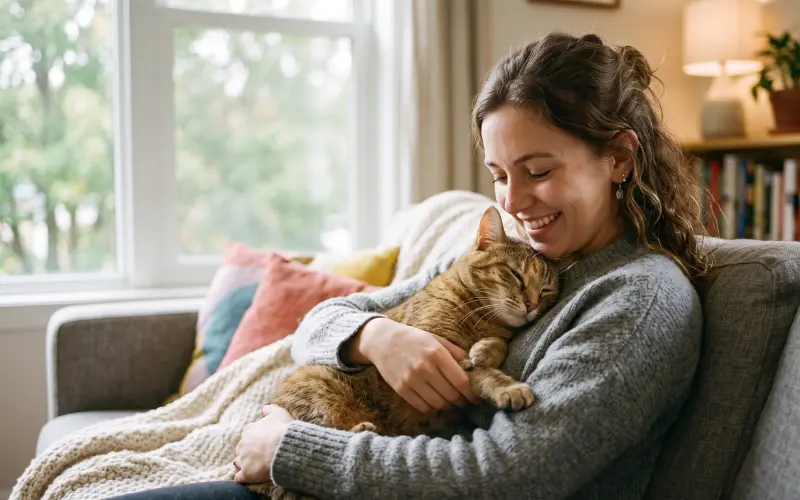
The psychological gap between the two bonds is smaller than most people assume. A 2019 Current Biology study by Oregon State University researchers ran cats through the same “Secure Base Test” originally designed for human infants and later used on dogs. Roughly 65 percent of cats and kittens showed secure attachment to their owner, nearly matching the 65 percent secure rate found in human infants. Dogs, in earlier comparable research, showed secure attachment in about 58 percent of cases.
In other words, cats form real, measurable attachment bonds to specific people, not just to whoever fills the food bowl. The behavioral difference lies elsewhere, in expression rather than depth. Dogs evolved under heavy selective pressure for cooperative, human-directed work across thousands of years of herding, hunting, and guarding roles. Cats largely selected themselves for one function, pest control, and kept far more independent hunting instinct as a result. Therefore, a cat’s bond can be just as genuine as a dog’s, even though it rarely announces itself with the same enthusiasm.
Why Have Cats Throughout History Been So Valuable to Civilization?
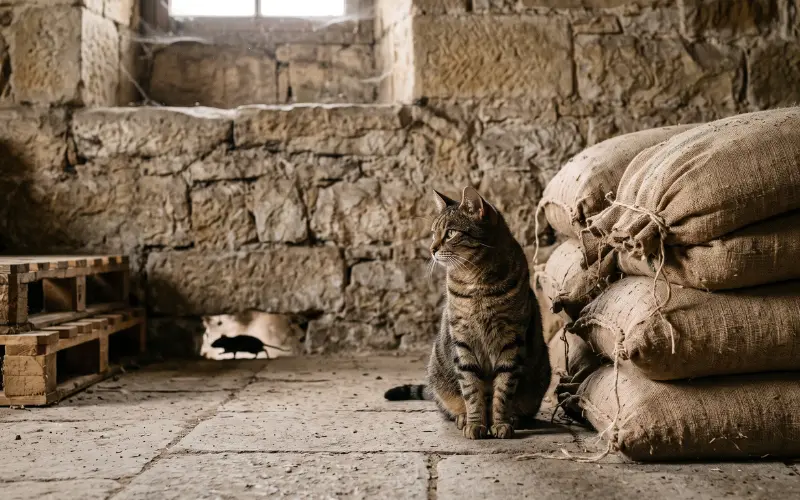
The core advantage was always straightforward: rodent control protected the food supply. A working cat population reduced grain losses to mice and rats, which directly supported food security in early agricultural societies. Fewer rodents also meant fewer rodent-borne diseases spreading through dense human settlements, a genuine public health benefit long before modern sanitation existed. Cats required almost no investment from humans in return, since they largely fed themselves. As a result, cats delivered an unusually strong return for civilizations, which likely explains why so many separate cultures independently reached the same conclusion about their worth. However, that same predatory efficiency has a real cost today.
A widely cited 2013 Nature Communications study estimated that free-ranging domestic cats kill between 1.3 and 4.0 billion birds and between 6.3 and 22.3 billion mammals annually in the United States alone. Un-owned and feral cats caused the majority of that mortality, not supervised house pets. In other words, the same instinct that made cats indispensable in ancient grain stores now threatens native wildlife when cats roam unsupervised. Responsible ownership genuinely matters, and it is not just a slogan.
How Do Cats See a World Humans Cannot?
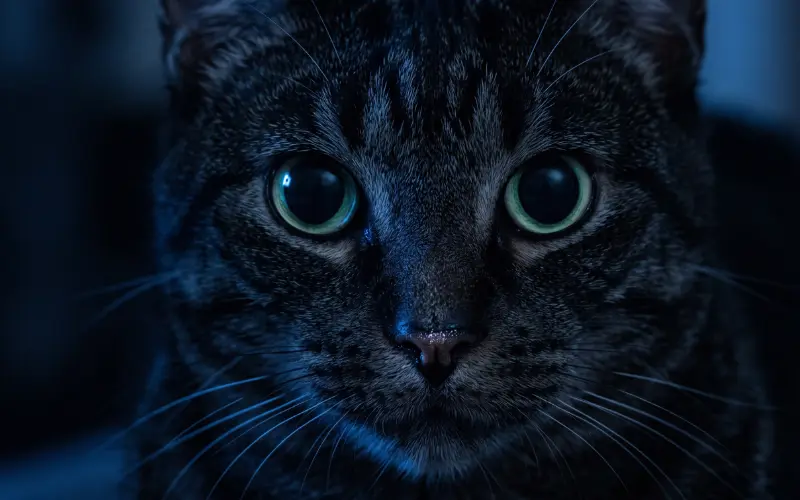
Cats trade fine detail for extreme sensitivity, and the gap explains a lot of their mythology. Human retinas carry roughly three times more cone cells than a cat’s, which is why humans perceive richer, more saturated color. Cats, in contrast, pack six to eight times more rod cells into their retinas than humans do. Rods handle motion and low-light detection rather than color, so cats trade vivid color for exceptional night sensitivity. Consequently, a cat can function in light roughly six times dimmer than the minimum a human needs to see clearly. A reflective layer behind the feline retina, the tapetum lucidum, bounces unused light back through the photoreceptors for a second pass.
This structure also explains why cat eyes glow in flash photographs. However, cats pay a genuine price for this power. Feline visual acuity sits around 20/100 to 20/200, meaning a cat sees at 20 feet what a human sees clearly at 100 to 200 feet. In other words, cats are functionally nearsighted by human standards, but they effectively own the night, which is precisely when they hunted for most of their evolutionary history.
What Are Whiskers Actually For?
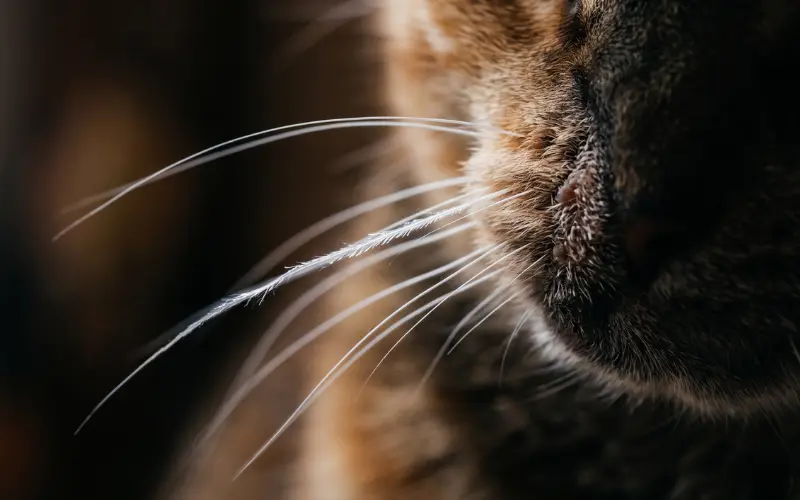
Whiskers, scientifically called vibrissae, function as a mechanical sensing system rather than decorative hair. Each whisker connects to a follicle containing 100 to 200 nerve endings and a blood-filled sinus at its base. When a whisker bends, even slightly from moving air, those nerve endings fire and report the direction and force of that bend directly to the brain. As a result, a cat can judge the size, shape, and distance of nearby objects without ever touching them. Whiskers also feed into proprioception, the body’s sense of its own position in space. Specialized cells at the whisker base respond to gravitational pull, feeding the brain constant data about head orientation. This information combines with balance signals from the inner ear, helping a cat navigate tight spaces and correct its movement mid-motion. Therefore, whiskers behave less like hair and more like a radar array wired directly into the nervous system.
Why Do Cats Almost Always Land on Their Feet?
The mechanism is called the righting reflex, and it starts in the inner ear rather than the eyes. A cat’s vestibular system, a set of fluid-filled canals in the inner ear, constantly tracks the body’s orientation relative to gravity. The instant a cat begins falling, this system detects the loss of an upright position within milliseconds. The spine, built from roughly 30 highly flexible vertebrae, then twists the front and back halves of the body independently. Specifically, the cat tucks its front legs to rotate the head end faster while extending its hind legs to slow rotation at the rear.
This entire sequence completes in under one second, driven by pure biomechanics, not conscious decision-making. Kittens begin showing this reflex around three weeks of age and largely master it by seven weeks. However, landing on the feet does not guarantee an injury-free landing. One large-scale study of cat falls found that over 92 percent of cats still sustained some injury despite landing paws-down, so this reflex is impressive biology, not a safety guarantee.
My Experience: What My Own Cats Taught Me About This History
I have had cats since I was a kid, and every single one of them has had a completely different personality, which is exactly what the attachment research above would predict. My first real teacher in this was Kooki, an orange Persian who lived to 18 years old and was, honestly, mostly my mother’s cat. My mother loved animals without a trace of fear; she handled snakes calmly, and that same comfort carried into every cat that ever lived in our home.
Watching Kooki age across nearly two decades gave me a front-row seat to the secure attachment pattern researchers later measured in a lab. He was never indifferent toward us. He had clear routines, clear preferences, and a clear reaction whenever someone he trusted walked back through the door. That is the exact bond Oregon State researchers documented in cats, playing out in an ordinary living room for 18 years. It is also, I suspect, close to what an ancient Egyptian household felt when they shaved their eyebrows for a cat they had lost.
Cats Throughout History FAQ
No, Egyptians inherited an already-domesticated animal. Genetic and archaeological evidence points to the Fertile Crescent roughly 10,000 to 12,000 years ago, long before Egyptian civilization existed as we know it.
Yes, research supports this directly. A 2019 Current Biology study found 65 percent of cats securely attached to their owner, nearly matching human infant attachment rates of 65 percent, while dogs measured slightly lower at 58 percent.
Cats carry six to eight times more rod photoreceptors than humans, plus a reflective tapetum lucidum layer behind the retina. Together, these let cats function in light roughly six times dimmer than the human minimum.
Whiskers are true sensory organs, not ordinary hair. Each one connects to 100 to 200 nerve endings that detect bending direction and force, feeding constant spatial data to the brain.
No, a successful righting reflex does not guarantee a safe landing. One large-scale study found over 92 percent of falling cats still sustained injuries despite landing on their feet.
Egypt showed the most extreme devotion, including legal protection and mass mummification. Rome, Norse mythology, and Islamic tradition also valued cats, but none matched Egypt’s combined religious and legal reverence.
Sources
- Nature (Genetics of Randomly Bred Cats Support the Cradle of Cat Domestication Being in the Near East)
https://www.nature.com/articles/s41437-022-00568-4 - Scientific American (How House Cats Evolved)
https://www.scientificamerican.com/article/how-house-cats-evolved/ - International Cat Care (The Origins of Cats)
https://icatcare.org/articles/the-origins-of-cats - Current Biology (Attachment Bonds Between Domestic Cats and Humans)
https://www.cell.com/current-biology/fulltext/S0960-9822(19)31086-3 - Oregon State University Newsroom (Cats, Like Children and Dogs, Develop Attachments to Their Caregivers)
https://news.oregonstate.edu/news/cats-children-and-dogs-develop-attachments-their-caregivers-study-shows - Nature Communications (The Impact of Free-Ranging Domestic Cats on Wildlife of the United States)
https://www.nature.com/articles/ncomms2380 - PetMD (How Do Cats See the World?)
https://www.petmd.com/cat/general-health/cat-vision - VCA Animal Hospitals (Why Do Cats Have Whiskers?)
https://vcahospitals.com/know-your-pet/why-do-cats-have-whiskers - Fear Free Happy Homes (Feline Physics: How the Righting Reflex Helps Cats Stick a Landing)
https://www.fearfreehappyhomes.com/feline-physics-how-the-righting-reflex-helps-cats-stick-a-landing/


Leave a Reply