
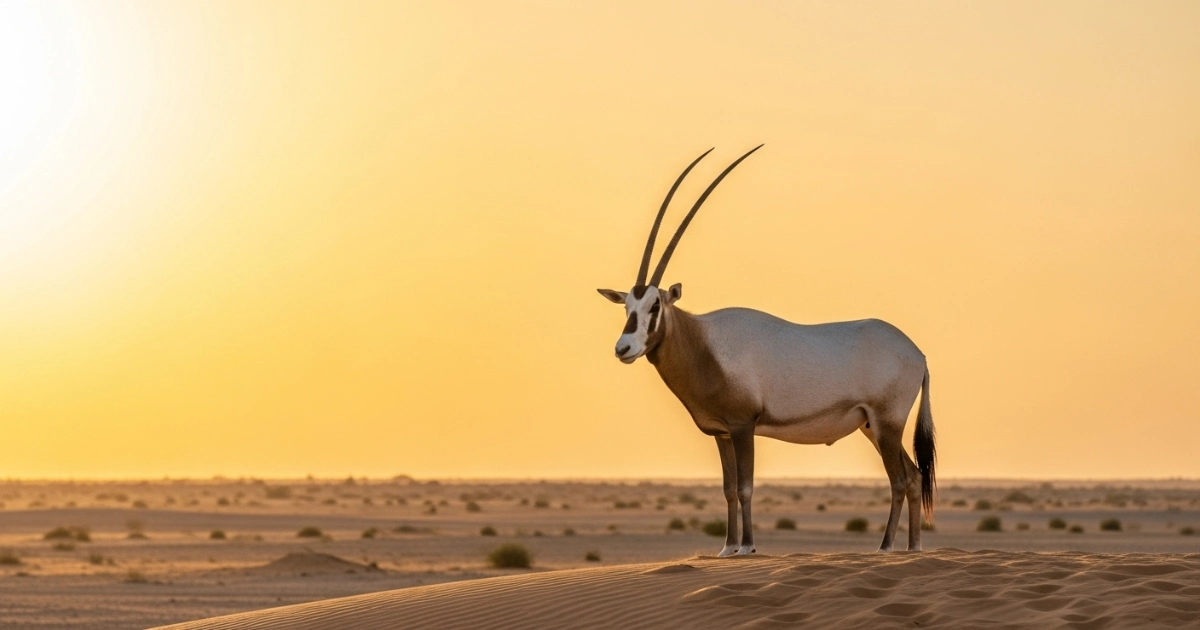
Very few phrases in conservation are as final and devastating as “Extinct in the Wild.” It is, in fact, an obituary. Specifically, it is a declaration. It signifies that a species has lost its natural place on Earth. From that point forward, it will exist only as a ghost behind the fences of zoos and private collections. For the magnificent Scimitar-Horned Oryx, that obituary was officially written in the year 2000. The great white antelope of the Sahara was gone. Its long, elegant, backward-curving horns gave rise to the myth of the unicorn. For this species, however, the story didn’t end there. Thanks to a monumental, multi-decade effort of unwavering dedication and incredible international collaboration, the impossible happened. Ultimately, that obituary was torn up.
The story of the Scimitar-Horned Oryx (Oryx dammah) is not just about preventing extinction; it is, quite literally, about reversing it. It stands as one of the most ambitious and successful large mammal reintroductions in history. Therefore, it serves as a powerful testament to the fact that with enough will, we can begin to heal the planet. This is the story of the Scimitar-Horned Oryx reintroduction success.
A Personal Reflection on Rewriting Obits
The phrase “Extinct in the Wild” highlights a sad failure in conservation, showing that nature is unsafe for its species. Writing about its return feels like a challenge to that loss, proving we can be protectors, not just destroyers. This story goes beyond facts and figures; it brings hope that endings we thought were final can change.
What is The Scimitar-Horned Oryx‘s Remarkable Conservation Journey?
The Scimitar-Horned Oryx faced a catastrophic decline for decades. Numerous human pressures caused this decline. As a result, the IUCN officially declared the species “Extinct in the Wild” in 2000. For over twenty years, the species existed only as a remnant population. It was a living museum piece scattered across captive herds in zoos and private collections worldwide. In December 2023, there was a truly historic moment for conservation. The IUCN officially downlisted the species from “Extinct in the Wild” to “Endangered.” This amazing change was made possible by a massive reintroduction project in Chad. This project has established a large and self-sustaining wild population. The population is growing, marking a milestone in the Scimitar-Horned Oryx reintroduction success.
In the world of wildlife conservation, we so often tell stories of loss. Consequently, it can feel like an endless, uphill battle. That’s why a story of true, resounding success breaks through the gloom, and it feels like a collective sigh of relief. The story of the Iberian Lynx recovery gives us one of those moments. I remember reading the news, years ago, that fewer than 100 of these beautiful cats remained. In fact, they were on a fast track to becoming a tragic footnote in history. Seeing them now, thriving, offers a powerful testament to human ingenuity. Ultimately, it proves that when we choose to act, we can pull a species back from the very brink.
The world once knew the Iberian Lynx (Lynx pardinus) as the most endangered feline. Today, however, it symbolizes successful wildlife conservation and offers a blueprint for hope.
What Pushed This Desert Antelope to Extinction in the Wild?
The main drivers of the oryx’s extinction were a devastating combination of uncontrolled, motorized overhunting and severe habitat degradation. In the mid-20th century, for example, the proliferation of modern four-wheel-drive vehicles and automatic firearms allowed hunters to pursue the oryx across the vast, open Sahara with deadly and unprecedented efficiency. Unlike traditional hunting methods, this modern approach gave the animals no chance of escape. They were hunted for their beautiful horns as trophies, for their durable hide which was used for leather goods, and for their meat.
Simultaneously, human activity increasingly degraded their fragile desert habitat. Prolonged and severe droughts, a hallmark of climate change in the Sahel region, intensified the process of desertification. Moreover, competition for grazing with a massive increase in domestic livestock like cattle, sheep, and goats compounded this environmental pressure. As human populations grew, their herds expanded as well. These herds consumed the sparse vegetation andwater resources essential for the oryx to survive. This consumption effectively pushed the oryx into ever more marginal lands. Eventually, they simply could not hold on.
What Biological Superpowers Allow The Scimitar-Horned Oryx to Conquer the Desert?
The Scimitar-Horned Oryx is, without a doubt, a masterpiece of desert evolution, equipped with a suite of incredible adaptations. Firstly, they have a pale white coat that acts like a natural heat shield, reflecting the intense desert sun and minimizing heat absorption. Secondly, and perhaps most impressively, they can survive for months or even years without drinking free-standing water. Instead, they obtain all the moisture they need from the desert plants they eat, such as acacia seed pods and wild melons. Their physiology is so efficient that they conserve every drop.
Furthermore, they possess a specialized internal cooling system to protect their most vital organ. A unique network of blood vessels, known as a carotid rete mirabile, allows them to cool the blood going to their brains. This prevents overheating even when their body temperature rises to levels that would be lethal for most other mammals. As for their behavior, they are nomadic, living in mixed-sex herds that constantly move across the vast landscape in a perpetual search for sparse vegetation, a strategy perfectly suited to an environment where resources are unpredictable.
Engineering the Success of the Scimitar-Horned Oryx Reintroduction
This recovery came from a long-term plan with two main parts: a global breeding program and a bold reintroduction effort. The first part acted as an “ark” that saved the oryx from extinction. Zoos and conservation centers carefully managed their oryx herds. A global studbook was created to ensure a diverse genetic pool, preventing inbreeding. These healthy captive populations were essential for returning the oryx to the wild.
The Environment Agency – Abu Dhabi (EAD) and the Sahara Conservation Fund (SCF) led the reintroduction, working closely with the Government of Chad. EAD provided the oryx for release from their herd in Abu Dhabi, while SCF focused on securing the habitat in Chad, engaging local communities, and managing logistics. Starting in 2016,conservationists took selected oryx to a large, fenced area in Chad’s Ouadi Rimé-Ouadi Achim Faunal Reserve. Beforereleasing them, they equipped the oryx with GPS collars and gave them time to acclimate. This process continued over several years, resulting in a resilient and thriving wild population, which marks the Scimitar-Horned Oryx reintroduction’s success.
What Does the Future Hold for the Returned Unicorn?
The reintroduced oryx herds are meticulously monitored. Data from the GPS collars, combined with aerial surveys from planes and on-the-ground ranger patrols, allows scientists to track their movements, monitor their health, and record birth rates. This constant flow of information is vital for managing the population effectively. However, the work is not done. The risk of a return to poaching, for instance, remains a constant threat that requires permanent vigilance and the continued support of local communities. Additionally, ensuring the long-term sustainability of their habitat in the face of climate change and ongoing human pressures remains a significant challenge.
Ultimately, the success of reintroducing the Scimitar-Horned Oryx shows what is possible. It demonstrates that a species can come back from near extinction through long-term planning, cooperation among governments, NGOs, and zoos, and science-driven choices. The desert’s unicorn has returned home, reminding us that with dedication, a global community can change the future for a species once thought lost.
Scimitar-Horned Oryx FAQ
The scimitar-horned oryx was declared extinct in the wild in 2000. However, in December 2023 the IUCN officially downlisted the species from “Extinct in the Wild” to “Endangered” following a successful reintroduction program in Chad that established a growing, self-sustaining wild population.
The primary causes were motorized overhunting using four-wheel-drive vehicles and automatic weapons, which gave the animals no chance of escape. Simultaneously, severe habitat degradation from prolonged drought, desertification, and competition with expanding domestic livestock herds destroyed the vegetation and water sources the oryx depended on.
The scimitar-horned oryx can survive months or years without drinking free-standing water by extracting all moisture from desert plants including acacia seed pods and wild melons. Its physiology is exceptionally efficient at conserving water, making it one of the most drought-resistant large mammals on Earth.
It is a specialized network of blood vessels that cools the blood flowing to the brain before it arrives. This biological cooling system prevents fatal overheating even when the oryx’s body temperature reaches levels lethal to most other mammals, allowing it to function in extreme Saharan heat.
The scimitar-horned oryx was reintroduced in Chad as part of a large-scale international conservation effort. The project successfully established a self-sustaining and growing wild population, directly leading to the IUCN’s historic 2023 downlisting from “Extinct in the Wild” to “Endangered.”
The scimitar-horned oryx’s long, elegantly curved horns are widely believed to have inspired the unicorn myth. When viewed from the side, the two horns can appear as a single horn, creating the illusion of the legendary creature. The species is sometimes called the unicorn of the desert.
Sources
- IUCN Red List
https://www.iucnredlist.org/species/15568/222165215 - Sahara Conservation Fund
https://www.saharaconservation.org/scimitar-horned-oryx/ - Zoological Society of London (ZSL)
https://www.zsl.org/what-we-do/projects/scimitar-horned-oryx-reintroduction - World Association of Zoos and Aquariums (WAZA)
https://www.waza.org/priorities/conservation/conservation-breeding-programmes/scimitar-horned-oryx/
Leave a Reply
You must be logged in to post a comment.