In the deepest corners of the aquarium hobby, there lives a group of giants. These are the “monster fish”. Powerful, intelligent, and enormous predators. Consequently, they require tanks the size of a car, and this commitment borders on obsession. For example, from the ancient, graceful Arowana to the brutish charm of a Redtail Catfish, these are not just pets; they are living titans. But what does it really take to house a river monster in your living room? Ultimately, this guide is your deep dive into the high-stakes world of monster fish keeping.
Difference Between a Predator and a Monster Fish
I consider myself a keeper of predators. My Channa pair are intelligent, efficient hunters. They are the top dogs of their 500-liter world, and I love their interactive, puppy-like aggression. But they are not monster fish.
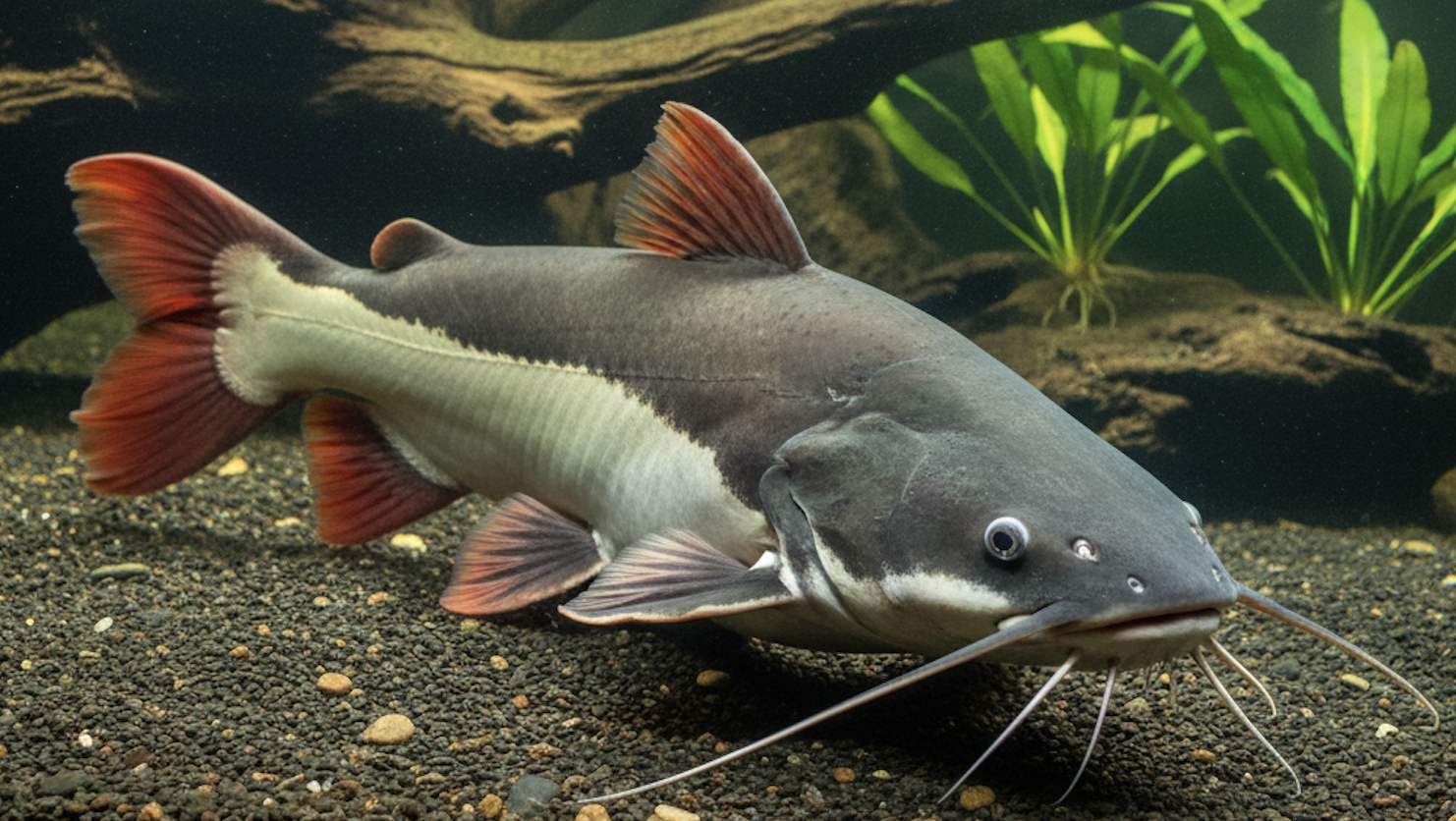
The first time I saw a full-grown Redtail Catfish, I had a moment of profound, soul-shaking humility. It wasn’t a fish; instead, it was a living submarine that looked like it could swallow my dog. Furthermore, the sheer scale, the power, and the tank required to house it were astonishing. Its vessel needed its own zip code. Consequently, my setup looked like a child’s toy in comparison. Therefore, the “monster” keeper isn’t just a hobbyist; they are a zookeeper who sleeps in their own house. This guide is written with a deep and abiding respect for those who dare to keep the true titans.
What Fish Are Classified as Monster Fish?
“Monster fish” is a hobbyist term for any fish that, due to its massive adult size, aggressive temperament, anddemanding care, is beyond the scope of a standard aquarium. Therefore, here are some of the most famous members of this exclusive club:

Arowanas
(Osteoglossum & Scleropages sp.)
The Arowana, often called the “Dragon Fish,” is a surface-dwelling predator that is both graceful and ancient. Furthermore, it is one of the most powerful and instantly recognizable titans in the hobby.

Flowerhorn Cichlid
The Flowerhorn is a monster fish hybrid. It is known for its massive nuchal hump (kok). It also has vibrant colors. This fish has a shockingly interactive, “wet pet” personality. However, this intelligence is also paired with extreme aggression.

Channa
(Snakeheads)
They are air-breathing, highly intelligent predators. While many species are manageable, giants like the Toman(Channa micropeltes) are in fact true monsters.

Oscar
(Astronotus ocellatus)
The Oscar is the classic “wet pet.” It is incredibly intelligent and personable, yet it has the temperament of a grumpy, furniture-rearranging toddler.

Jack Dempsey
(Rocio octofasciata)
Famous for their stunning iridescent blue spangles, they have a notoriously pugnacious attitude. With a bulldog-like demeanor, the Jack Dempsey is a popular choice.

Jaguar Cichlid
(Parachromis managuensis)
A beautiful monster fish. It is a brutally aggressive Central American predator. The Jaguar Cichlid will dominate any tank it’s in.

Red Devil/Midas Cichlid
(Amphilophus sp.)
Unbelievably charismatic and intelligent, the Red Devil exhibits a level of aggression so high that they are often best kept alone.

Datnoid
(Tiger Fish, Datnioides sp.)
The Datnoid (often called the Tiger Fish), is a slow-growing, majestic ambush predator. It is specifically known for its bold, vertical, tiger-like stripes that make it a striking centerpiece.

Payara
(Vampire Fish, Hydrolycus scomberoides)
A vibrant, fast-moving, and powerful South American predator, the Payara requires an enormous tank and, consequently, a diet of large foods.

Giant Gourami
(Osphronemus goramy)
The Giant Gourami is the largest of the gouramis. Though this gentle giant can grow to over 2 feet long, it is nevertheless surprisingly peaceful for its size.

Pacu
(Piaractus brachypomus)
Often sold deceptively as a “silver dollar,” this relative of the piranha grows into a 2-3 foot, plant-eating behemoth. Consequently, it requires a pond-sized aquarium.

Redtail Catfish
(Phractocephalus hemioliopterus)
This beautiful catfish grows to over 4 feet long and, consequently, will eat, without exception, any fish that can fit in its cavernous mouth.

Tiger Shovelnose Catfish
(Pseudoplatystoma sp.)
Another massive predatory catfish that is active and fast-swimming, requiring a tank of immense length.
Can I Create a Successful Monster Fish Community Tank?
Yes, but it is the ultimate high-stakes gamble in the aquarium hobby. In fact, it is not a peaceful community; instead, it is a carefully managed, controlled chaos. Ultimately, however, success depends on a few non-negotiable principles.
1. The Foundation: What is the Minimum size of a Monster Fish Aquarium?
You are no longer in the realm of standard aquariums. For a monster fish community, therefore, you need tanks that are 300 gallons (1100+ liters); in fact, tanks of 500 to 1000 gallons are the norm for housing true giants together. Crucially, the footprint (length and width) is far more important than height.
2. The Golden Rule: The Mouth Size Test on Steroids
The rule of “if it fits, it will be eaten” is absolute here. Therefore, you must stock your tank with fish that are of a similar size and, most importantly, have a similar growth rate. For instance, a slow-growing Datnoid added with a fast-growing Redtail Catfish will inevitably become a meal.
3. Aggression Management in Monster Fish Tanks
Match Temperaments
First and foremost, you must research and match the aggression levels of your chosen inhabitants. For example, housing a moderately aggressive Oscar with a hyper-aggressive Jaguar Cichlid will likely result in the Oscar being bullied to death.
Grow Them Out Together
Furthermore, the best chance for success is to start with a group of juveniles of all your chosen species. Let them grow up together. This approach will establish a natural pecking order. In fact, adding a new fish to an established monster tank is extremely difficult and dangerous for the newcomer.
Massive Filtration
Also, the bio-load of these large, messy predators is astronomical. Therefore, you will need a filtration system to match, typically a large sump or multiple, high-capacity canister filters.
Break Lines of Sight
Finally, use massive pieces of driftwood and rockwork to create distinct territories and visual barriers.
What are the Risks of Monster Fish Keeping?
The Inevitable Gamble
The Personality Shift
This, however, is the biggest risk. A monster fish that has been a model citizen for two years can “flip a switch” as it reaches sexual maturity and become a tank-terrorizing killer overnight. Ultimately, there are no guarantees.
The Need for a Backup Plan
Therefore, you must have a plan for what to do when it goes wrong. This often means having a spare “backup” tank of a massive size, or a network of fellow hobbyists or local fish stores who are willing and able to take on a 2-foot, aggressive adult fish at a moment’s notice.
Keeping monster fish is a deeply rewarding obsession for a select few. Nevertheless, it is a commitment that requires immense space, resources, and, above all, a profound respect for the raw, untamable power of the animals you keep.
Monster Fish Care FAQ
Monster fish keeping requires a minimum of 300 gallons (1,100+ liters), with giant species communities regularly needing 500 to 1,000 gallons. Standard aquarium sizing rules do not apply. The tank’s footprint — length and width — matters far more than height, as most monster fish are powerful horizontal swimmers.
Monster fish can be kept together in a community tank, but only under strict non-negotiable conditions. All species must be started as juveniles simultaneously to establish a natural pecking order, matched by aggression level and adult size, and housed in a tank of at minimum 300 gallons with extensive filtration and visual barriers.
The mouth size rule is absolute in monster fish keeping: any fish small enough to fit inside another’s mouth will eventually be eaten. This rule becomes especially dangerous in a monster fish tank because growth rates differ between species. A slow-growing Datnoid added alongside a fast-growing Redtail Catfish will inevitably become its meal.
A personality shift occurs when a monster fish that has been peaceful for years suddenly becomes aggressive, often at sexual maturity. There are no warning signs and no guarantees this will not happen. Every monster fish keeper must have a backup tank large enough to house the aggressive fish alone.
A Pacu is not a Silver Dollar, despite being deceptively sold as one in the aquarium trade. Pacus grow into 2–3 foot plant-eating fish requiring a pond-sized enclosure, while Silver Dollars reach a manageable 6 inches and suit a standard large aquarium. The two species are not interchangeable.
Monster fish produce an astronomical bioload compared to standard aquarium fish, requiring a filtration system that dramatically exceeds the tank’s stated capacity. A large sump or multiple high-capacity canister filters running simultaneously are the minimum requirement. Standard filter ratings based on tank volume are insufficient for monster fish — always oversize the filtration significantly.
An Oscar is widely considered the ideal gateway into monster fish keeping, thanks to its interactive “wet pet” personality and manageable 12–14 inch adult size. It does not reach the scale of true giants like a Redtail Catfish or Arowana. Oscar care is achievable for dedicated intermediate hobbyists.
Sources
- Monster Fish Keepers (Peacock Bass)
https://www.monsterfishkeepers.com/forums/threads/peacock-bass-identification-guide.236750/ - Seriously Fish (Piaractus brachypomus)
https://www.seriouslyfish.com/species/piaractus-brachypomus/ - Practical Fishkeeping (Giant Snakehead)
https://www.practicalfishkeeping.co.uk/features/channa-micropeltes-the-giant-snakehead/ - Datnoid Keepers (Care Guide)
https://www.monsterfishkeepers.com/forums/threads/datnoid-care-guide.249272/ - Arowana Club (Tank Sizing)
https://arowanaclub.com/arowana-tank-size-guide/
Leave a Reply
You must be logged in to post a comment.