
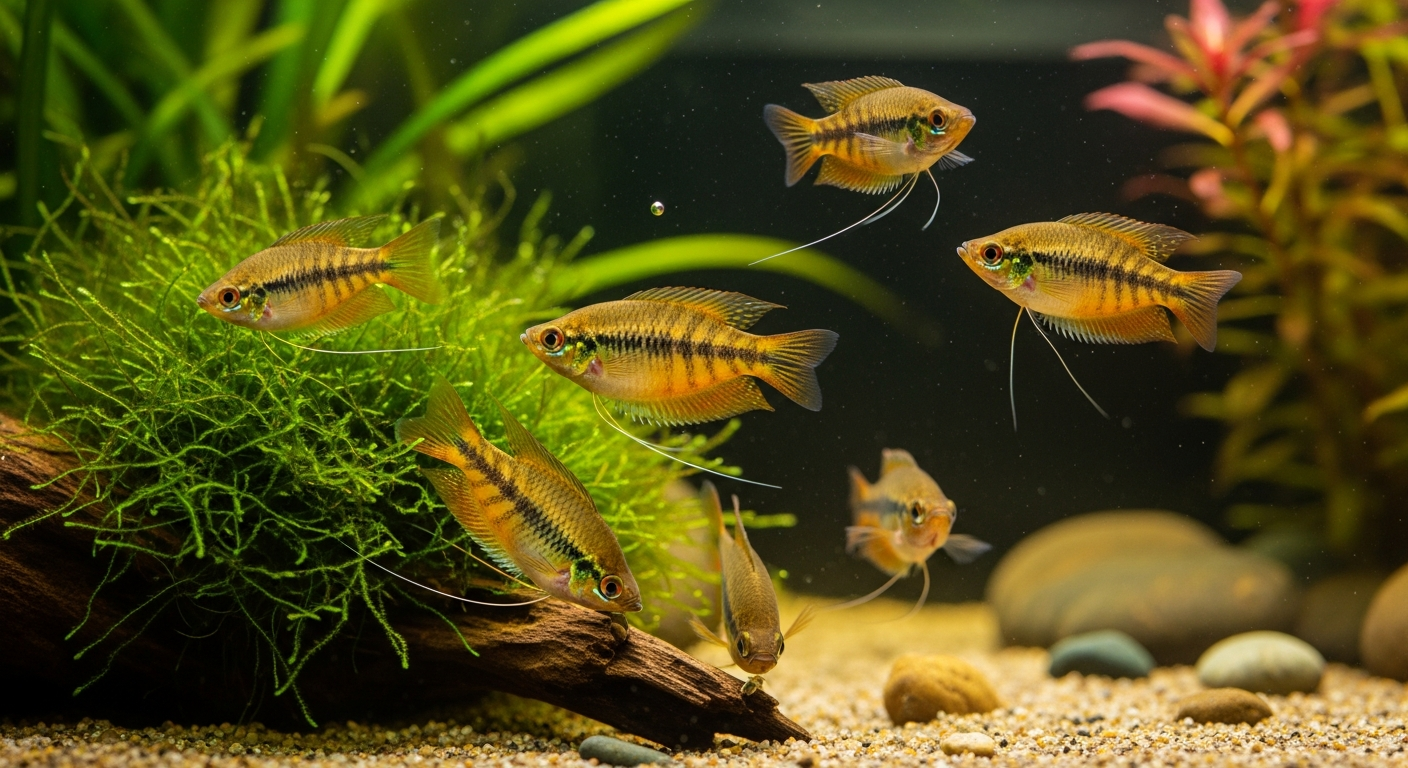
The Honey Gourami (Trichogaster chuna) is a small labyrinth fish from the rivers of India and Bangladesh. It is, without a doubt, the most peaceful and beginner-friendly member of the common gourami family, a tiny sunbeam that brings a quiet, gentle grace to any aquarium it inhabits.
General Information and Temperament
Are Honey Gouramis good pets for beginners?
Yes, they are an absolutely fantastic choice for beginners. Specifically, they are hardy and peaceful, and their small size makes them suitable for smaller aquariums. Thus, they offer all the intelligence and interactive charm of a gourami without the aggression that can come with their larger cousins.
What is the average lifespan of a Honey Gourami?
In a well-maintained and stable aquarium, you can expect your Honey Gouramis to live for 4 to 5 years.
How large do they get?
They are a true small or “nano” fish, reaching a maximum adult size of only 2 inches (5 cm).
What is the temperament of a Honey Gourami?
They are exceptionally peaceful and timid; this cannot be overstated. Indeed, they are the polar opposite of the boisterous Blue Gourami. Because they are shy by nature, they will never be the aggressor in a tank, but they can easily become the victim of bullying. Therefore, their confidence is built on a safe environment and peaceful tank mates.
Should I keep one Honey Gourami or a group?
You have options! Unlike a Corydoras that must be in a school, Honey Gouramis are more flexible.
- A Single Male: Can be a wonderful, solitary centerpiece for a small tank.
- A Pair (Male/Female): A classic setup that will allow you to see their fascinating breeding behaviors.
- A Group: A group of 4-6 (ideally with more females than males) can be kept in a larger tank, but be aware that males may establish small territories.
What is the difference between a male and a female?
The difference is dramatic, especially when the male is in breeding condition. Specifically, females are typically a simple, silvery-beige or honey-gold color. Furthermore, a non-breeding male will look similar but may have a hint of orange in his fins. A breeding male, however, undergoes a spectacular transformation: his body turns a deep, fiery honey-orange orred, and he also develops a stunning, jet-black throat and underside that extends into his anal fin.
Tank Setup: A Jungle of Security
What is the minimum tank size for a Honey Gourami?
For a single or a pair, a 15-gallon (approx. 60 liters) tank is a good minimum. A 20-gallon (75 liters) or larger is even better and allows for a more stable environment and more tank mates.
Do they need a lot of hiding spots and plants?
Yes, this is the most important part of their setup. A Honey Gourami in a bare tank is a terrified Honey Gourami. They absolutely thrive in a heavily planted aquarium with plenty of driftwood, caves, and, most importantly, floating plants. The shaded cover from floating plants is the number one thing that will give them the confidence to come out and show off their beautiful colors and personality.
What kind of filtration is needed?
They come from slow-moving waters and hate strong currents. The ideal filtration is a gentle sponge filter or a hang-on-back filter with its flow baffled to create a calm water surface.
Water Parameters and Diet
What are the ideal water parameters?
They are quite adaptable to different water parameters, but prefer warm, stable water.
- Temperature: A stable temperature between 74-82°F (23-28°C) is ideal. A heater is a must.
- pH: 6.0 to 7.5.
Clean water is important, so a regular weekly water change schedule is key.
What do Honey Gouramis eat?
They are omnivores and are not picky. A high-quality flake food or micro-pellet can be their staple. However, they have small mouths and are micropredators by nature. They truly thrive when you supplement their diet with small live or frozen foods, such as daphnia and baby brine shrimp, and bloodworms.
Breeding: The Bubble Nest Builder
Like most gouramis, the Honey Gourami is a bubble nester. Specifically, a male in breeding condition will build a floating nest of bubbles and saliva under a leaf or amidst floating plants. Subsequently, he will perform a courtship “dance” for a female. Furthermore, after spawning, he will carefully place the fertilized eggs in his nest and will thenguard it aggressively, even chasing the female away. Ultimately, he remains a dedicated father until the fry become free-swimming.
Tank Mates: Choose Your Friends Wisely
What are good tank mates for a Honey Gourami?
This is a critical choice for their well-being. Their tank mates must be equally small and peaceful.
- Perfect choices: Small Rasboras (Chili, Espei), Ember Tetras, Neon Tetras, Corydoras catfish, Otocinclus catfish, and freshwater shrimp.
- Fish to avoid: Any fin-nippers like Tiger Barbs, boisterous fish like Danios, or any fish large enough to see them as a snack. They should never be housed with a Betta fish or a more aggressive Dwarf Gourami, as the timid Honey Gourami will be bullied relentlessly.
Honey vs. Dwarf Gourami: An Important Distinction
For beginners, it’s vital to know the difference. The Honey Gourami is often confused with the similarly sized but much more colorful Dwarf Gourami (Trichogaster lalius). While beautiful, the Dwarf Gourami is known for being more assertive and is sadly prone to the incurable Dwarf Gourami Iridovirus (DGIV). The Honey Gourami is the hardier, healthier, and far more peaceful choice.
Honey Gourami Fish Care FAQ
Honey Gouramis reach a maximum adult size of 2 inches or approximately 5 centimeters. This compact size makes them one of the few genuine gourami species suitable for smaller community tanks. They remain small regardless of tank size or feeding frequency, making size estimation straightforward for tank planning.
Honey Gouramis and Dwarf Gouramis are entirely separate species with different health profiles in captivity. Honey Gouramis are significantly hardier and lack the disease vulnerability that defines the Dwarf Gourami trade. Dwarf Gouramis carry a high risk of the incurable Dwarf Gourami Iridovirus, making the Honey Gourami the safer long-term purchase.
Females are silvery-beige with minimal coloration visible throughout the year. A breeding male develops a deep honey-orange or red body with a striking jet-black throat and underside. Outside breeding condition, males appear only slightly more orange than females, making the difference subtle at first glance.
Honey Gouramis accept high-quality micro-pellets or flake food as the foundation of their diet. Their small mouths and micropredatory instincts mean they thrive with regular live or frozen daphnia, brine shrimp, and bloodworms. Dietary variety directly improves coloration, immune health, and the consistency of breeding behavior in males.
Honey Gouramis are among the most peaceful fish in the gourami family and are never the aggressor. Males display briefly toward one another but rarely escalate to any physical confrontation or fin damage. Their primary risk in community tanks is being bullied by boisterous or fin-nipping tankmates, not the reverse.
Honey Gouramis require a heavily planted aquarium with floating plants, driftwood, and multiple hiding points. Without adequate plant cover, they remain permanently hidden and display none of their characteristic color or personality. A gentle sponge filter or baffled hang-on-back filter provides the calm water current they require for comfort.
Tiger Barbs, Zebra Danios, and fin-nipping species will physically damage and chronically stress the timid Honey Gourami. Betta fish and assertive Dwarf Gouramis will bully them without pause in any shared environment. Any fish large enough to view a 2-inch Honey Gourami as a meal must be excluded entirely.
Sources
- Seriously Fish (Trichogaster chuna)
https://www.seriouslyfish.com/species/trichogaster-chuna/ - Britannica (Labyrinth Fish)
https://www.britannica.com/animal/labyrinth-fish - Practical Fishkeeping (Breeding Honey Gouramis)
https://www.practicalfishkeeping.co.uk/features/breeding-honey-gouramis/ - University of Florida (Iridovirus in Fish)
https://edis.ifas.ufl.edu/publication/FA182 - Aquarium Co-Op (Honey Gourami Care Guide)
https://www.aquariumcoop.com/blogs/aquarium/honey-gourami-care-guide
Leave a Reply
You must be logged in to post a comment.