
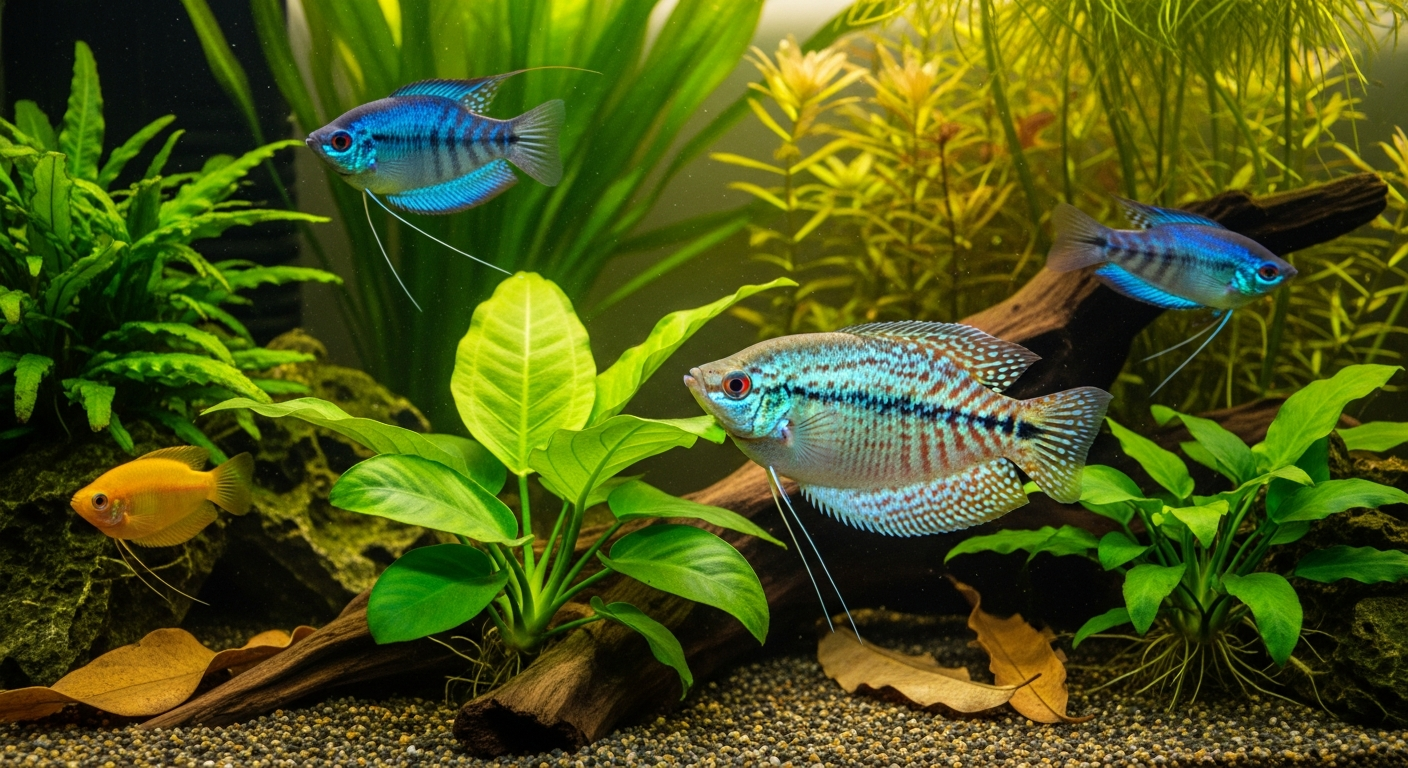
Long before I learned the language of cichlid aggression or the social cues of a Corydoras school, I learned the art of patience from a Pearl Gourami. It wasn’t a fish of frantic energy; it was a creature of slow, deliberate grace. I’ll never forget the way it would explore its world, not just with its eyes, but with its two long, thread-like ventral fins, its “feelers.” It would gently and purposefully touch a new leaf, a piece of driftwood, even my hand during maintenance, with a curiosity that felt more like a cat’s than a fish’s. This fish taught me that some aquatic pets don’t just swim; they investigate, they ponder, they interact. They are the thinking fish of the aquarium, and their quiet intelligence is a special kind of magic.
The Gourami family is a diverse group of labyrinth fish from Asia, which are famous for their unique ability to breathe air from the surface. Furthermore, their personalities are just as varied as their colors, thereby making them one of the most rewarding and fascinating groups in the hobby.
The Labyrinth Organ: An Evolutionary Superpower
Before diving into their care, it’s essential to understand what makes a gourami a gourami. Specifically, they possess a “labyrinth organ,” a specialized, lung-like structure that allows them to gulp atmospheric air from the surface. This is anadaptation for their often slow-moving, low-oxygen native habitats. Therefore, this is why you will frequently see them make a deliberate trip to the top of the tank for a bubble of air. Ultimately, it’s a completely normal and fascinating behavior.
Gourami General Information and Temperament
Are gourami fish good pets for beginners?
Some are, and some are not. Specifically, the smaller, more peaceful species like the Honey Gourami, Pearl Gourami, and Dwarf Gourami are excellent choices for a well-researched beginner with an appropriately sized tank. Conversely, the larger and more aggressive species, such as the Blue Gourami or the Giant Gourami, are not suitable for beginners.
How long do gourami fish live?
With good care, most common gourami species will live for 4 to 6 years, with the giant varieties living much longer.
How intelligent are Gourami fish?
They are very intelligent and inquisitive fish. As a result, they will quickly learn to recognize their owner, and they will come to the front of the glass to beg for food. Moreover, they will use their sensitive feeler fins to thoroughly investigate everything in their territory.
Are they noisy?
Some species, most famously the Croaking Gourami, can produce audible croaking or clicking sounds, especially during spawning or territorial disputes!
Housing: A Calm, Planted Jungle
What is the minimum tank size for a Gourami?
This varies dramatically by species:
Dwarf Species (Honey, Sparkling)


A 15 or 20-gallon tank is a great start.


A 30 to 55-gallon tank is necessary.
Large Species (Giant Gourami)


This is a true tank buster, requiring a pond or a massive aquarium of 200+ gallons.
What kind of setup do Gourami Fish need?
They come from slow-moving, densely planted waters, and their ideal tank mimics this. Consequently, they thrive in a well-planted aquarium with gentle filtration. Moreover, floating plants are highly appreciated because they provide shade and a sense of security.
Do Gourami fish need hiding spots?
Yes, a network of driftwood, caves, and dense plant thickets is essential for them to feel secure, especially for the shyer species.
Water Parameters and Diet
What are the ideal water parameters?
Most captive-bred gouramis are very adaptable, but they prefer warm, stable water.
- Temperature: A heater is a must. A range of 75-82°F (24-28°C) is ideal for most species.
- pH: 6.0 to 7.8. Clean water is important, so a regular weekly water change schedule is key.
What do gouramis eat?
They are omnivores and are generally not picky. A high-quality flake food or small floating pellet should be the staple of their diet. They also love to hunt and will eagerly accept frozen or live foods like bloodworms, brine shrimp, and daphnia. Many will also pick at soft algae in the tank.
Breeding: The Bubble Nesters
Most popular gourami species are “bubble nesters.” Specifically, the male will build an intricate, floating nest made of bubbles and saliva at the water’s surface, often under a floating plant leaf. Subsequently, he will court a female and, after spawning, will place the fertilized eggs in the nest and then guard it ferociously until the fry hatch.
Tank Mates: The Art of a Peaceful Community
Can gouramis be aggressive?
Yes, this is an important point. While many are peaceful, they can be considered “semi-aggressive.” Males, in particular, can be very territorial towards other male gouramis or other similarly shaped, brightly colored fish.
- Good Tank Mates: Fast-moving schooling fish like tetras and rasboras, and robust bottom-dwellers like Corydoras and peaceful loaches.
- Fish to Avoid: Fin-nippers like Tiger Barbs (which will shred their long feelers) and other male gouramis (unless the tank is very large). Do not keep them with a Betta fish, as they will likely fight.
The Gourami Family: A Tour of the Hobby’s Favorites
The gourami family is vast. Here’s a look at the superstars.
The Gentle Dwarfs Gouramis (Perfect for Smaller Tanks)
Honey Gourami (Trichogaster chuna)
The most peaceful and timid of the common gouramis. Reaching only 2 inches, these gentle, golden-hued fish are perfect for a calm community tank.
Sparkling or Pygmy Gourami (Trichopsis pumila)
A tiny, shimmering jewel that stays under 1.5 inches. Famous for its croaking sound, it’s a true nano fish.
Dwarf Gourami (Trichogaster lalius)
Incredibly popular for the male’s brilliant neon blue and red stripes. A beautiful centerpiece for a 20-gallon, but sadly prone to the incurable Dwarf Gourami Iridovirus (DGIV).
The Graceful Mid-Sizers Gouramis (Community Tank Centerpieces)
Pearl Gourami (Trichogaster leeri)
Often called the “queen” of the aquarium. With a pearlescent, spotted body and a gentle, peaceful nature, this 4-5 inch fish is arguably the perfect mid-sized community centerpiece.
Moonlight Gourami (Trichopodus microlepis)

A subtle beauty with a ghostly, silvery-green sheen. Peaceful and elegant, growing to about 6 inches.
The Oddballs & Giant Gouramis (For the Specialist)
Chocolate Gourami (Sphaerichthys osphromenoides)

A beautiful but famously delicate and difficult species that requires very soft, acidic “blackwater” conditions. For experts only.
Paradise Fish (Macropodus opercularis)

A stunningly colored and incredibly hardy gourami that can even be kept in unheated tanks. They are, however, very aggressive and not suitable for a peaceful community.
Giant Gourami (Osphronemus goramy)
The true “tank buster” of the family. This is a massive fish that can reach over 2 feet long and live for decades. It is a true monster fish suitable only for huge, pond-like aquariums.
Gourami Fish Family FAQ
Gouramis possess a labyrinth organ, a lung-like structure that allows them to breathe surface air. This adaptation evolved for survival in the slow-moving, oxygen-depleted waters of Southeast Asia. Gouramis must have unobstructed access to the surface at all times or they will suffocate.
Honey Gouramis, Pearl Gouramis, and Sparkling Gouramis suit beginners due to their peaceful nature and modest tank needs. Dwarf Gouramis are popular but carry a high risk of the incurable Dwarf Gourami Iridovirus. Giant and Blue Gouramis require advanced experience and tanks exceeding 100 gallons, ruling them out for beginners.
Two male gouramis of the same species housed in a small tank will fight persistently. This causes chronic stress, fin damage, and often death for the subordinate male. A single male kept with multiple females in a larger, heavily planted tank is always the safer configuration.
Tank size requirements vary enormously across the gourami family. Dwarf species like the Honey Gourami need 15 to 20 gallons; medium species like the Pearl Gourami require 30 to 55 gallons. The Giant Gourami reaches over two feet in length, demanding a minimum of 200 gallons.
Certain gourami species, including the Croaking and Sparkling Gourami, produce audible clicking and croaking sounds. These sounds are created mechanically and serve as communication during territorial disputes and courtship rituals. Hearing these sounds from your tank confirms healthy, actively social behavior requiring no intervention from the keeper.
Gourami fish and Betta fish must never share a tank under any circumstances. Both are labyrinth fish with strong territorial instincts toward species of similar body shape and coloration. The encounter reliably results in severe fin damage, chronic stress, or death for one or both fish.
Most gourami species are bubble nesters, with the male constructing a floating nest of bubbles and saliva. He courts a female, places the fertilized eggs inside the nest, and then guards it aggressively. He will attack any fish that approaches the nest, including the female, until the fry hatch.
Sources
- Britannica (Labyrinth Fish)
https://www.britannica.com/animal/labyrinth-fish - Seriously Fish (Pearl Gourami Profile)
https://www.seriouslyfish.com/species/trichogaster-leeri/ - Practical Fishkeeping (Breeding Labyrinth Fish)
https://www.practicalfishkeeping.co.uk/features/breeding-labyrinth-fish/ - University of Florida (Iridovirus in Fish)
https://edis.ifas.ufl.edu/publication/FA182 - Monster Fish Keepers (Giant Gourami Care)
https://www.monsterfishkeepers.com/forums/threads/giant-gourami-care-guide.66725/ - The Spruce Pets (Gourami Tank Mates)
https://www.thesprucepets.com/best-gourami-tank-mates-1381015


Leave a Reply