
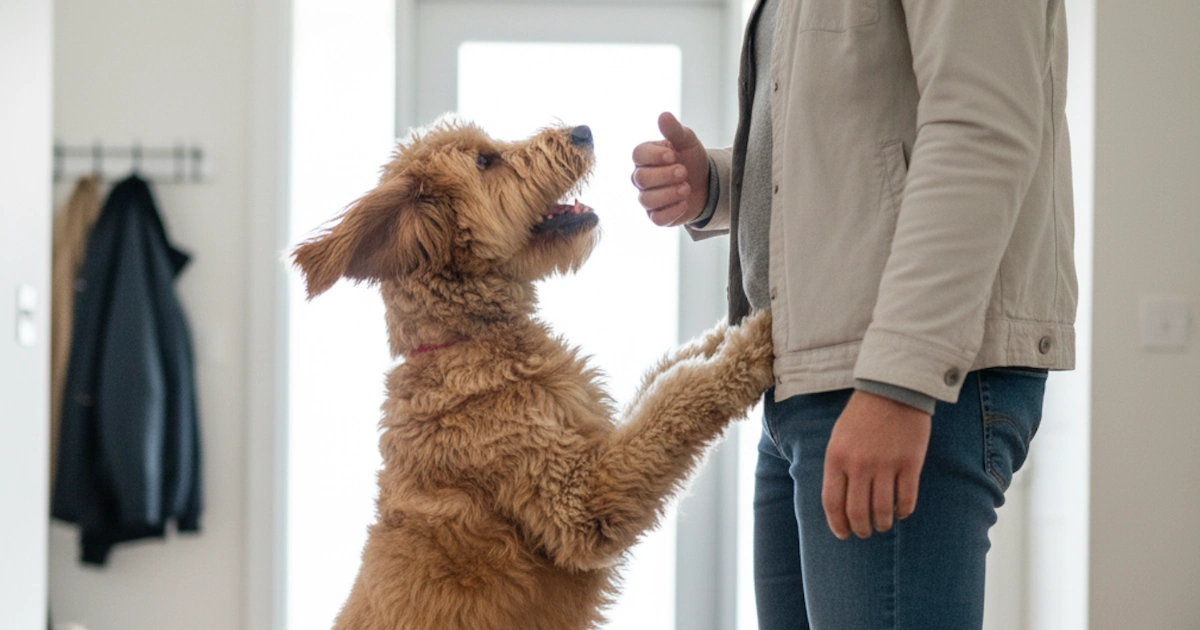
It’s a scene played out in doorways across the world: you walk in, and you are immediately greeted by your dog’s jump, intent on giving you a full-body hug whether you want one or not. An enthusiastic dog jump can be a charming quirk in a tiny puppy, but in an adult dog, it’s a messy, annoying, and even dangerous habit. So, how do you convince your dog that a polite, “four-on-the-floor” greeting is a better life choice? This guide is your complete training plan, designed to transform your dog’s frantic, airborne assaults into calm, happy hellos.
Why Does My Dog Jump on People in the First Place?
First, let’s be clear: in almost all cases, jumping is a greeting, not a sign of dominance. It’s a social behavior rooted in simple, understandable instincts.
They Want to Say Hello, Face-to-Face: Puppies greet their mothers by licking their faces. Your dog is trying to get closer to your face to give you a proper, affectionate “hello.”
It’s Exciting! Your arrival is the most exciting event of their day. The jump is a physical explosion of that pent-up, happy energy.
It Works (This is the most important reason): This is the crucial part. When your dog jumps on you and you react—by petting them, pushing them away, shouting “down,” or even just making eye contact—you have just given them attention. In your dog’s mind, the jump was a success. You have accidentally rewarded the very behavior you want to stop.
How Do I Teach My Dog Not to Jump? (The Training Techniques)
The foundation of all training is simple: ignore the behavior you don’t want, and lavishly reward the behavior you do want.
Technique 1: The “Be a Tree” or “Become a Statue” Method
This is your most powerful tool. It teaches your dog that jumping makes you “turn off.”
How it Works: The moment your dog jumps on you, you immediately freeze. Turn your back on them, cross your arms over your chest, and look up at the ceiling. You become a completely boring, unresponsive tree. Do not speak to them, do not touch them, and do not make eye contact.
Why it Works: This removes the reward (your attention). The dog’s jumping is met with a complete lack of response, making it an ineffective strategy.
Technique 2: The “Four on the Floor” Reward
This is the second half of the “Be a Tree” method.
How it Works: The moment your dog gives up and all four of its paws are back on the floor, you can calmly turn around, praise them (“Yes! Good boy!”), and give them a treat or a gentle pet.
The Critical Timing: If they jump up again, you instantly become a tree again. The cycle is simple: jumping = the human turns off; four paws on the floor = the human turns back on.
Techn-ique 3: Teach an Incompatible Behavior
You can’t sit and jump at the same time. Teaching your dog an alternative, default greeting is a fantastic way to manage the behavior.
The “Sit to Greet” Command: Teach your dog that the only way they will get any attention from you or a guest is if their bottom is on the floor. When you come in the door, immediately ask for a “Sit.” The moment they comply, reward them with calm praise and affection.
How Do I Manage My Dog Jump When Guests Arrive?
This is the real-world test. It’s where you must become a manager, not just a trainer.
Communicate with Your Guests: Before your guest even walks in the door, explain the rules. “We are training him not to jump. When you come in, please ignore him completely until he is calm. Don’t even look at him.”
Use a Leash as a Management Tool: Have your dog on a leash when the guest arrives. This gives you physical control and prevents the dog from successfully jumping on them in the first place. You can let the leash go slack as soon as the dog is calm.
Use Crates or Baby Gates: For very boisterous dogs or situations with children or nervous guests, it is perfectly acceptable to put your dog in its crate or behind a baby gate with a high-value chew toy until the initial excitement of the arrival has passed.
What Common Mistakes Should I Absolutely Avoid?
DON’T Knee Them in the Chest: This is an old, aversive, and dangerous piece of advice. It can physically injure your dog and can be interpreted by the dog as “playing rough,” which can actually encourage more jumping.
DON’T Push Them Away or Yell: To your dog, pushing and shouting is still a very exciting form of attention. It may be negative attention, but it’s still a reward for the jump.
DON’T Just Blame the Dog: Often, it’s the humans who are inconsistent. If one family member lets the dog jump, the training will fail. Everyone must be on the same page.
Dogs Jump Training FAQ
Jumping is a greeting behavior, not dominance. Dogs naturally attempt face-to-face contact because puppies greet their mothers by licking their faces. Your arrival is the most stimulating event of their day. Any reaction you give — petting, pushing, or eye contact — registers as a reward and reinforces the jump.
The Be a Tree method removes your attention the moment your dog jumps. Turn your back, cross your arms, and look away completely. Make no sound and no eye contact. The dog receives zero response from jumping. The moment all four paws return to the floor, you calmly turn around and reward.
Kneeing a dog in the chest is physically dangerous and counterproductive. It can injure the dog’s sternum and joints. Many dogs interpret the physical contact as rough play, which increases rather than reduces excitement. Aversive methods damage the trust required for reliable training. Positive management techniques produce faster and more durable results.
Put the dog on a leash before guests enter. This provides physical control without punishment. Brief guests in advance — instruct them to ignore the dog until all four paws are on the floor. One person who engages with a jumping dog undoes all training progress. Crates and baby gates are equally valid management tools.
The sit-to-greet method teaches the dog that sitting is the only behavior that produces attention from visitors. Ask for a sit the moment a guest arrives. Reward compliance immediately with calm praise. A dog cannot sit and jump simultaneously, making this an incompatible behavior replacement. It requires consistent enforcement from every person the dog greets.
Saying no and pushing the dog away both constitute attention. A dog does not distinguish between positive and negative responses — any reaction confirms that jumping produced a result. Shouting and physical contact register as excitement-amplifying stimuli rather than corrections. Complete, immediate withdrawal of all attention is the only response that communicates jumping fails.
Sources
- The Spruce Pets
https://www.thesprucepets.com/why-do-dogs-jump-on-people-1118312 - American Kennel Club
https://www.akc.org/expert-advice/training/how-to-stop-a-dog-from-jumping-on-people/ - Association of Professional Dog Trainers
https://apdt.com/resource-center/how-to-stop-jumping/ - VCA Animal Hospitals
https://vcahospitals.com/know-your-pet/dog-behavior-problems-greeting-people-jumping-up - Humane Society of the United States
https://www.humanesociety.org/resources/how-stop-your-dog-jumping


Leave a Reply