
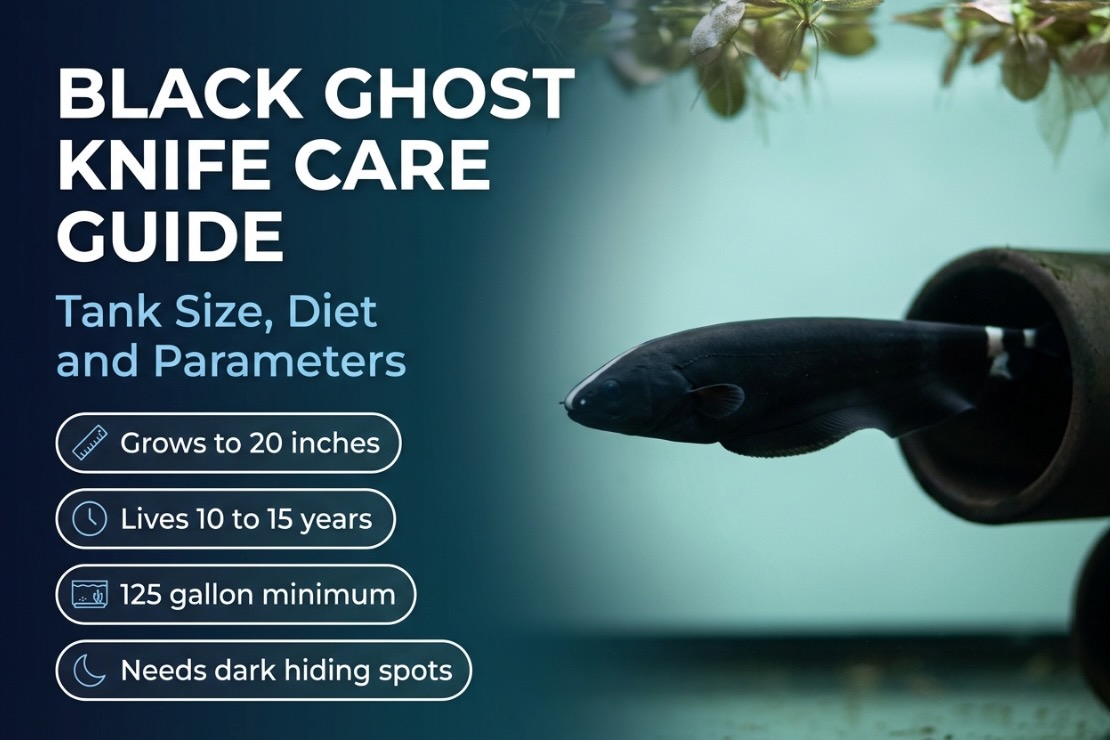
There are some fish that you keep, and then there are fish that you experience. My journey with a Black Ghost Knife Fish (Apteronotus albifrons) was one of the most rewarding and challenging experiences of my aquarium keeping life. I named him Phantom. For the first few months, he was little more than a whisper in the dark, a velvet black shadow that would only emerge from his favorite ceramic log when the lights were off. But slowly, with patience and the nightly ritual of offering bloodworms from a pair of tongs, a trust was built. Eventually, he would come out to greet me, his body flowing with an elegance that defied logic, his long, undulating fin a mesmerizing ribbon. To have this shy, nocturnal creature eventually learn to eat directly from my hand was a lesson in earning an animal’s trust.
The Ghost Knife is not a fish for the impatient; it is a creature that rewards quiet dedication with moments of pure, otherworldly magic. The Black Ghost Knife Fish is a living piece of the Amazonian night. It is not a fish for beginners, but for the dedicated aquarist, it is one of the most unique and intelligent freshwater inhabitants you can ever hope to keep.
What is the average lifespan and growth potential of this species?
The Black Ghost Knife is a long-lived predator that demands a significant commitment from any aquarist. Specifically, you can expect this fish to live between 10 and 15 years with professional grade care. Furthermore, that small juvenile will rapidly transform into a 20-inch behemoth. Consequently, I reject the assumption that they are suitable for small “starter” tanks. Therefore, you must prepare for a decade of specialized husbandry. In fact, their growth rate is explosive in the first year. As a result, you must plan for their adult size immediately.
Why is the Black Ghost Knife unsuitable for beginner hobbyists?
This species requires technical precision that far exceeds the skills of a novice keeper. Specifically, their lack of traditional scales makes them hyper-vulnerable to water fluctuations. Furthermore, they possess a shy, nocturnal nature that requires advanced observation skills. In fact, they are one of the most sensitive fish in the hobby regarding chemical treatments. Consequently, a single mistake with copper based medication can prove lethal. Therefore, I classify them as an intermediate to expert level animal. As a result, beginners should gain experience with hardier species first.
How does the electrical field assist with navigation and hunting?
The Black Ghost Knife utilizes an incredible “biological radar” to interact with its surroundings. Specifically, an organ in the tail generates a weak electrical discharge. Furthermore, electroreceptors along the body detect disturbances in this field. Consequently, the fish can “see” obstacles and prey in absolute darkness. In fact, this adaptation is a response to their naturally poor eyesight. Therefore, they do not rely on visual cues to hunt. As a result, they are perfectly adapted for the murky depths of the Amazon. Specifically, they are masters of the night.
What is the minimum tank size for a healthy adult?
Maintaining a 20 inch fish requires a massive environment of at least 125 gallons. Specifically, the horizontal length of the tank is more important than the vertical depth. Furthermore, a six-foot footprint is necessary for the fish to turn comfortably. Consequently, keeping this giant in a 55 gallon tank is an act of animal cruelty. In fact, restricted space will lead to spinal deformities and stunted growth. Therefore, I prioritize a high-volume setup for this species. As a result, you provide the swimming room they require.
Why are hiding spots and dim lighting non-negotiable?
Providing a secure sanctuary is vital for the psychological health of the Ghost Knife. Specifically, these fish are nocturnal and feel exposed under bright aquarium lights. Furthermore, you must provide specialized “Ghost Tubes” or long PVC pipes as retreats. Consequently, a fish without a dark cave will suffer from chronic stress. In fact, floating plants like Water Lettuce can help diffuse intense light. Therefore, I recommend a “blackwater-style” setup to mimic their native home. As a result, the fish will be more active and confident.
How do you manage the delicate water parameters for a Black Ghost Knife?
Maintaining pristine water quality is the most analytical challenge of keeping this species. Specifically, you must maintain a temperature between 75–82∘F and a slightly acidic pH. Furthermore, because they are scaleless, they have no barrier against ammonia or nitrites. Consequently, even low levels of nitrogenous waste will cause immediate skin irritation. In fact, I prioritize 30% weekly water changes to keep nitrates near zero. Therefore, robust filtration is mandatory for their survival. As a result, you prevent the systemic failure of their immune system.
What is the scientifically balanced diet for a Black Ghost Knife?
The Black Ghost Knife functions as a high protein carnivore that requires diverse whole foods. Specifically, you should offer frozen bloodworms, brine shrimp, and sinking carnivore pellets. Furthermore, because they are nocturnal, you must feed them after the main lights are turned off. In fact, faster daytime fish will often steal their food if you are not careful. Consequently, I recommend target feeding them with a turkey baster near their cave. Therefore, you ensure they receive adequate nutrition every night. As a result, the fish maintains a healthy weight.
Is it possible to hand feed and bond with this species?
Developing a bond with a Black Ghost Knife is one of the most rewarding aspects of the hobby. Specifically, they can learn to recognize their keeper through food association and electrical signatures. Furthermore, many individuals will eventually take food directly from your fingers or tongs. In fact, this interaction demonstrates their high level of intelligence. Consequently, you must move slowly and patiently to build this trust. Therefore, I recommend consistent evening feeding sessions to foster this relationship. As a result, the “shadow” becomes a curious pet.
Which tank mates are analytically compatible with a giant black ghost knife?
Selecting tank mates for the Ghost Knife requires a focus on size and temperament. Specifically, any fish that fits in their mouth is simply an expensive snack. Furthermore, peaceful giants like Severums or large Angelfish make ideal companions. In fact, you must strictly avoid fin-nippers that could damage their undulating anal fin. Consequently, cohabitation with other electrical fish is also discouraged. Therefore, I prioritize a single-species focus or a large community of robust fish. As a result, you avoid unnecessary aggression and stress.
Why is breeding considered nearly impossible for hobbyists?
Breeding the Black Ghost Knife in a home environment remains a benchmark that few have achieved. Specifically, they require massive spawning triggers like simulated rainy seasons and specific mineral shifts. Furthermore, their electrical fields can cause high levels of aggression between males. In fact, most commercial specimens are bred in large outdoor ponds with hormone assistance. Consequently, you should not expect a “pair” to spawn in a standard tank. Therefore, I categorize them as a “display-only” species for the average keeper. As a result, success is rare.
Black Ghost Knife Fish FAQ
They reach up to 20 inches in length and live between 10–15 years with expert-level care. That small juvenile from the pet store will become a large, impressive fish within the first year. You must plan for their adult size and lifespan from day one — this is not a fish you can upgrade tanks for later.
A minimum of 125 gallons with a six-foot horizontal footprint is required for a healthy adult. Horizontal length matters more than depth — the fish needs space to turn comfortably. Keeping a 20-inch fish in a 55-gallon tank causes spinal deformities, stunted growth, and chronic stress. It is not a matter of preference; it is a welfare issue.
Any fish small enough to fit in their mouth is a meal, not a tank mate. Safe companions include peaceful giants like Severums or large Angelfish. Strictly avoid fin-nippers that can damage their undulating anal fin, and never house two electrical fish together. A large community of robust, similarly sized fish is the safest approach.
This is completely normal — they are nocturnal fish that feel exposed under bright aquarium lighting. They require dedicated hiding spots such as Ghost Tubes or long PVC pipes at all times. A fish with no dark retreat will suffer chronic stress. Adding floating plants to diffuse light and feeding after lights-out will encourage more visible activity.
Yes — and it is one of the most rewarding aspects of keeping this species. They can learn to recognise their keeper through food association and their own electrical field detection. Many individuals will eventually take bloodworms directly from tongs or fingers. It requires consistent evening feeding sessions and slow, patient movement to build trust over time.
Sources
- Aquarium Co-Op
https://www.aquariumcoop.com/blogs/aquarium/black-ghost-knifefish - eLife
https://elifesciences.org/reviewed-preprints/88287v2 - Seriously Fish
https://www.seriouslyfish.com/species/apteronotus-albifrons/ - Aquatic Arts
https://aquaticarts.com/products/black-ghost-knifefish - Fishkeeper
https://www.fishkeeper.co.uk/fish/freshwater/miscellaneous/black-ghost-knifefish
Leave a Reply
You must be logged in to post a comment.