
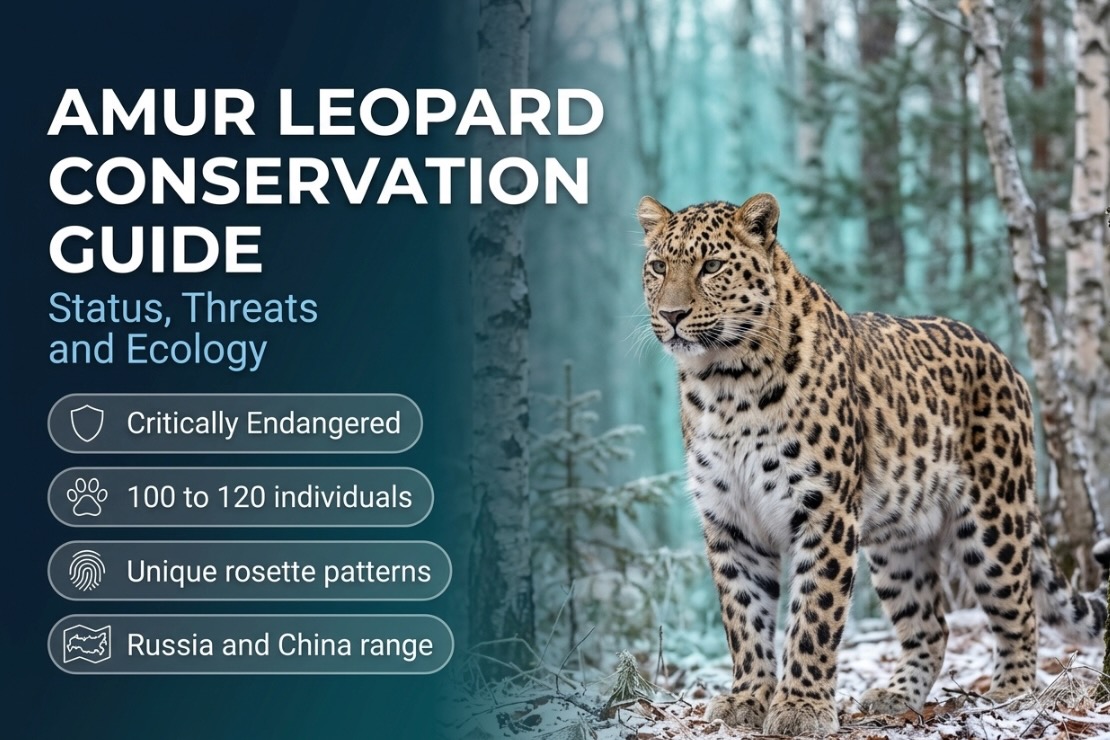
There are few animals on Earth that embody such a powerful paradox as the Amur Leopard. To clarify, to see a photograph of one is to witness perfection forged by a harsh, frozen world. It is a creature of breathtaking power andghost-like elegance. And yet, this magnificent predator is one of the most fragile beings on our planet. Its entire existence hangs by the thinnest of threads. In fact, a tiny population clings to a small patch of forest on the border of Russia and China. To know the Amur Leopard is to feel profound awe. Consequently, there is an urgent, aching need to protect it. Ultimately, its story is not just one of survival; rather, it is a story of fighting for a ghost to remain a living, breathing part of our world.
The Amur Leopard (Panthera pardus orientalis) is a symbol of resilience. Although its population fell to a critical low decades ago, now there is a glimmer of hope because of intensive Amur Leopard conservation efforts. This, therefore,is the story of their fight for survival.
What is the Current Status of Amur Leopard Conservation?

The Amur leopard is listed as Critically Endangered. For decades, it teetered on the absolute brink of extinction. Intensive conservation efforts have led to remarkable recovery. The population was as low as 30-40 individuals. Now it is estimated at 100-120 individuals today. While this is a hopeful sign, the population remains incredibly fragile.
What Are the Biggest Threats to the Amur Leopard?

The primary threats are poaching, habitat loss, and prey scarcity. Furthermore, the dangerously small gene pool compounds these issues, leading to the threat of inbreeding depression.
- Poaching: Despite protections, poaching remains a significant threat. Their stunning coat is a valuable prize on the black market.
- Habitat Loss: Additionally, their forest habitat is constantly under threat from logging, forest fires, and development.
- Prey Scarcity: Amur leopards prey on deer and boar. When these prey populations are reduced, the leopards struggle to find food. This can lead to starvation or human-leopard conflict.
- Inbreeding Depression: With such a small population, genetic diversity is dangerously low. In fact,inbreeding can lead to reduced fertility and weakened immune systems.
- Competition with Tigers: Amur leopards share their habitat with the much larger Siberian tiger. As a result, this natural competition becomes more intense when both species are confined to a shrinking landscape.
Biology and Ecology: A Ghost Forged in Ice
Amur leopards are exquisitely adapted to their cold climate. For instance, they have a much paler coat and thicker fur than other leopards. Like most leopards, furthermore, they are solitary animals. Cubs, consequently, will stay with their mother for up to two years to learn essential survival skills. Interestingly, the rosette pattern on every Amur leopard is unique, much like a fingerprint. Therefore, researchers can use photos from camera traps to effectivelyidentify and track individual leopards.
How Do Researchers Monitor Amur Leopard Conservation?

The primary monitoring tool is the camera trap. By analyzing the unique spot patterns, researchers can identify individuals and estimate population density. Furthermore, genetic analysis of scat and hair samples also provides crucial data on diet and health.
The core habitat of the Amur leopard straddles the border of Russia and China. Consequently, a groundbreaking transboundary protected area now allows for unprecedented cooperation between the two nations, which represents a huge step forward for Amur Leopard conservation.
Key Strategies in Amur Leopard Conservation
What are the most effective anti-poaching strategies?

Anti-poaching patrols and community partnerships remain the most effective tools against Amur Leopard poaching. Rangers patrol the forest regularly, and they track suspicious activity using both foot patrols and technology. In fact, many parks now equip patrol teams with GPS trackers and camera traps to monitor movement across vast, remote terrain. Consequently, poachers face a far higher risk of detection than they did decades ago.
However, patrols alone cannot solve the problem. Local communities often live alongside leopard habitat, and some historically turned to poaching for income. Therefore, conservation groups now offer economic alternatives, such as ecotourism jobs, alternative livelihoods, and education programs. This approach reduces the financial incentive to poach in the first place. As a result, communities become active partners in protection rather than a source of pressure on the species. Furthermore, stronger law enforcement and international bans on illegal wildlife trade support these efforts by making leopard parts harder to sell.
How are protected areas helping?

The establishment of Land of the Leopard National Park in Russia stands as the single most effective conservation action for this species. This park covers the vast majority of the Amur Leopard’s remaining range. Consequently, it gives the population a large, connected space to hunt, breed, and move safely.
Protected status also restricts logging, development, and uncontrolled hunting within the park boundaries. Therefore, prey species like deer and boar can recover alongside the leopards that depend on them. Furthermore, the park sits along the Russia-China border, and this location led to a groundbreaking transboundary protection agreement between the two nations. As a result, leopards can move across the border without losing legal protection halfway through their range. This kind of international cooperation represents a major step forward, since a fragmented habitat with inconsistent protection would undermine every other conservation effort.
What is the role of captive breeding programs?
Captive breeding programs function as a genetic insurance policy for the Amur Leopard. Zoos around the world maintain small, carefully managed populations outside the wild. In fact, these programs track lineage closely to preserve as much genetic diversity as possible.
This genetic diversity matters enormously, given how small and inbred the wild population has become. Consequently, captive populations offer a backup source of healthy genetics if the wild population faces a sudden collapse. Furthermore, captive-bred individuals could theoretically support future reintroduction efforts, should suitable habitat and prey populations allow for it. However, captive breeding is not a replacement for wild conservation. Instead, it works as a safety net alongside anti-poaching patrols and protected habitat, not as a standalone solution.
How Can Individuals Help?

Ultimately, you can play a role in Amur Leopard conservation.
- Donate: Support key organizations working on the ground.
- Be a Responsible Tourist: Choose tour operators that support conservation.
- Raise Your Voice: Share the Amur leopard’s story of struggle and hope.
The future of the Ghost of the Forest is more hopeful than it has been in decades. However, its survival still depends on constant vigilance and unwavering international support.
Sources
- WWF
https://www.wwf.org.uk/learn/wildlife/amur-leopards - WCS China
https://china.wcs.org/Wildlife/Amur-Leopard.aspx - WildCats Conservation Alliance
https://conservewildcats.org/2024/12/18/mutations-in-wild-amur-tigers-2/ - One Earth
https://www.oneearth.org/species-of-the-week-amur-leopard/ - Warp News
https://www.warpnews.org/human-progress/endangered-amur-leopard-population-increases-to-130-individuals/
Leave a Reply
You must be logged in to post a comment.