
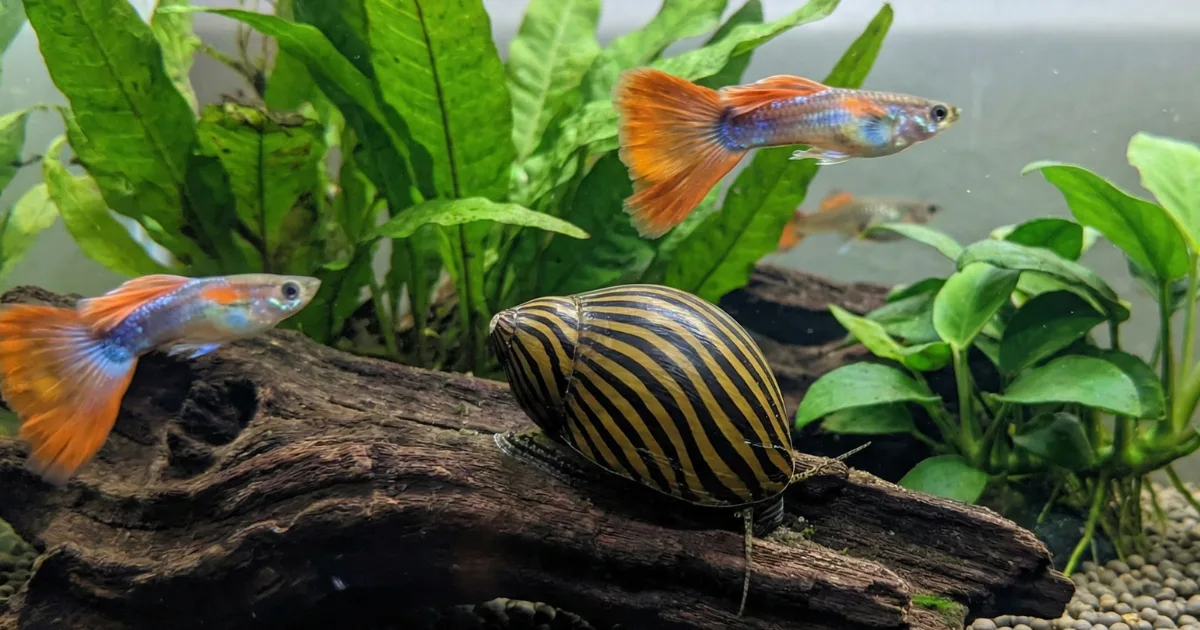
When I first got into the aquarium hobby, my focus was entirely on the fish the bright flash of a tetra, the gentle sway of a betta’s fins. Snails, to me, were just part of the cleanup crew, a functional afterthought. It wasn’t until I looked I mean really looked at a Zebra Nerite Snail that my perspective completely changed. I saw the intricate, unique patterns on its shell, a perfect series of black and gold zigzags, like a tiny piece of living art. I watched it meticulously clean a patch of algae off the glass, its slow, deliberate work a peaceful and fascinating display. It was in that moment I realized they aren’t just janitors; they are one of the most beautiful, useful, and worry-free inhabitants you can possibly add to a freshwater tank.
The Zebra Nerite Snail (Neritina natalensis) is a superstar for a reason. They are incredible algae eaters, they won’t eat your plants, and they won’t take over your tank with babies. This guide will cover everything you need to know to help these little beauties thrive.
What is the scientific origin of the Zebra Nerite snail?
The Zebra Nerite snail, known scientifically as Neritina natalensis, originates from the coastal river estuaries of Eastern Africa. Specifically, they are native to countries like South Africa, Mozambique, and Kenya. Furthermore, their evolution in these tidal areas allows them to tolerate a wide range of salinity. Consequently, this origin explains why their complex breeding cycle requires brackish water to succeed. Therefore, they are uniquely adapted to thrive in home aquaria without the risk of overpopulation. In fact, each individual possesses a bold, golden-yellow shell with unique black zigzag stripes.
How long can a Zebra Nerite survive in a home aquarium?
In a stable and healthy environment, these snails typically live for approximately two to three years. Specifically, their longevity depends heavily on the availability of minerals and consistent water parameters. Furthermore, many hobbyists underestimate the impact of diet on their lifespan. Consequently, ensuring a steady supply of natural algae is vital for their survival. Therefore, providing an established tank is much better than placing them in a brand-new setup. As a result, a well-maintained snail will remain an active cleaner for several seasons.
What are the critical water parameters for shell health?
Maintaining alkaline water is the most critical aspect of keeping the Zebra Nerite. Specifically, you must keep the pH between 7.0 and 8.2 to prevent shell erosion. Furthermore, the water must be moderately hard to provide the calcium necessary for shell growth. Consequently, acidic water will eventually cause the shell to become thin and develop white pits. Therefore, you should aim for a general hardness of at least 8 dGH. In fact, providing a reliable heater is also necessary to keep these tropical gastropods active and healthy.
What do Zebra Nerite snails eat besides algae?
These snails are premier algae eaters that specialize in consuming soft film and diatoms. Specifically, they will efficiently clean green spot algae from glass, rocks, and plant leaves. Furthermore, they are highly sought after because they do not consume healthy live plants. However, they are often picky eaters that may ignore commercial sinking pellets. Consequently, if your tank is too clean, you must supplement their diet with blanched spinach or algae wafers. Therefore, ensuring they have constant access to biofilm is the best way to prevent starvation.
Why is this species the perfect choice for planted tanks?
The Zebra Nerite is an exceptional companion for planted aquaria because it is strictly herbivorous. Specifically, they will graze on the algae growing on delicate leaves without damaging the plant tissue. Furthermore, their small bioload ensures they do not contribute significantly to nitrate buildup. Consequently, they are far more desirable than “pest” snails like Ramshorns or Bladder snails. Therefore, they provide a functional service while remaining peaceful toward all other inhabitants. In fact, they are excellent scavengers that help clean up uneaten fish food.
Do Zebra Nerite snails require a tight-fitting lid?
Yes, these snails are notorious escape artists that will frequently climb out of an open aquarium. Specifically, their natural instinct is to explore above the waterline during the night. Furthermore, they can survive for short periods outside of the water, but they will eventually dry out. Consequently, you must ensure that your tank has a secure, tight-fitting lid. Therefore, checking the rim of your tank is a good daily habit for any Nerite keeper. As a result, preventing escapes is the easiest way to avoid accidental snail loss.
How do you manage the white eggs laid in freshwater?
A major selling point of the Zebra Nerite is that they cannot reproduce in freshwater. Specifically, while females will lay small, white, sesame-seed-like eggs on decor, these eggs will never hatch. Furthermore, the larval stage requires full saltwater or brackish conditions to develop. Consequently, you will never have to worry about a population explosion in a standard tank. However, the eggs are very hard and can be difficult to remove from driftwood or rocks. Therefore, many keepers use a razor blade or credit card to gently scrape them away.
Which tank mates are safe for the Zebra Nerite?
These snails are peaceful and can be housed with almost any community fish that is not a known predator. Specifically, Bettas, Guppies, and Shrimp are excellent choices for shared housing. Furthermore, you must avoid fish like Loaches or Puffers that are specialized to eat mollusks. Consequently, large and aggressive cichlids should also be avoided to prevent the snail from being harassed. Therefore, a community of small, calm fish provides the safest environment. In fact, adding Corydoras catfish is a great way to clean the substrate where the Nerite rarely travels.
Zebra Nerite Snails FAQ
No — this is their single biggest advantage over other aquarium snails. While females lay small white eggs on decorations and glass, these eggs cannot hatch in freshwater. The larval stage requires brackish or saltwater conditions to develop, making population explosions impossible in a standard freshwater tank.
No — they are strictly herbivorous and graze only on algae growing on plant leaves, never the plant tissue itself. This makes them one of the few algae eaters safe for planted tanks. They also have a small bioload, meaning they do not contribute significantly to nitrate buildup.
This is caused by acidic water dissolving the shell over time. Zebra Nerites require a pH between 7.0 and 8.2 and moderately hard water with at least 8 dGH to maintain healthy shell growth. Soft or acidic water causes the shell to thin, pit, and eventually fail.
Yes — they are notorious escape artists that instinctively climb above the waterline at night. They can survive briefly out of water but will dry out and die if not returned. A secure, tight-fitting lid is mandatory, and checking the rim of the tank daily is a good habit for any Nerite keeper.
If the tank is too clean, they must be supplemented with blanched spinach, zucchini, or algae wafers. They are picky and may ignore commercial sinking pellets. Starvation is a genuine risk in an overly clean tank — ensuring constant access to biofilm and algae is the most important factor in their survival.
Sources
- Aquarium Source
https://www.aquariumsource.com/zebra-nerite-snail/ - Seriously Fish
https://www.seriouslyfish.com/invertebrates/ - Tropical Fish Care Guides
https://tropicalfishcareguides.com/nerite-snail-care-guide/ - Aquarium Science
https://aquariumscience.org/index.php/17-5-snails/ - Aquatic Arts
https://aquaticarts.com/pages/zebra-nerite-snail-care-guide
Leave a Reply
You must be logged in to post a comment.