
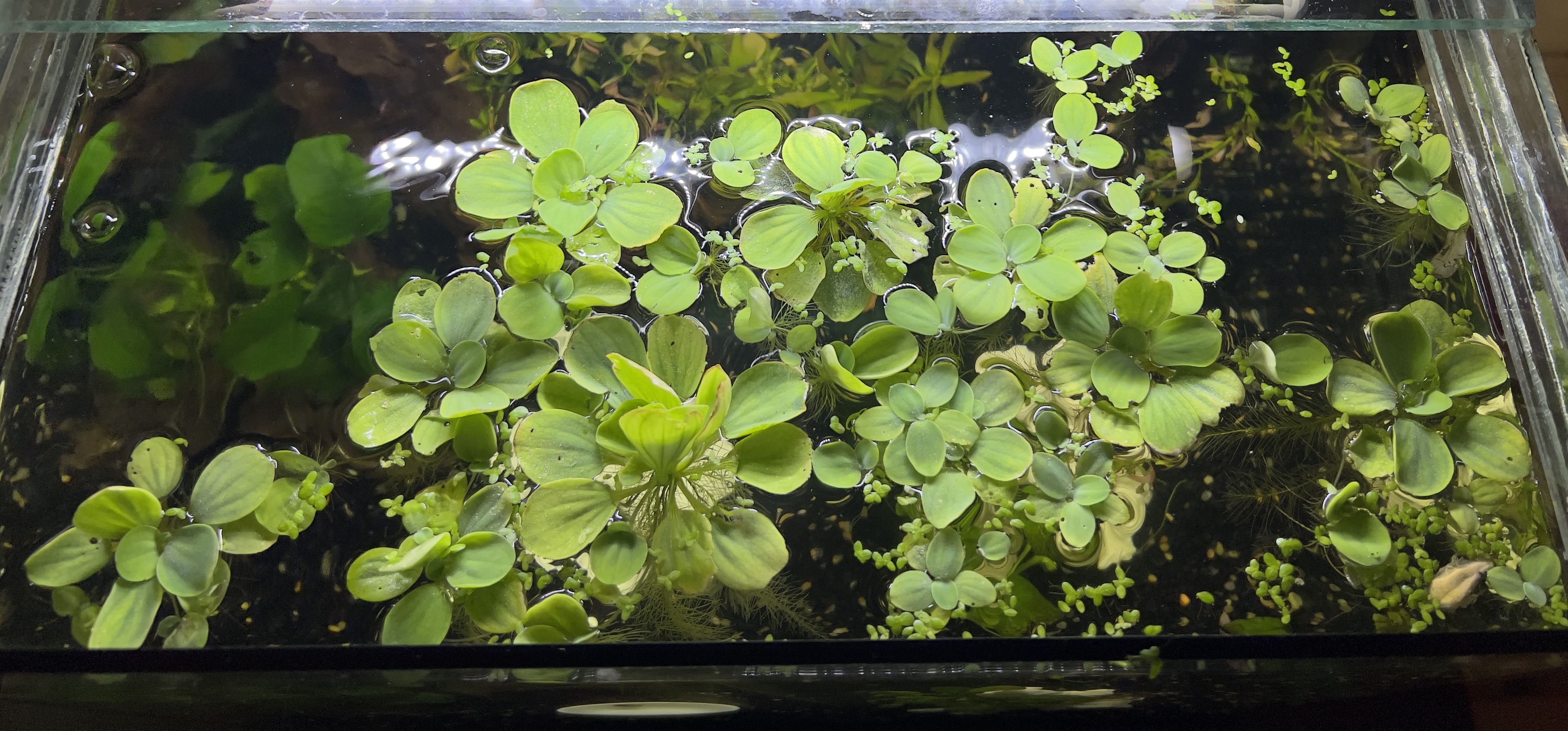
For the longest time, I thought of my aquariums as underwater worlds, focusing only on what happened beneath the surface. My perspective completely shifted when I decided to create a naturalistic home for a group of shy Honey Gouramis. They were beautiful but timid, always hiding. On a whim, I added a few small rosettes of Dwarf Water Lettuce. Within weeks, their long, feathery roots had grown into a dense, tangled jungle, and the surface was a lush green canopy. The transformation in the gouramis was astounding. They emerged from hiding, weaving through the roots with a newfound confidence, feeling safe under the shade. It didn’t just change the look of my tank; it changed the entire experience for its inhabitants, teaching me that a truly complete ecosystem has a life both above and below the water.
Water Lettuce (Pistia stratiotes), especially its smaller dwarf variety, is one of the most beautiful and functional floating plants you can add to your aquarium. Scientifically, “Dwarf” Water Lettuce is usually just Pistia stratiotes that remains small due to the limited light and nutrients of an indoor aquarium. If placed outside in a pond with full sun, “Dwarf” lettuce will often grow into the massive, cabbage sized monsters found in the wild. It’s a powerhouse of nutrient absorption and a living piece of art.
Benefits and Uses
What are the benefits of having water lettuce in an aquarium?
It is a true workhorse. Its primary benefits include being a massive “nutrient sponge” that purifies your water, providing a natural, shaded canopy that reduces stress for fish, and offering a dense root system that serves as a perfect hiding place for fry and shrimp.
Can water lettuce help control algae?
Yes, it is an algae-fighting champion. It combats algae in two powerful ways: first, by shading the tank, it limits the light that fuels algae growth on your substrate and decor. Second, as a very fast-growing plant, it aggressively consumes nitrates and phosphates from the water column, effectively starving algae of the nutrients it needs to thrive.
Does water lettuce help with nutrient export?
Absolutely. This is one of its most important functions. As the water lettuce grows, it locks up excess nutrients (like nitrates from fish waste) in its tissues. When you physically remove a handful of the plant during maintenance, you are permanently exporting those nutrients from your aquarium, which is the key to maintaining pristine water quality.
Does water lettuce provide shade for fish that prefer lower light?
Yes, this is one of its best features. The floating mat of leaves creates a natural, dappled light effect that is perfect for shy or light-sensitive fish like betta, gouramis, killifish, and many wild-type rasboras and tetras. It encourages them to be more active and feel more secure.
Can water lettuce provide hiding places for fry?
The long, feathery, tangled roots of water lettuce create the ultimate “fry jungle.” They provide an incredibly dense and safe refuge for newborn fish and shrimplets to hide from larger, predatory tank mates, significantly increasing their survival rate.
Growth and Proliferation
Why is my water lettuce dying?
The number one killer of water lettuce is excessive surface agitation. The leaves are covered in fine, water-repellent hairs, but if a strong filter output constantly splashes them or drives them underwater, the leaves will become waterlogged, rot, and the plant will die. It needs a calm water surface to survive. The second most common reason is a lack of nutrients in a very clean or new tank.
What are the ideal water parameters?
Water lettuce is highly adaptable and isn’t fussy. It will do well in most standard tropical aquariums with a temperature between 72-86°F (22-30°C) and a pH from 6.0 to 7.5.
What kind of lighting does water lettuce need?
As a floating plant, it is close to the light source and is quite light-hungry. It needs moderate to high lighting to grow well and maintain its vibrant green color. In low light, it will grow slowly and may develop yellow leaves.
Does water lettuce need fertilizer?
Yes. Because it is such a fast-growing nutrient sponge, it will often consume all the available nutrients in the water very quickly. It benefits greatly from a comprehensive liquid fertilizer, especially one rich in potassium and iron, to prevent its leaves from turning yellow or developing pinholes.
Control and Removal
How do I get rid of water lettuce?
Compared to its tiny cousin duckweed, water lettuce is much larger and significantly easier to control and remove. Manual removal with a net or your hand is the best and most effective method. it is worth noting that Water Lettuce contains Calcium Oxalate crystals. It is toxic to cats and dogs if they crunch on the leaves from an open-top tank, causing intense mouth burning and drooling.
How do I keep water lettuce from getting sucked into the filter intake?
This is a very common problem. The best solution is to create a floating corral around your filter intake or outflow. A simple ring made of airline tubing connected at the ends creates a perfect barrier that keeps the plants contained while allowing water to flow freely.
How can I prevent water lettuce from spreading to other tanks?
Practice good aquarium hygiene. Use a dedicated net and tools for the tank containing water lettuce, and wash your hands and arms thoroughly before working in another aquarium to avoid accidentally transferring a tiny plantlet.
Common Problems
Why is my water lettuce turning yellow or brown?
Yellowing leaves are a classic sign of a nutrient deficiency, most commonly a lack of potassium or iron. It can also happen to older leaves as they naturally die off.
Why are the roots of my water lettuce disappearing?
If your roots are looking trimmed and short, it’s a near-certainty that a fish is eating them. Goldfish, Silver Dollars, and even some large mollies and gouramis will happily graze on the tender roots.
Why is my water lettuce getting waterlogged and sinking?
This is almost always caused by too much surface agitation. The leaves get constantly wet, lose their buoyancy, and begin to rot from the center.
Tank Mates and Species Information
Are there any fish that will eat water lettuce?
Yes, herbivorous fish like goldfish and some species of cichlids will readily eat the entire plant.
Is it true that water lettuce is considered invasive?
Yes, this is critically important. Pistia stratiotes is a highly invasive species in many parts of the world, especially in warmer climates like Florida and Texas. It can completely choke out natural waterways, killing native plants and wildlife. Never, ever release it into the wild. Dispose of unwanted plants by composting them or sealing them in a bag and putting them in the trash.
What is the difference between water lettuce and frogbit?
They are often confused but are easy to tell apart. Water lettuce has velvety, ribbed leaves that grow in a rosette, resembling a tiny head of lettuce. Amazon Frogbit has smooth, glossy, round leaves.
How can I make sure my water lettuce gets enough air circulation?
It’s important to have a small gap between the surface of the water lettuce and the aquarium lid. If condensation constantly drips on the leaves, it can cause them to rot. Good air circulation prevents this.
Water Lettuce (Pistia stratiotes) Care FAQ
Water lettuce is a fast-growing floating plant that absorbs nitrates, phosphates, and ammonia directly from the water column, making it one of the most effective natural filtration tools available. Its dense root system creates shelter for fry and shrimp, while its floating canopy provides shade that reduces stress in light-sensitive fish.
Excessive surface agitation is the most common cause of water lettuce dying in an aquarium. Strong filter outputs or powerful bubblers constantly splash and submerge the leaves, which are covered in fine water-repellent hairs, causing them to become waterlogged and rot. A calm water surface is non-negotiable for this plant’s survival.
Yes, water lettuce contains calcium oxalate crystals, which are toxic to cats and dogs if ingested. Contact with the plant causes intense mouth burning, excessive drooling, and irritation of the mouth and throat. Owners with open-top tanks and free-roaming pets must ensure animals cannot reach or chew on the plant’s leaves.
Manual removal during regular maintenance is the most effective method for controlling water lettuce. Use a net to skim excess plants from the surface every few days before they multiply further. Creating a floating airline tubing ring around your filter intake also prevents plants from being drawn into and clogging the filter mechanism.
Yes, Pistia stratiotes is classified as a highly invasive species in warm climates, including Florida and Texas, where it can completely blanket natural waterways and kill native plant life. Never release water lettuce into local ponds, rivers, or drainage systems. Dispose of it by composting or sealing it in a bag for the trash.
Yes, Pistia stratiotes is classified as a highly invasive species in warm climates, including Florida and Texas, where it can completely blanket natural waterways and kill native plant life. Never release water lettuce into local ponds, rivers, or drainage systems. Dispose of it by composting or sealing it in a bag for the trash.
Sources
- University of Florida IFAS (Water Lettuce)
https://plants.ifas.ufl.edu/plant-directory/pistia-stratiotes/ - Aquarium Co-Op (Floating Plants Care)
https://www.aquariumcoop.com/blogs/aquarium/floating-plants - Buce Plant (Floating Plant Guide)
https://buceplant.com/blogs/aquascaping-guides-and-tips/top-5-floating-aquarium-plants - Pond Informer (Water Lettuce Growth)
https://pondinformer.com/water-lettuce-pistia-stratiotes/ - ASPCA (Water Lettuce Toxicity)
https://www.aspca.org/pet-care/animal-poison-control/toxic-and-non-toxic-plants/water-lettuce


Leave a Reply