

In a quiet corner of the aquarium world, a tiny, vibrant city bustles with activity. This is the world of Neocaridina shrimp. Including species from the brilliant Red Cherry all the way to the deep Blue Dream, these small invertebrates function as a fantastic cleanup crew, a fascinating breeding project, and a splash of living color for any peaceful tank. Though they are often considered the perfect “starter shrimp,” their simple care is, nonetheless, balanced by a real sensitivity. Consequently, this guide will answer all your questions, from setting up your first colony to the secrets of their care.
The Tiny World I Can’t Wait to Rebuild
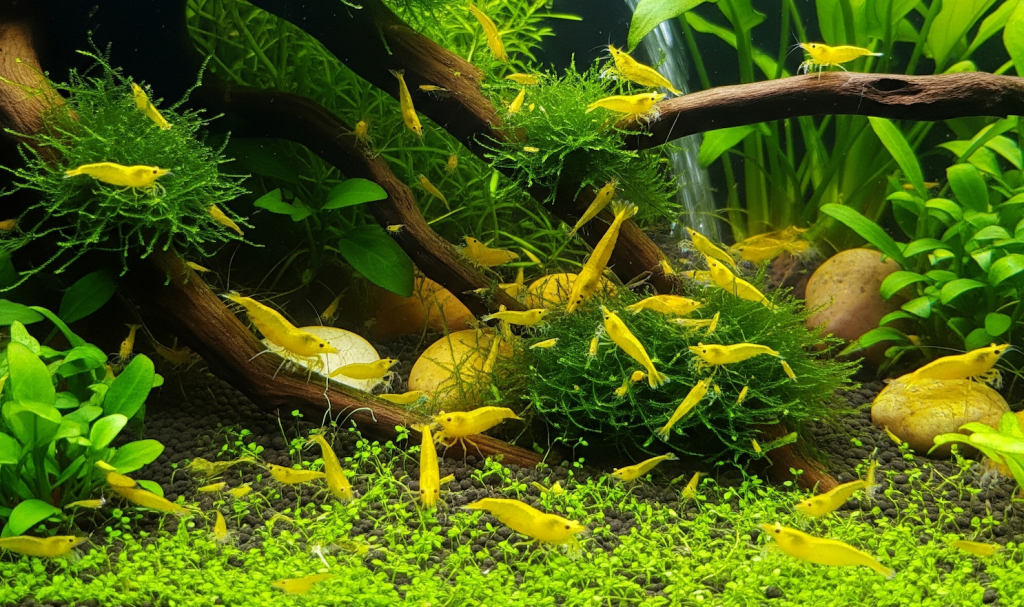
My 5-gallon Neocaridina shrimp tank was one of the most mesmerizing ecosystems I’ve ever kept. It was a tiny, bustling city populated by my colony of Golden-striped Yellow Neocaridinas, with each one a tiny jewel going about its important business. The experience was, indeed, incredible. Then, however, I learned a hard and swift lesson in their delicacy. One day, in a rush, I performed a slightly larger than usual water change; the parameters shifted just enough.Consequently, over the next few weeks, I watched my bustling city slowly quiet down as the shrimp began to disappear.
It was a heartbreaking mistake. Nevertheless, that experience taught me a profound respect for their sensitivity. I’m eager to get back into shrimp keeping soon, armed with that hard won knowledge and ready to give them my full, undivided attention. This guide is built on that lesson for you to start your journey with the stable foundation they deserve.
What is the Minimum Tank Size for Neocaridina Shrimp?
While they are tiny, stability is key.
- Minimum Size: For this reason, a 5-gallon (approx. 20 liters) tank is a great starting point for a small colony.
- Recommended Size: Ideally, a 10-gallon (40-liter) tank is preferable, as the larger water volume directly contributes to maintaining stable water parameters, which is the most critical factor for shrimp health.
What Kind of Filter is Best for a Shrimp Tank?
A gentle sponge filter is the undisputed king of the shrimp tank. But why?
- It’s Safe: First and foremost, it has no intake slots that can suck up and kill tiny baby shrimp (shrimplets).
- It’s a Buffet: Furthermore, the sponge becomes a massive surface area where biofilm and microorganisms can grow, thereby providing a 24/7 natural food source for your shrimp.
- Alternative: However, if using a hang-on-back filter, you must, as a mandatory precaution, cover the intake with a pre-filter sponge to ensure it is shrimp-safe.
What Water Parameters Do Neocaridina Shrimp Need?
This is the most important part of their care. They are sensitive to fluctuations.
- Temperature: They are adaptable but do best with a stable temperature between 70-78°F (21-26°C). A heater is recommended to prevent swings.
- pH: 6.5 – 7.5
- GH (General Hardness): 6 – 8 dGH. This is crucial for their shells.
- KH (Carbonate Hardness): 2 – 4 dKH. This helps keep the pH stable.
- TDS (Total Dissolved Solids): 150 – 250 TDS.
- Ammonia/Nitrite/Nitrate: 0 / 0 / <20 ppm.
Is My Tap Water Safe for My Shrimp?
Maybe, but you must treat it. This is because tap water contains chlorine or chloramine, which is lethal to shrimp.Consequently, you must use a high-quality water conditioner that neutralizes both. Furthermore, if your tap water is very soft or very hard, using RO/DI water remineralized with a shrimp-specific product is the best way to achieve perfect parameters.
How Do I Acclimate New Neocaridina Shrimp?
This is a life-or-death step. Drip acclimation is, therefore, the only safe method. This is due to the fact that shrimp are extremely sensitive to sudden changes in water parameters. The process, consequently, involves using a piece of airline tubing to slowly drip your tank water into the container with the new shrimp. This must be done over 1-2 hoursto gradually equalize the parameters before netting them. Once complete, you can then place them in their new home.
What Should I Feed My Shrimp?
Neocaridina Shrimp are scavengers. Their primary food is biofilm, the slimy layer that grows on all surfaces.However, supplement this 2-3 times a week with a high-quality, specialized shrimp food, blanched vegetables (zucchini, spinach), and algae wafers.
How often should I feed them?
Do not overfeed. This is the most common mistake. Instead, feed a tiny amount that they can finish in an hour or two.
Are shrimp foods with copper safe?
No. Copper is lethal to all invertebrates. Therefore, always check the ingredients of any fish food you use in a shrimp tank.
How Can I Get My Neocaridina Shrimp to Breed?
If your shrimp are healthy and in a stable, mature tank, they will breed automatically.
How can I tell male from female?
Neocaridina shrimp females are larger, more intensely colored, and have a rounded underbelly. They may have a visible yellow or green “saddle” on their back, which are undeveloped eggs. Males are smaller, less colorful, and have a straight under belly.
What are the signs of a female carrying eggs?
A female carrying fertilized eggs is called “berried.” You will see a cluster of tiny eggs tucked under her tail, which she will constantly fan to keep oxygenated.
What should I do after the baby neocaridina shrimp hatch?
Nothing! The shrimplets are miniature adults and will immediately begin feeding on the biofilm in the tank. A mature, well-planted tank is the best nursery.
Why Are My Shrimp Dying? (Troubleshooting)
Why are my shrimp dying for no reason?
This is almost always a water parameter issue. A large, sudden water change can cause TDS shock.
What is a failed molt?
Shrimp need to shed their exoskeleton to grow. A “failed molt” (often seen as a white ring around their body) happens when they get stuck, and it is usually fatal. It’s caused by incorrect GH levels (a lack of calcium and other minerals in the water).
Why are my shrimp at the surface?
This is a bad sign, usually indicating a lack of oxygen or a toxin (like ammonia) in the water. Test your water immediately.
Can I Keep Different Colors of Neocaridina Together?
The Science:
All common color morphs—Red Cherry, Blue Dream, Yellow, Black, Orange, etc.—are the same species, Neocaridina davidi.
What happens if I mix them?
They will interbreed freely. However, the offspring will not be a beautiful rainbow mix. Over generations, the colony will revert to its “wild type” form, which is a mostly clear or brownish, camouflaged shrimp.
The Rule:
If you want to maintain a pure, vibrant color, you must keep only one color variety per tank.
Neocaridina Shrimp Care FAQ
Neocaridina shrimp are extremely sensitive to sudden parameter changes, making drip acclimation the only safe transfer method. Standard float-and-dump acclimation causes immediate physiological shock and rapid death. Drip acclimation over one to two hours equalizes parameters gradually, giving the shrimp time to adjust without stress.
A failed molt occurs when a Neocaridina shrimp becomes trapped inside its old exoskeleton during the shedding process and is almost always fatal. It is directly caused by incorrect General Hardness (GH) levels in the water, specifically a lack of calcium and other essential minerals the shrimp needs to build and shed its shell properly.
Neocaridina shrimp require stable water with a temperature of 70–78°F (21–26°C), a pH of 6.5–7.5, a General Hardness of 6–8 dGH, and a carbonate hardness of 2–4 dKH. Ammonia and nitrite must remain at zero, with nitrates kept below 20 ppm. Parameter stability matters far more than achieving exact numbers.
Copper is lethal to all invertebrates, including Neocaridina shrimp, even in trace amounts. Many standard fish foods, fertilizers, and medications contain copper as an ingredient, making label checking a non-negotiable habit for any shrimp keeper. A single dose of copper-contaminated product in a shrimp tank can wipe out an entire colony within hours.
Mixing different Neocaridina shrimp colors causes the colony to lose its color over successive generations. All popular color morphs, including Red Cherry, Blue Dream, and Yellow, are the same species and interbreed freely. Offspring revert toward the wild-type form, which is a mostly transparent or brownish camouflage coloration with no market value.
A sponge filter is the best choice for a Neocaridina shrimp tank. It has no intake slots that can kill newborn shrimplets, and its surface grows biofilm that provides a constant natural food source. Any hang-on-back filter used in a shrimp tank must have the intake covered with a pre-filter sponge.
Neocaridina shrimp are scavengers whose primary food source is the biofilm that grows naturally on all tank surfaces. Supplement biofilm with specialized shrimp food, blanched vegetables such as zucchini and spinach, and algae wafers two to three times per week. Overfeeding is a serious mistake that spikes ammonia levels and destabilizes the tank.
Sources
- The Shrimp Farm (Care Guide)
https://www.theshrimpfarm.com/posts/shrimp-care-guide-red-cherry-shrimp/ - Aquarium Breeder (Neocaridina Parameters)
https://aquariumbreeder.com/red-cherry-shrimp-detailed-guide-care-diet-and-breeding/ - Buce Plant (Acclimation Guide)
https://buceplant.com/blogs/aquascaping-guides-and-tips/how-to-acclimate-shrimp - Aquarium Co-Op (Feeding Shrimp)
https://www.aquariumcoop.com/blogs/aquarium/shrimp-feeding - Aquarium Breeder (White Ring of Death)
https://aquariumbreeder.com/dwarf-shrimp-and-molting-problems-the-white-ring-of-death/ - Garnelio (Shrimp Genetics) https://www.garnelio.de/en/blog/shrimp/crossing-table-for-neocaridina

Leave a Reply