
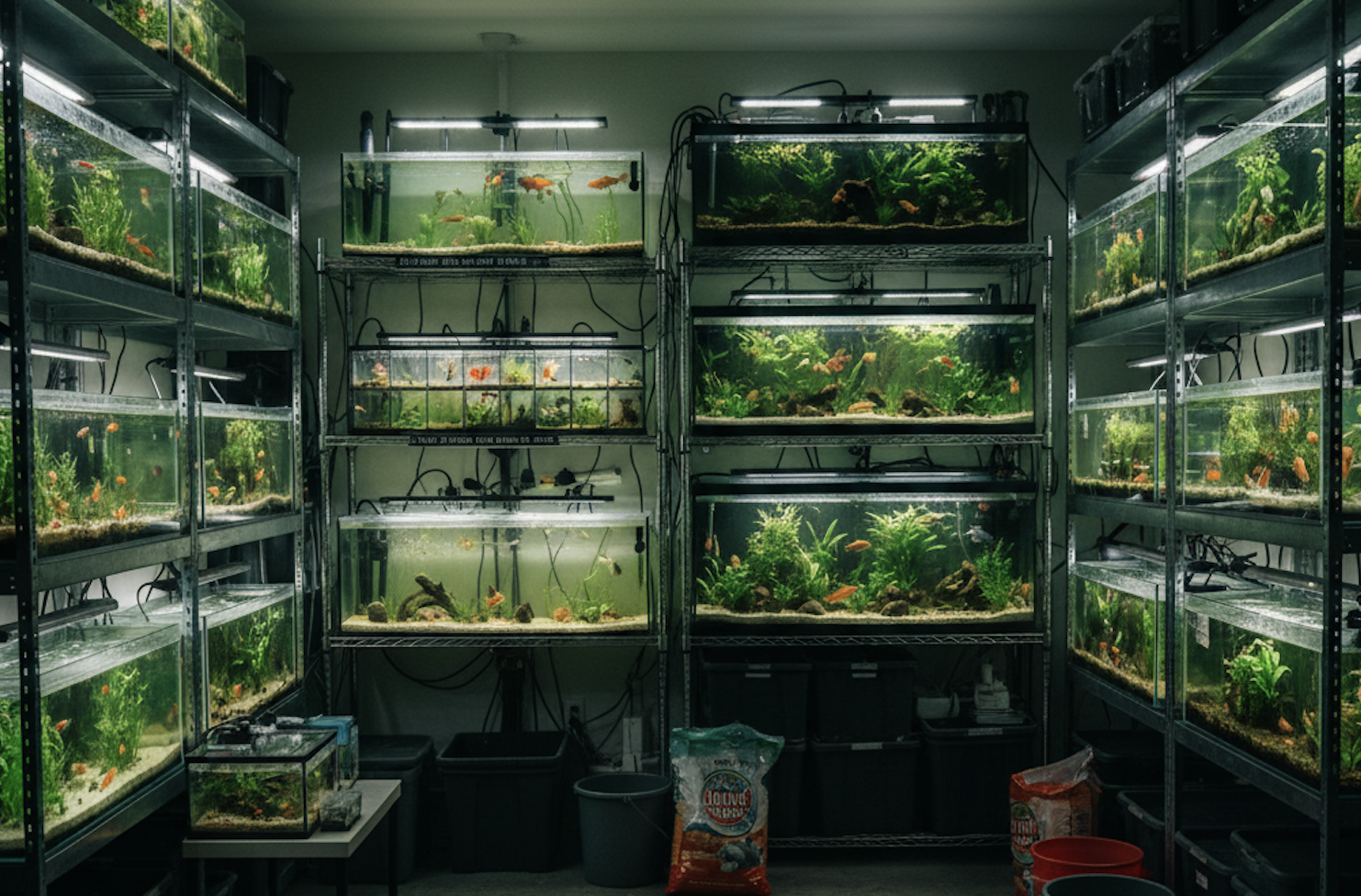
It begins with a single, innocent aquarium. A modest 20-gallon, perhaps. It is a source of joy and tranquility. But then, a thought creeps into your mind and a dangerous and seductive whisper: “What if I got a small tank just for shrimp?” And just like that, you are on the slippery slope to a full-blown case of Multiple Tank Syndrome (MTS). This phenomenon is the “disease” every aquarist jokes about, a progressive, behavioral condition characterized by the unstoppable urge to acquire more tanks. Therefore, this guide is your diagnostic manual, a support group, and an exploration into the glorious madness of this beautifully incurable affliction.
I’m Not in Denial, I’m Just Expanding My Research
My name is Noha, and I have a problem. My problem is that I have run out of walls.
It started with one tank. Then I needed a quarantine tank (for responsible fishkeeping, of course). Next, I needed a dedicated breeding tank for my Swordtails. Finally, I decided to start a species-only Betta world. My home is no longer a collection of rooms; instead, it is a collection of potential tank stands. I have found myself staring at a perfectly good bathroom counter and thinking, “You know, with the right lighting, this would be an excellent spot for a nano shrimp tank.” I’ve even measured floor joists. My family calls it an obsession. I call it an “expansion of my aquatic research portfolio.” This guide is for every other researcher out there who is just one tank away from a major breakthrough.
How is Multiple Tank Syndrome (MTS) Diagnosed?You may be in the early stages of MTS if you experience three or more of the following:
- Finally, you have ever uttered the phrase, “But it’s only a 10-gallon! It barely even counts.”
- You know the pH and GH of your tap water by heart, yet you can’t remember your own wedding anniversary.
- You view any empty horizontal surface in your home not as a place for a lamp or a book, but as a “potential tank stand.”
- You get more excited about a new shipment of driftwood at your local fish store than you do about your own birthday.
- Furthermore, you have started referring to your various tanks by their function (“the shrimp tank,” “the cichlid tank,” “the quarantine tank”).
What Are the Stages of MTS?
MTS is a progressive condition.
Stage 1: The Gateway Tank. The first aquarium. At this stage, you believe this single, beautiful community tank will be enough to satisfy you for the rest of your life. You are adorably naive.
Stage 2: The “Justification” Tank. Next, you acquire a second, smaller tank for a very logical and responsible reason. The most common justification is, “It’s a quarantine tank to protect my main display!” Alternatively, another popular excuse is, “It’s a breeding tank for my Guppies!” This marks the point of no return.
Stage 3: The Specialization Phase. Following this, you realize you cannot keep all the fish you love in one tank. You now have a “hard water livebearer tank” and a separate “soft water blackwater tank.” Furthermore, you may add a dedicated shrimp tank. Your identity has shifted from “person with a fish tank” to “aquarium hobbyist.”
Stage 4: Full-Blown MTS. Finally, you are no longer buying tanks; instead, you are buying industrial shelving units. You have a dedicated “fish room,” likely in a basement or a garage, where the hum of filters is a constant symphony. You buy fish food in bulk. Your water bill is a source of constant mystery and dread to your family.
How Do You “Treat” MTS?

First, it’s crucial to understand that there is no “cure” for MTS. There is only management.
Experimental and Unproven Treatments
- Spousal Intervention: This is a common but notoriously ineffective treatment, often resulting in complex negotiations involving new shoes or home renovation projects.
- Financial Reality Check: Although looking at your bank account after a trip to the fish store can induce a temporary remission, it is rarely a long-term solution.
Palliative Care: Managing the Symptoms
Since a cure is not an option, the goal is to make living with the condition as efficient as possible.
The Consolidation Strategy (Go Big, Not Wide): This is, arguably, the most effective management tool. Instead of buying five separate 20-gallon tanks, sell them all and buy one massive 125-gallon tank. This approach gives you the satisfaction of a major project, allows for a stunning showpiece, and simultaneously consolidates your maintenance into one (admittedly very large) location.
The Automation Strategy: Next, invest in technology to reduce the daily grind. Automatic water changers, dosing pumps for fertilizers, and automatic feeders can turn the chore of managing multiple tanks into a more automated process.
The “One In, One Out” Rule: Alternatively, this is a difficult but disciplined approach. You are not allowed to set up a new tank until you have sold or broken down an existing one. However, this method is highly theoretical and has a very low success rate in clinical trials.
Acceptance: The final stage of treatment is acceptance. Accept that your house is now an aquatic sanctuary. Embrace the gurgling sounds of your sump, the slightly elevated humidity, and the fact that you are now a full-time, dedicated zookeeper.
Is There a Permanent Cure for MTS?
Yes. A bigger house!
Sources
- Aquarium Co-Op (A major source for hobbyist culture)
https://www.aquariumco-op.com/blogs/aquarium/multiple-tank-syndrome - The Spruce Pets (Discusses managing multiple tanks)
https://www.thesprucepets.com/managing-multiple-tanks-1378486 - Practical Fishkeeping
https://www.practicalfishkeeping.co.uk/ - Reef2Reef (Community forum where MTS is a constant joke)
https://www.reef2reef.com/ - FishLore (Another major forum discussing MTS)
https://www.fishlore.com/



Leave a Reply