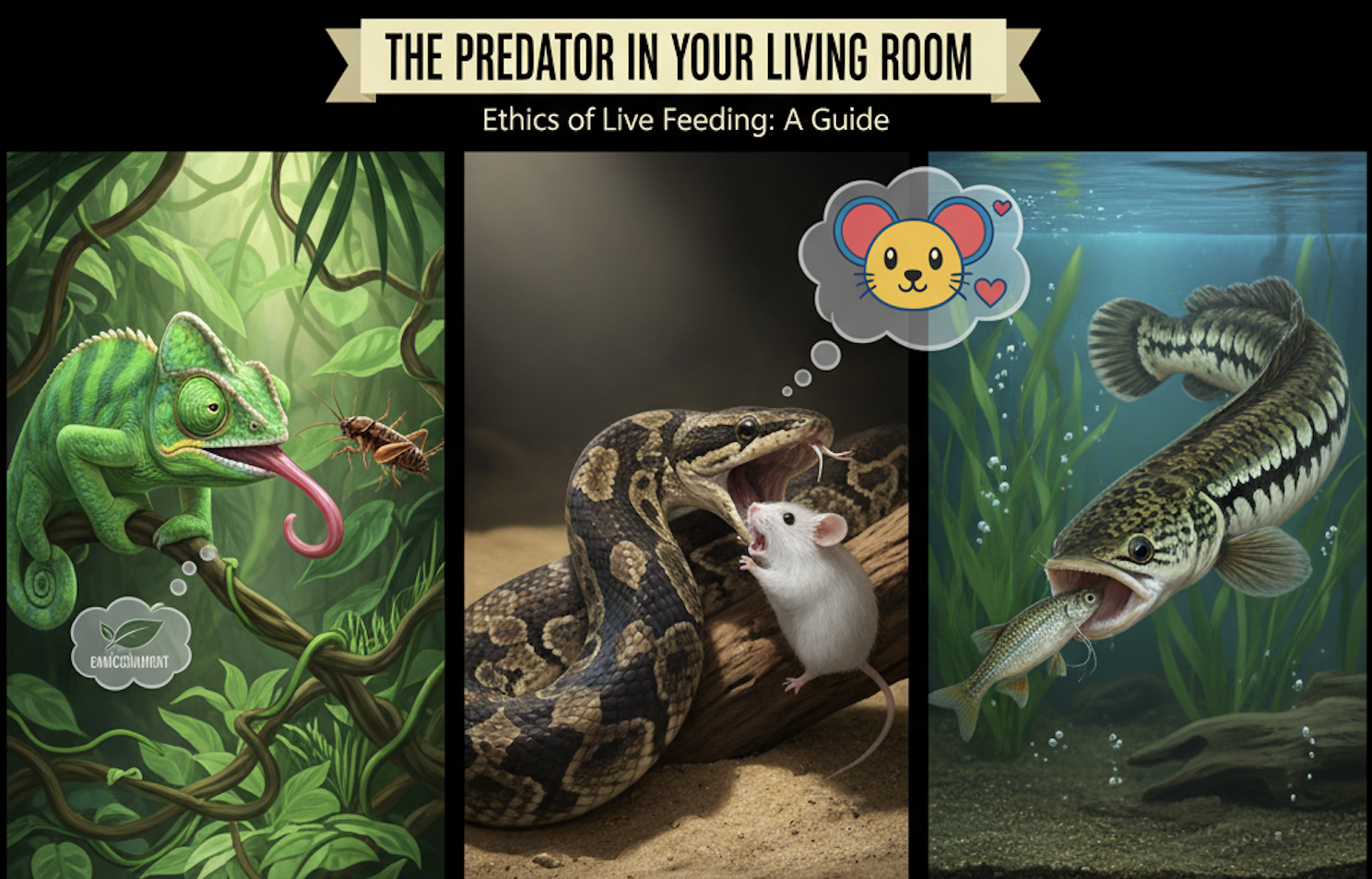
Every keeper of a carnivorous pet faces this moment: a snake’s tongue flicks, a chameleon focuses its gaze, a predator fish makes a swift dart, and then, a life ends. You feed your beloved pet, and in doing so, you facilitate a hunt. For many, this moment provides immense fascination, but for just as many, it creates profound guilt and ethical turmoil. Is feeding live prey humane? Is it necessary? Therefore, this guide offers an honest exploration of one of the hobby’s most challenging aspects.
The Hierarchy of Cuteness
My life is a complicated, and often hypocritical, food chain. I will spend an entire afternoon cultivating a thriving colony of dubia roaches. I will give them the best food, the best hydration, and ensure they are happy and healthy. And then I will take one of them, without a shred of guilt, and offer it to my grumpy chameleon, Cosmo. I watch the hunt with a sense of scientific fascination. But the day I had to consider feeding a fuzzy mouse to a snake? That’s when my brain’s “Hierarchy of Cuteness” kicked in and started screaming protests. It’s a hilarious, illogical, and deeply human contradiction. We will defend the life of one animal while serving another as its lunch. It is the central, uncomfortable truth of this hobby. This guide is for everyone who has ever wrestled with that uncomfortable, ethically squishy reality.
Why is live feeding Even a Debate?
The fundamental conflict lies between two competing desires. We want to provide the most natural and stimulating life for our predatory pets, yet we also want to prevent suffering in all animals, including the ones destined to become food. Finding that balance is the core of responsible carnivore husbandry.
Live Feeding: A Look at Common Scenarios
Why are chameleons fed live crickets and roaches?
For an insectivore like a chameleon, the “live” part of the meal is essential enrichment.
The Hunt: The movement of a live cricket triggers a chameleon’s natural, hardwired hunting instincts. The swiveling eyes, the slow stalk, the lightning-fast launch of the tongue—this is a complex behavioral sequence that a dead insect simply cannot replicate. It provides crucial mental and physical stimulation.
How does the prey die? It’s incredibly fast. The chameleon’s tongue is a muscular hydrostat that hits with force, stunning the insect. The powerful jaws then crush the insect’s exoskeleton almost instantly.
Snakes: Why do some people feed live mice?
This is the most ethically fraught scenario. While the vast majority of snakes in captivity can and should be fed frozen/thawed mice, some keepers opt for live prey.
The Claim: Some argue it’s more “natural” or that it’s the only way to get a picky snake to eat.
The Reality: Feeding live rodents is not only a prolonged and terrifying experience for the prey, but it is extremely dangerous for the snake. A cornered, frightened rodent will fight for its life, and its sharp teeth and claws can inflict horrific, and sometimes fatal, injuries on the snake.
How does the prey die? A snake is a constrictor. It strikes and then coils its body around the prey, cutting off blood flow to the brain, which leads to a very rapid loss of consciousness. However, the moments leading up to this are filled with terror for the rodent.
Is feeding live fish and worms cruel?
Feeder Fish (like guppies or minnows): This practice is questionable. Live feeder fish from pet stores often carry diseases and parasites because of poor living conditions, and they can introduce these into your aquarium. Furthermore, the chase stresses both the predator and the prey.
How does the prey die? Predatory fish like my Channa are incredibly efficient. The strike is instant. They will often kill or swallow the prey fish in a single, powerful motion.
Live Worms: This is generally considered much more acceptable. Worms have a very simple nervous system and their death is instantaneous. They provide excellent enrichment value for fish without the same level of ethical baggage as a vertebrate feeder.
Is Feeding Frozen/Thawed Prey More Humane?
You can’t live feed your pet, so you consider frozen prey. The most common and understandable fear is that the process of producing frozen rodents is cruel. The word that often comes to mind is “suffocation.” This is a crucial and tragic misunderstanding of the actual process. Suffocation is the terrifying, conscious struggle for air, a state of panic caused by oxygen deprivation. Humane euthanasia with carbon dioxide (CO₂), the industry standard, is not suffocation; it is a form of anesthesia that leads to a peaceful death.
Let’s break down the process
It is an Anesthetic, Not a Poison
Carbon dioxide is a natural component of the air we breathe. However, in very high concentrations, it acts as a powerful anesthetic agent. Crucially, it does not cause pain or burning; it rapidly induces a state of unconsciousness.
Unconsciousness Precedes Death
When the rodents are exposed to a high concentration of CO2, the gas causes a rapid increase of CO2 in the bloodstream, a state called hypercapnia. This state of hypercapnia has a direct and immediate anesthetic effect on the brain, causing a rapid loss of consciousness, much like the anesthesia a patient receives before surgery.
Bypassing the Panic Response
The animal’s brain is effectively “put to sleep” before the body’s natural panic response to a lack of oxygen (hypoxia) can even begin. Therefore, they do not struggle for air because they are not conscious that oxygen is being displaced.
A Peaceful Cessation
Once the animal is unconscious, the continued presence of the CO2 quickly and painlessly causes all brain and heart function to cease.
This method is not a random approach created by feeder breeders. Rather, it is the euthanasia technique for laboratory rodents that is endorsed by the American Veterinary Medical Association (AVMA) and many other prominent animal welfare organizations globally, as it has been demonstrated to be the most compassionate, swift, and pain-free option available. As a result, many hobbyists choose this method over live feeding, understanding the importance of minimizing suffering.
The Two Core Benefits of This Humane Choice
Zero Suffering for the Prey: This is the most important ethical consideration. The animal feels no fear, no panic, and no pain. It goes from a conscious state to an unconscious one in a matter of seconds, and then passes away. This stands in stark, brutal contrast to the terror and potential agony a live rodent experiences when constricted by a snake.
100% Safety for Your Pet: This is the most important practical consideration for you as a keeper. A frozen/thawed rodent is completely incapacitated. It cannot bite, scratch, or injure your snake. A live rat, especially one that is cornered and fighting for its life, is a formidable and dangerous animal. It can inflict horrific, deep bites on a snake’s face, eyes, or body. These bites can lead to severe, abscessed infections that require expensive veterinary care and can sometimes be fatal to the snake. Every single time you offer live prey, you are rolling the dice on your pet’s safety. Feeding frozen/thawed eliminates that risk entirely.
Convenience and Health
Beyond the ethics and safety, frozen/thawed prey is simply better for husbandry. First, they are easy to buy in bulk and you can store them for months in a dedicated freezer. Furthermore, the process of flash-freezing also kills many potential parasites that a live rodent could carry.
The vast majority of snakes in captivity, from the tiniest hognose to the largest python, can and should eat frozen/thawed prey. The idea that snakes “need” to hunt live prey is a myth born from our own desire to witness a dramatic spectacle. A responsible and ethical keeper’s priority isn’t the thrill of the hunt, but rather the health and safety of their beloved pet and the humane treatment of every animal involved in its care. Making the switch to frozen/thawed is a hallmark of that commitment.
How Do I Overcome the Guilt of live feeding?
Respect the Predator: Accept the fundamental nature of the animal you chose to keep. Your snake is an obligate carnivore; it is not, and never will be, a vegan. To deny it the food it is biologically designed to eat would be the greater cruelty.
Focus on the Feeder’s Welfare: The most ethical approach is to ensure the feeder animal has the best possible life, right up until the end. For insects, this means “gut-loading”—feeding them a highly nutritious diet so they are healthy and pass on that nutrition to your pet.
Choose the Most Humane Method: Whenever possible, choose a non-live option. For snakes, this means using frozen/thawed rodents. For fish, this means using high-quality frozen foods like bloodworms and brine shrimp instead of live feeder fish.
Reframe Your Role: You are not a villain. You are a responsible keeper facilitating a natural process in the most humane way possible. Your role is to ensure your pet gets the nutrition and enrichment it needs to thrive, while minimizing the suffering of the animals it needs to consume.
Live Feeding FAQ
Live insect feeding is widely considered ethical and necessary for insectivorous reptiles like chameleons. The movement of live prey directly triggers a hunting behavioral sequence the animal is neurologically hardwired to perform. Denying this form of live feeding removes critical mental and physical stimulation from the animal’s daily experience.
Live feeding mice to snakes is actively dangerous for the snake, not just the prey. A cornered rodent will bite and scratch defensively, inflicting severe wounds that can become infected or prove fatal. Frozen-thawed rodents eliminate this risk entirely while providing identical nutritional value to the predator.
Frozen prey is significantly more humane than live feeding for vertebrate animals like rodents. Commercial frozen rodents are euthanized using carbon dioxide, which induces rapid unconsciousness before death, causing no pain or panic. The animal never experiences the terror or physical trauma associated with live predation.
CO2 euthanasia does not cause suffocation; it functions as a rapid anesthetic. High concentrations of carbon dioxide induce unconsciousness within seconds by triggering hypercapnia in the bloodstream, shutting down brain function before the body can register oxygen deprivation. The animal has no conscious experience of the process.
Live feeder fish from pet stores carry a significant disease and parasite transmission risk, making this practice questionable for health reasons alone. The chase stresses both animals, and the welfare of commercially bred feeder fish is often extremely poor. High-quality frozen alternatives like bloodworms provide comparable enrichment without these risks.
Guilt from live feeding often stems from applying human emotional frameworks to an obligate carnivore’s biological needs. A keeper’s ethical responsibility is to minimize suffering through the most humane feeding method available, not to alter the predatory nature of the animal. Choosing frozen-thawed prey where possible represents the most responsible resolution to that conflict.
Gut-loading means feeding feeder insects a highly nutritious diet for 12 to 24 hours before offering them as live food. The nutritional content of the insect transfers directly to the reptile consuming it, making feeder quality a direct variable in the predator’s overall health. A malnourished feeder insect provides a nutritionally hollow meal.
Sources
- Chameleon Academy (Feeding)
https://chameleonacademy.com/chameleon-feeding/ - RSPCA (Snake Feeding Guidelines)
https://kb.rspca.org.au/knowledge-base/what-should-i-feed-my-pet-snake/ - AVMA Guidelines for the Euthanasia of Animals (2020 Edition)
https://www.avma.org/sites/default/files/2020-01/2020-Euthanasia-Guidelines.pdf - WetWebMedia (Thiaminase in Feeder Fish)
http://www.wetwebmedia.com/ca/volume_6/volume_6_1/thiaminase.htm

Leave a Reply
You must be logged in to post a comment.