
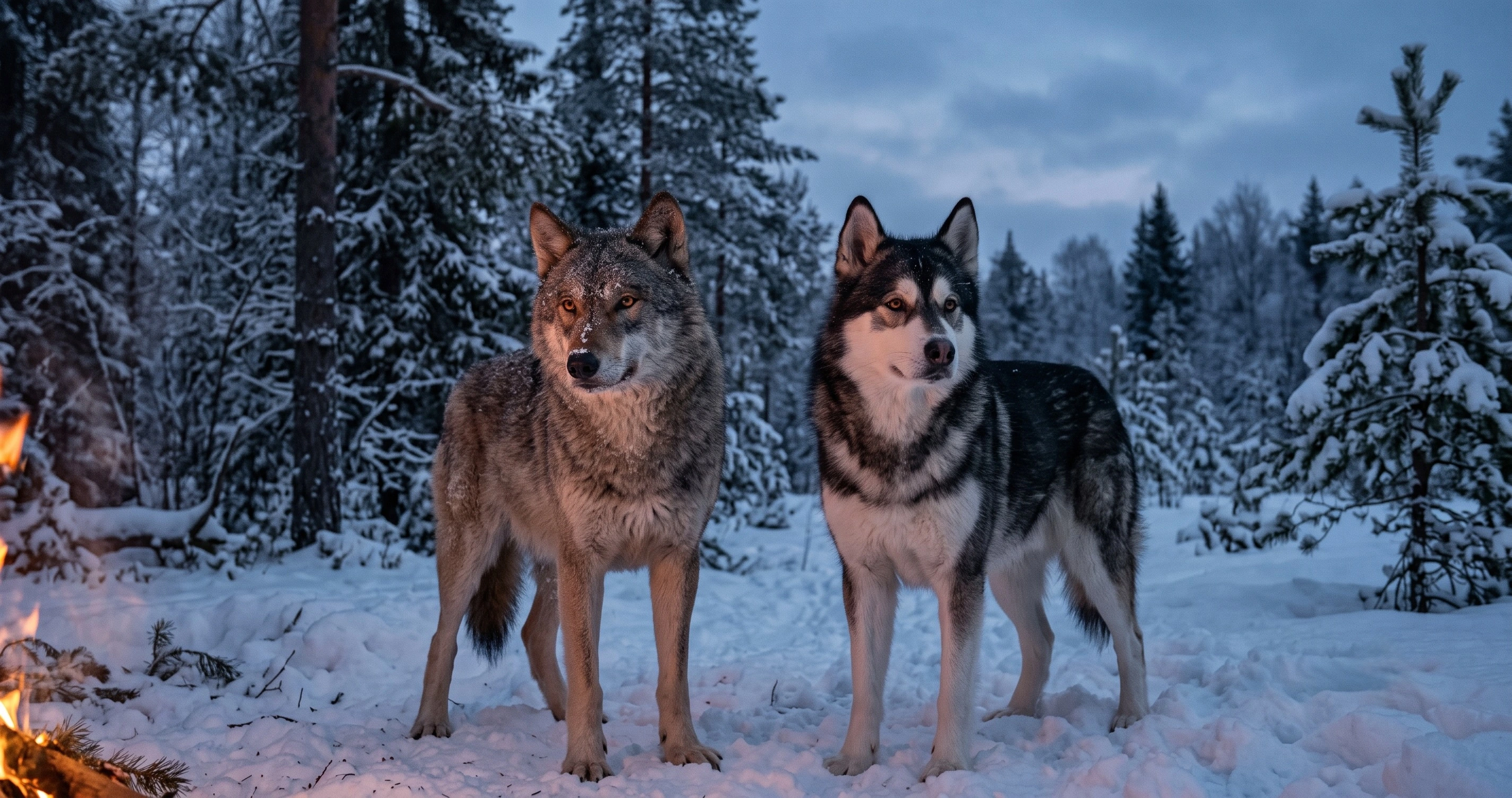
Dogs sleep on beds, ride in cars, and eat better than most livestock on the planet. However, none of that comfort explains how a wolf became a couch companion in the first place. Dog domestication history is not a cute origin story. Consequently, it is one of the most debated and rigorously studied questions in evolutionary biology.
This article covers the full arc. First, the ancient partnership between hunter-gatherers and wolves. Then, the modern discoveries proving dogs process the world in ways scientists are only now beginning to understand.
Who Domesticated the First Wolves?

No single person or tribe gets credit for domesticating the first wolves. Instead, the process likely happened gradually across multiple hunter-gatherer populations in Ice Age Eurasia. Genetic studies suggest a single domestication event, though the exact human group responsible remains unidentified. Wolves that tolerated human proximity, and scavenged from kill sites, gained a survival edge over their more fearful relatives. Therefore, natural selection favored the boldest, calmest wolves long before any human deliberately bred them. Humans did not domesticate dogs so much as certain wolves domesticated themselves.
When and Where Did Dog Domestication Take Place?
Genetic and fossil evidence places dog domestication between 15,000 and 30,000 years ago across Ice Age Eurasia. Specifically, researchers have pointed to Siberia, Europe, and parts of Central Asia as likely regions. A 2021 genomic study comparing ancient and modern dog DNA supports a single domestication origin rather than several separate events. However, the exact location remains contested among geneticists. Fossil remains from Belgium and Siberia, dated to over 30,000 years old, show wolf-like skulls with dog-like jaw proportions. These transitional fossils suggest domestication began earlier than many textbooks once claimed.
Was Dog Domestication Before or After the Invention of Agriculture?
Dogs predate agriculture by thousands of years, making this humanity’s oldest documented partnership. Agriculture emerged roughly 12,000 years ago, while dog domestication happened well before that shift. In fact, hunter-gatherers relied on dogs for hunting assistance, protection, and warmth long before anyone planted a crop. This timeline matters because it proves early humans valued companionship and cooperative hunting skills over food production alone. As a result, dogs became partners to nomadic hunters rather than farmhands to settled villagers.
Is There Archaeological Evidence of a Close Bond Between Early Humans and Dogs?
Yes, and the evidence is emotionally striking rather than purely technical. Archaeologists have uncovered graves dating back roughly 14,000 years containing humans buried alongside dogs. One notable site in Bonn-Oberkassel, Germany, held a dog buried with a young man and woman, and the dog’s teeth showed signs it survived severe illness under human care. This detail matters because a sick, non-working animal would have been a burden to feed. Consequently, its survival strongly implies emotional attachment rather than pure utility. Nobody nurses a tool back to health for weeks; people nurse companions.
How Did Dog Domestication Reshape the Wolf Into the Dog?
Domestication triggered rapid physical and behavioral changes that separated dogs from their wolf ancestors within a few thousand years. Selection for tameness produced floppier ears, curled tails, shorter snouts, and smaller brains relative to body size. Researchers call this cluster of traits “domestication syndrome,” and it shows up across many domesticated species, not just dogs. Furthermore, dogs retained juvenile wolf behaviors into adulthood, a process scientists call neoteny. This explains why adult dogs bark, play, and seek attention far more than adult wolves typically do. Selective breeding by humans later refined these traits into the hundreds of breeds seen today.
Recent Science: What Modern Dogs Reveal About Their Ancient Wiring

The domestication story explains where dogs came from. The following discoveries explain what that ancient wiring still does inside every dog today.
Can Dogs Sense Earth’s Magnetic Field?
Yes, and the evidence comes from an unusually specific behavior: pooping. A 2013 study published in Frontiers in Zoology tracked 70 dogs across 37 breeds during nearly 7,500 defecations and urinations over two years. Researchers found dogs preferred aligning their bodies along the north-south axis while excreting, but only during calm geomagnetic conditions. This alignment vanished whenever solar activity disrupted Earth’s magnetic field. Scientists still do not know why dogs do this, or whether they consciously perceive the field at all. However, the pattern held up consistently enough to rule out coincidence.
Is It True That a Dog’s Brain Connects Scent Directly to Vision?
Yes, and this 2022 discovery genuinely surprised neuroscientists at Cornell University. Using diffusion tensor imaging, researchers found a direct white matter pathway linking a dog’s olfactory bulb to its occipital lobe, which functions as the visual cortex. This connection has never been documented in any other species studied this way. Consequently, dogs may partly “see” the world through smell, using scent to build a spatial picture the way humans use sight. This helps explain why blind dogs still navigate confidently and play fetch. Their nose is doing work most species reserve for their eyes.
Does the Direction a Dog Wags Its Tail Carry Distinct Biological Meaning?

Indeed, tail direction reflects which brain hemisphere is currently active, according to research led by neuroscientist Giorgio Vallortigara. A 2007 study found dogs wag more to the right, indicating left-hemisphere activation, when viewing something they want to approach, such as their owner. In contrast, they wag more to the left, indicating right-hemisphere activation, when facing something threatening or unfamiliar. A 2013 follow-up study in Current Biology showed other dogs can detect this asymmetry. Dogs watching left-biased tail wagging on video showed higher heart rates and more anxious behavior. Therefore, tail direction is not decorative; it is a readable emotional signal between dogs.
What Happens Biologically When a Human and a Dog Make Eye Contact?
Mutual gaze triggers a hormonal feedback loop involving oxytocin, the same hormone active in human parent-infant bonding. A landmark 2015 study published in Science, led by Miho Nagasawa, found that dogs gazing at their owners raised oxytocin levels in both the dog and the owner. Notably, this effect did not occur between hand-raised wolves and their human caregivers, suggesting the loop evolved specifically during dog domestication. However, later researchers have questioned how universally this loop applies, noting that breed, sex, and prior bonding history all influence the response. Even with that caveat, the core finding remains one of the strongest biological arguments for a real emotional bond between species.
Can Dogs Understand Human Language Using Child-Like Cognitive Mechanisms?
A small group of dogs, nicknamed “Gifted Word Learners,” genuinely can. A 2026 study published in Science found these dogs could learn new object names by overhearing conversations, without ever seeing the object while its name was spoken. Researchers compared this to how 18-month-old human toddlers acquire vocabulary through passive listening. The dogs succeeded at a group-level accuracy of 81 percent on the first trial. However, this ability appears rare, and most typical dogs do not show it to this degree. Earlier research on a border collie named Rico, and another named Chaser who learned over 1,000 object names, supports the same underlying mechanism.
Can Dogs Smell Time and Human Emotional States?
Regarding emotional states, yes, this is well documented. A 2024 University of Bristol study found dogs could distinguish stressed human breath and sweat samples from relaxed ones with over 90 percent accuracy, based on cortisol-linked volatile organic compounds. A follow-up study showed dogs exposed to a stressed stranger’s scent became more pessimistic in a decision-making test. Regarding “smelling time,” the claim is more informal than proven. It stems from the observation that scent molecules decay predictably, letting trained dogs estimate how long ago a scent trail was laid. This is well established in search-and-rescue and tracking work, though it reflects scent decay analysis rather than a literal sense of time passing.
My Experience: Three Dogs, Three Different Lessons in Canine Behavior
I have lived with dogs since I was a teenager, and each one has confirmed a piece of the research above in a very unscripted way. My first dog, Stupy, a Griffon-Shih Tzu mix, lived 13 years with me until March 2017. She had the classic right-biased tail wag every single time I walked through the door, and a completely different, stiffer posture around unfamiliar dogs at the park.
Vhagar came into my life in July 2017 at age eight, a large Baladi-German Shepherd mix with a broken leg nobody else wanted. He lived until October 2025. Vhagar taught me the oxytocin gaze loop firsthand, long before I read the Nagasawa study. He would hold eye contact for uncomfortably long stretches during quiet evenings, and it never once felt threatening. It felt like check-ins.
Now I have Rosie, a Griffon-Shih Tzu mix who joined us in December 2025 at four months old. Watching her learn object names by simply overhearing my daughters talk has been a small, live demonstration of the word-learning research above. She is not a Gifted Word Learner by any scientific measure, but she already recognizes “walk,” “outside,” and, unfortunately, “vet.”
Dog Domestication FAQ
No, current genetic evidence suggests wolves self-selected for tameness first. Bolder, calmer wolves scavenged near human camps and gained a survival advantage. Deliberate human breeding for specific traits came much later, after the core domestication process was already underway.
Dogs and humans have shared a partnership for roughly 15,000 to 30,000 years, based on genetic and fossil evidence. This predates agriculture, pottery, and permanent human settlements by thousands of years, making it humanity’s oldest documented animal relationship.
Dogs process scent through a direct brain pathway connected to their visual cortex, according to 2022 Cornell research. This connection has not been documented in any other studied species. It likely helps dogs build a spatial understanding of their surroundings through smell alone.
The 2015 Nagasawa study found strong evidence for an oxytocin feedback loop during dog-human eye contact, absent in wolf-human pairs. However, later researchers have noted the effect varies by breed, sex, and relationship history, so it should not be treated as universal or automatic.
Only a small subset of dogs, called Gifted Word Learners, have demonstrated this ability in controlled studies. Most typical dogs do not show this level of vocabulary acquisition. The finding is genuine, but it applies to rare individuals rather than the species broadly.
A 2013 Frontiers in Zoology study found dogs align their bodies north-south while excreting, but only under stable magnetic conditions. Researchers still do not know whether dogs consciously perceive this field. The behavioral pattern itself, however, has held up across repeated observation.
Sources
- Frontiers in Zoology (magnetic alignment study)
https://link.springer.com/article/10.1186/1742-9994-10-80 - Journal of Neuroscience (canine olfactory-visual pathway)
https://www.jneurosci.org/content/42/33/6392 - Current Biology (tail-wagging asymmetry perception)
https://www.cell.com/fulltext/S0960-9822(13)01143-3 - Science (oxytocin-gaze positive loop)
https://www.science.org/doi/10.1126/science.1261022 - Science (Gifted Word Learner dogs)
https://www.science.org/doi/10.1126/science.adq5474 - PLOS ONE (dogs detecting human stress odour)
https://journals.plos.org/plosone/article?id=10.1371%2Fjournal.pone.0274143 - Nature Scientific Reports (stress odour affecting dog decisions)
https://www.nature.com/articles/s41598-024-66147-1
Leave a Reply
You must be logged in to post a comment.