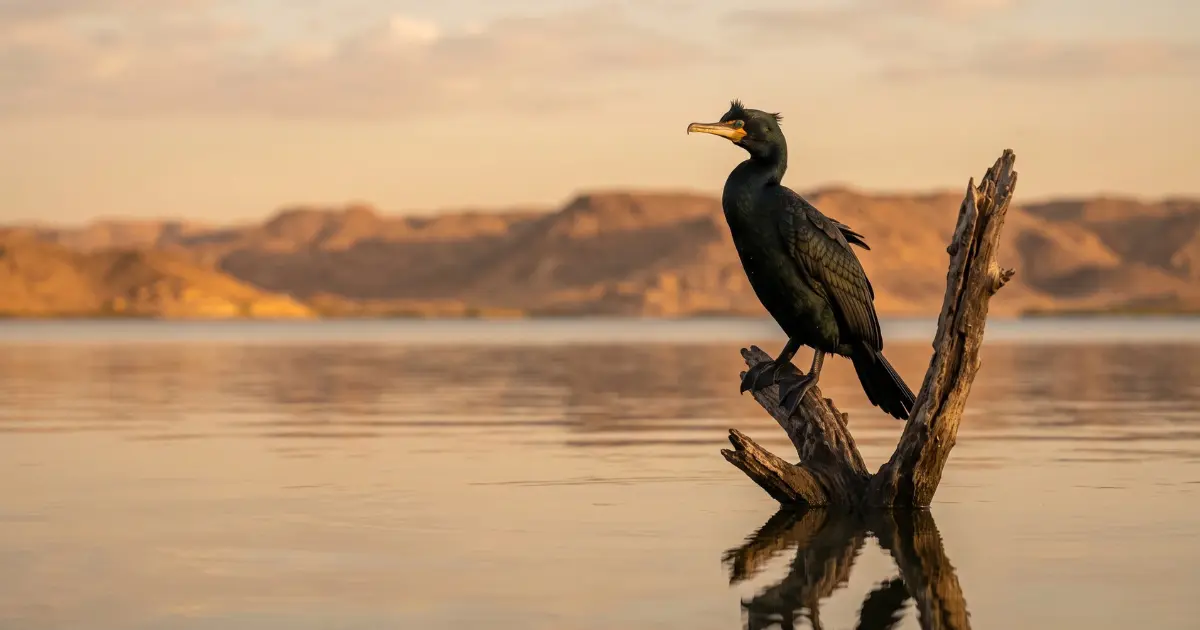
Researchers confirmed active African Cormorant nests with chicks at Lake Nasser in 2025. This is the first proof of African Cormorant breeding in Egypt since 1903. Consequently, the 122-year gap cited in recent reports is accurate, not exaggerated.

The story started earlier, however. In March 2024, birdwatcher Thomas Chinnick photographed a flock of over 20 individuals at the same lake. That sighting alone did not confirm breeding. Therefore, researchers Rabie and Mahmoud Elshamy spent the following season documenting nests directly.
Why Did the African Cormorant Disappear From Egypt for So Long?
Historical hunting pressure and habitat loss likely drove the species out. Birds of Egypt (1989) lists 1903 as the last confirmed record. As a result, any sighting since then remained unconfirmed and anecdotal.
Lake Nasser itself is a relatively young habitat, formed after the Aswan High Dam’s construction. Its shorelines and islands took decades to mature into viable nesting ground. Furthermore, Egypt’s stricter anti-poaching enforcement in recent years likely reduced pressure on the site.
How Big Is the African Cormorant?

The African Cormorant is a genuinely small cormorant. It measures 50–55 cm in length, with a wingspan of 80–90 cm. Consequently, it is easy to mistake for a young Great Cormorant at a distance. However, its size and slender build set it apart on closer inspection.
Where Do African Cormorants Live?
This species sticks to freshwater habitats across most of Africa. It thrives in freshwater wetlands, rivers, lakes, and estuaries throughout sub-Saharan Africa and Madagascar. Large reservoirs like Lake Victoria and Lake Nasser count among its preferred sites. Therefore, Lake Nasser was never a random location for this breeding record — it fits the species’ known range perfectly.
What Do African Cormorants Eat?

African Cormorants are dedicated fish hunters. Their diet relies heavily on small to medium-sized fish caught by diving underwater. They can stay submerged for 20 to 30 seconds per dive, propelled by strong webbed feet. As a result, healthy fish stocks at a lake directly determine whether the species can nest there at all.
Are Their Feathers Waterproof ?

Not entirely, and that shapes their whole daily routine. Their feathers are not completely waterproof, which helps them dive efficiently but requires frequent sunning. Like other cormorants, they often perch with wings spread wide to dry. This is why cormorants are so often photographed in that distinctive wings-out pose.
Do African Cormorants Make Noise?
Yes, though not dramatically so. They are known for subtle, soft vocalizations, typically grunts or croaks used in social interactions. Consequently, birders rely far more on visual identification than calls when confirming a sighting at a busy site like Lake Nasser.
Is This Bird an Exotic Pet Species?
No. The African Cormorant is a wild, protected bird, not a hobbyist species. Consequently, this article is a conservation update, not a care guide. However, the underlying habitat story still matters to aquarists and reptile keepers.
Lake Nasser supports fish stocks, aquatic plants, and reptiles alongside its birdlife. In fact, the same water quality that lets cormorants fish successfully also supports native cichlids and turtles. Habitat protection rarely benefits just one species.
What Does This Mean for Egypt’s Wetland Conservation?

It signals that current protections are working, at least at this site. The Ministry of Environment’s anti-poaching measures get direct credit in Egyptian reporting. Therefore, this case offers measurable proof rather than a vague policy claim.
Skeptics should note one caveat, though. A single successful breeding season does not guarantee a stable, self-sustaining population. Researchers will need several more seasons of confirmed nesting before calling this a true recovery.
My Experience
Exotastic Earth normally covers captive reptiles and aquatic invertebrates, not wild native birds. This story sits outside our usual scope. However, it directly supports our core mission: bridging hobbyist passion with scientific accuracy.
Every aquarium or reptile keeper depends on healthy wild ecosystems, even indirectly. A cormorant nesting successfully at Lake Nasser means that lake’s water and fish populations are stable enough to support it. That is a useful signal for anyone tracking Nile Basin biodiversity, hobbyist or not.
African Cormorant FAQ
No. The African Cormorant (Microcarbo africanus) is a smaller, separate species. The Great Cormorant (Phalacrocorax carbo) is larger and far more widespread globally. Confusing the two misrepresents how rare this Egyptian record actually is.
Confirmed breeding stopped after 1903, per historical records. Unconfirmed sightings occurred afterward but lacked verified evidence. The 2024–2025 records are the first scientifically documented proof since that gap.
Lake Nasser is one of the world’s largest artificial lakes. Its scale and relative isolation give birds nesting space with reduced human disturbance. That combination made confirmed breeding possible here rather than elsewhere in Egypt.
Technically yes, but access requires permits near sensitive conservation zones. Disturbing active nesting sites could undo the very recovery being celebrated. Responsible birdwatching from a distance is strongly preferable to close approach.
Not yet. One confirmed breeding season is encouraging, not conclusive. Researchers need multiple consecutive seasons of successful nesting to call this a stable population.
Sources
- BirdGuides
https://www.birdguides.com/news/reed-cormorant-breeds-in-egypt-for-first-time-in-more-than-a-century/ - Aswan Bird Watching
https://aswanbirdwatching.com/the-first-in-a-century-breeding-record-for-reed-cormorant-in-egypt/ - BirdGuides (2024 sighting)
https://www.birdguides.com/news/reed-cormorant-photographed-in-egypt/ - Youm7
https://www.youm7.com/story/2025/9/10/عودة-الطيور-المهاجرة-بعد-غياب-122-عاما-ظهور-طائر-الغاق-الأفريقى-على-ضفاف-النيل-بأسوان/7116903 - Birda Species Guide
https://app.birda.org/species-guide/7671/Reed_Cormorant - Oiseaux-Birds
https://www.oiseaux-birds.com/card-reed-cormorant.htmlBird - Buddy
https://app.mybirdbuddy.com/birds/reed-cormorant/2da4d984-d7b7-4649-a985-fd95be648385 - AswanBird Watching (Facts)
https://aswanbirdwatching.com/10-interesting-facts-about-the-reed-cormorant/
Leave a Reply
You must be logged in to post a comment.