
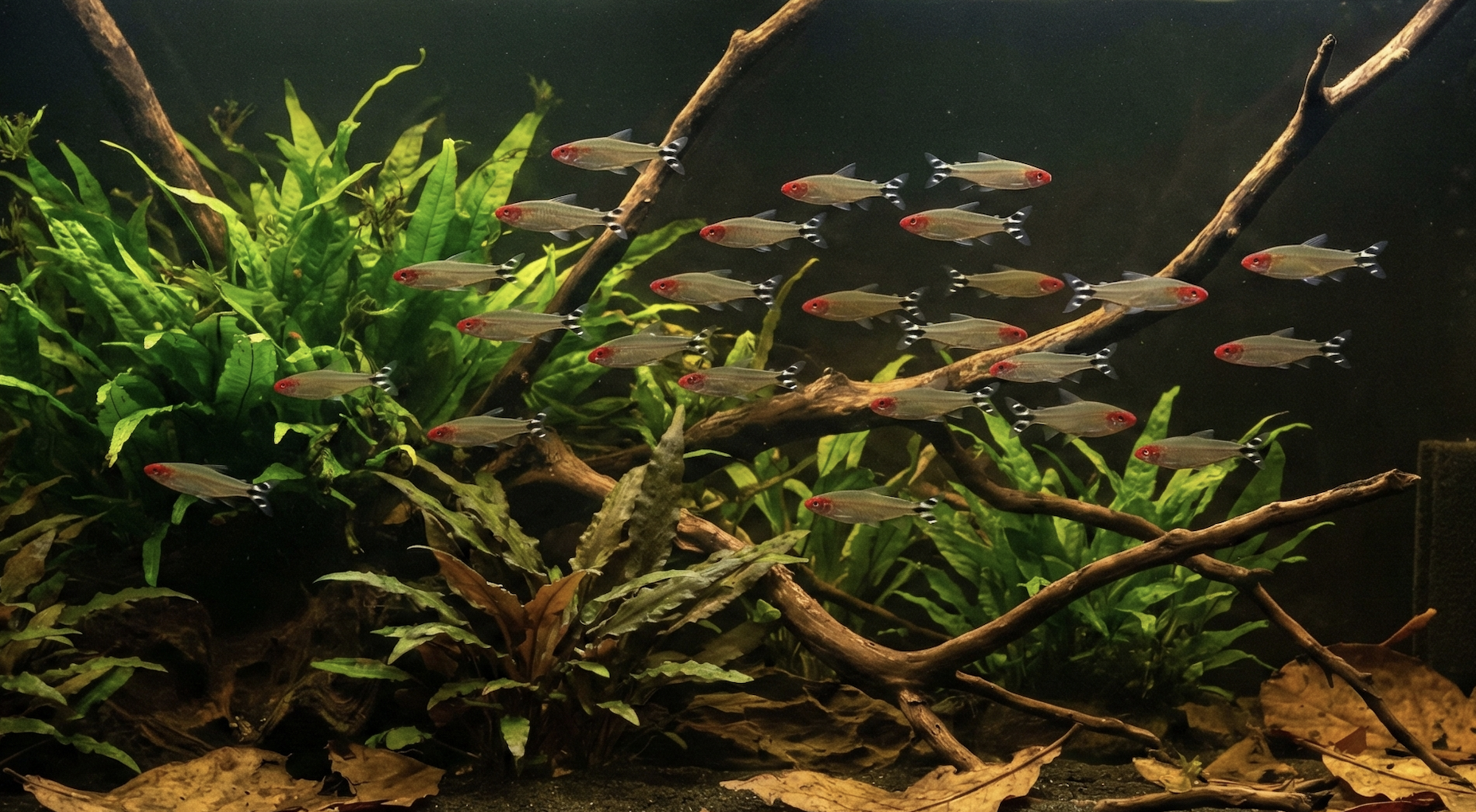
With their tight, synchronized schooling behavior, striking black-and-white tail, and a nose that glows like a ruby-red beacon, the Rummy Nose Tetra (Hemigrammus bleheri) is a true showstopper in the freshwater aquarium. But their most fascinating trait isn’t just their beauty; it’s their honesty. This is the “canary in the coal mine” of the fish world, a living barometer whose vibrant red nose is a direct reflection of its happiness and the quality of its environment. This guide will be your deep dive into the care of this sensitive, beautiful, and incredibly rewarding fish.
What is the Minimum Tank Size for Rummy Nose Tetras?
What is the absolute minimum aquarium volume?
A 20 gallon long aquarium is the analytical minimum for Rummy Nose Tetra. Specifically, they require at least 30 inches of horizontal swimming space to accommodate their constant motion. Furthermore, you must keep them in a group of at least eight to ten individuals. In fact, a school of fifteen to twenty is where their social dynamics truly manifest. Consequently, keeping them in small tanks or tiny groups leads to psychological stress and physical lethargy. Therefore, I prioritize a large footprint over vertical height. As a result, the school moves with natural fluidity.
What is the Best Tank Setup?
How do you create an accurate “Blackwater” setup?
The goal is to replicate the soft, tannin rich waters of the Rio Negro basin. Specifically, you must provide a densely planted environment using Java Fern and Cryptocorynes. Furthermore, the addition of catappa leaves and driftwood is essential for releasing beneficial humic acids. In fact, these tannins slightly lower the pH and provide the chemical security these fish require. Consequently, their red masks appear significantly more vibrant against a dark, organic background. Therefore, I prioritize gentle filtration to avoid exhausting these small swimmers. As a result, they feel secure and display bold behavior.
What Are the Ideal Water Parameters ?
Are Rummy Nose Tetras effective indicators of water quality?
These fish are famous for acting as a biological alarm system for the aquarist. Specifically, a vibrant ruby red nose indicates pristine water quality and high stability. Furthermore, a pale or washed out nose is your first reliable sign of rising ammonia or nitrate levels. In fact, they demand soft, acidic water with a pH between 5.5 and 6.8. Consequently, they are hyper sensitive to sudden shifts in chemistry or temperature. Therefore, you must only add them to a mature, fully cycled aquarium. As a result, you ensure their long-term survival through environmental precision.
What Should I Feed My Rummy Nose Tetras?
What diet maximizes the red coloration of the Rummy Nose Tetra?
Achieving peak coloration requires a diet rich in natural carotenoids and diverse proteins. Specifically, high-quality micro-pellets should serve as the nutritional foundation. Furthermore, you must supplement their diet with frozen daphnia and baby brine shrimp. In fact, these live-prey mimics stimulate their predatory instincts and enhance their physical vibrance. Consequently, a single-source diet will lead to a dull, pale appearance over time. Therefore, I recommend two small feedings daily to support their high metabolic rate. As a result, their internal health is reflected in their external brilliance.
What Are Good Tank Mates for Rummy Nose Tetras?
Which species are analytically compatible with a peaceful Rummy Nose Tetra school?
The best tank mates are other peaceful species that share their preference for warm, acidic water. Specifically, Cardinal Tetras and German Blue Rams are excellent companions. Furthermore, bottom-dwellers like Corydoras and Kuhli Loaches fill different ecological niches within the tank. In fact, they are generally safe to keep with adult dwarf shrimp in heavily planted setups. However, they may opportunistically consume newborn shrimplets during their active foraging. Consequently, I prioritize community members that will not outcompete them for food. As a result, the aquarium remains a harmonious Amazonian display.
Why Is My Rummy Nose Tetra’s Nose Pale?
What does a pale nose signify in a Rummy Nose Tetra?
A pale nose is a definitive distress signal that requires immediate analytical intervention. Specifically, poor water quality such as high nitrates is the primary cause of pigment loss. Furthermore, the stress of transport or bullying from aggressive tank mates can also trigger this reaction. In fact, if the nose does not return to red within 24 hours of acclimation, a parameter failure is likely. Consequently, you must test your water chemistry immediately upon noticing any color loss. Therefore, I prioritize stable conditions as the only cure for paleness. As a result, you protect your school from systemic failure.
What Are the Differences Between the Rummy Nose Species?
How do you distinguish between the three species of Rummy Nose Tetra?
There are three distinct species often sold under the same common name. Specifically, Hemigrammus bleheri is the most common and possesses the most intense red coloration. Furthermore, Hemigrammus rhodostomus is identified by a specific dark spot at the base of the tail. In fact, Petitella georgiae, the “False” Rummy Nose, has a thinner black line extending into its body. Consequently, misidentification is frequent in the pet trade. Therefore, I recommend verifying the operculum coloration to ensure you have the “Brilliant” variety. As a result, you know exactly which biological needs to meet.
How Do I Breed Rummy Nose Tetras?
How difficult is it to breed the Rummy Nose Tetra in captivity?
Breeding this species is a significant challenge that requires professional-grade water management. Specifically, you must maintain a pH below 5.5 and extremely low water hardness. Furthermore, the eggs are hyper-sensitive to light and must be kept in total darkness to hatch. In fact, the parents are notorious egg-eaters and must be removed immediately after spawning. Consequently, raising the microscopic fry requires specialized foods like infusoria for the first week. Therefore, I prioritize a dedicated, dimly lit breeding tank for this project. As a result, raising them to adulthood is a benchmark of success.
How Long Do Rummy Nose Tetras Live?
What is the realistic lifespan of a Rummy Nose Tetra in a stable aquarium?
In a well-maintained system, these tetras have a lifespan of five to eight years. Specifically, their longevity is entirely dependent on the stability of their environment. Furthermore, keeping them in warm, acidic conditions prevents the chronic stress that leads to early mortality. In fact, they are remarkably long-lived for small characins when their specific biological needs are met. However, fluctuating parameters will significantly reduce this timeframe. Consequently, a long-term commitment to water quality is mandatory. Therefore, providing a pristine habitat is the best way to ensure they reach their full potential.
Sources
- Seriously Fish
https://www.seriouslyfish.com/species/hemigrammus-bleheri/ - FishBase
https://www.fishbase.se/summary/Hemigrammus-bleheri.html - Practical Fishkeeping
https://www.practicalfishkeeping.co.uk/features/rummy-nose-tetras-the-ultimate-schooling-fish/ - Aquarium Care Basics
https://www.aquariumcarebasics.com/freshwater-aquarium-fish/rummy-nose-tetra/ - Tropical Fish Hobbyist
https://www.tfhmagazine.com/articles/freshwater/rummynose-tetras-the-rednosed-reindeer-of-the-aquarium - Aquatic Arts
https://aquaticarts.com/pages/rummy-nose-tetra-care-guide


Leave a Reply