
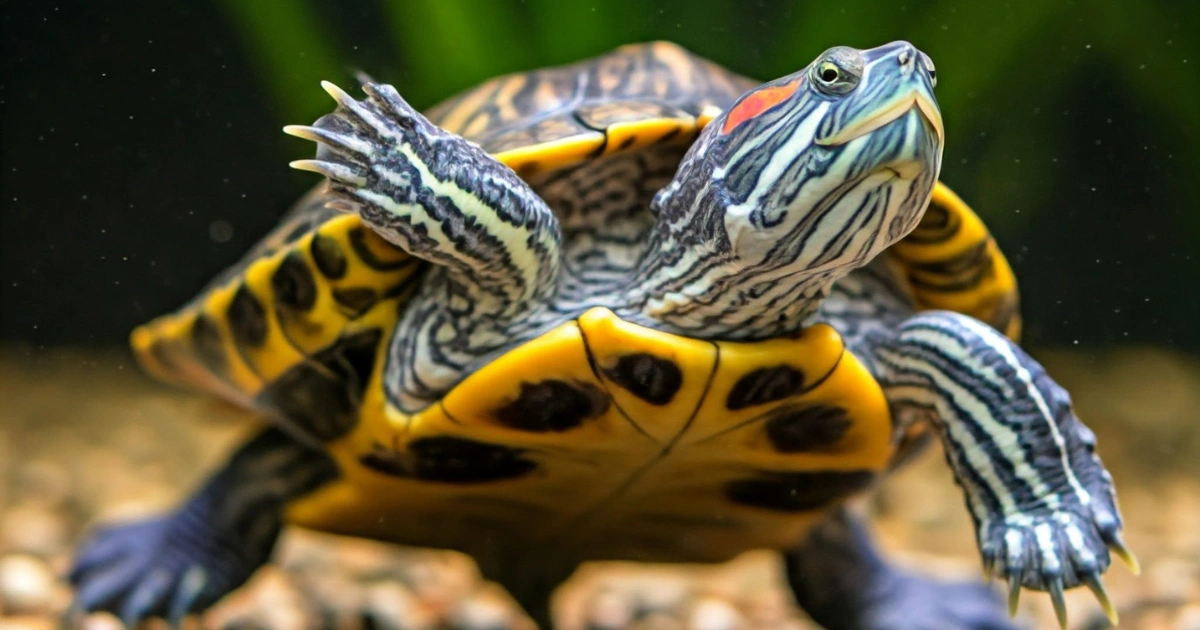
The longer I had Mike and Frida, my RES turtles, and the more I watched them, the more I realized they have a whole secret language. For instance, I learned that Mike’s frantic swimming means “I see the food container!” and Frida’s full-body basking stretch is a sign of pure contentment. They don’t cuddle or purr, but they communicate constantly. Therefore, this guide is your “translation dictionary,” written to help you understand the subtle and wonderful world of Red Eared Slider behavior.
A Winter Nap? Understanding Brumation vs. Hibernation
To begin with, let’s talk about some basics. You might wonder if your turtle needs to hibernate like a bear. In fact, they don’t hibernate; they brumate.
What is Brumation?
Brumation in reptiles is a state of dormancy that happens during winter. It’s a natural slowdown, not a deep sleep. However, this is a key point: if you are keeping your slider indoors in a heated tank, it will not brumate and should not be encouraged to.
Why is Basking so Important for Red Eared Slider Behavior?
After brumation, basking is the next most vital behavior. Turtles bask in the sun to regulate their body temperature. Additionally, this helps them dry out completely, which reduces the risk of fungal infections. If you keep your slider indoors, you’ll need two types of lamps. First, provide a UVB lamp to mimic the sun’s effect. Second, use a heating lamp to maintain the necessary warmth.
When a turtle’s body absorbs UVB rays, it produces vitamin D3, which is crucial for bone and muscle health. This vitamin, in turn, allows your turtle to utilize calcium from its food. Note that the UVB lamp should be positioned directly above the basking platform, as glass and fine mesh can block a significant percentage of the rays. Thus, it’s best to have an open-top basking area. Alternatively, if you prefer natural basking, you should expose your turtle to direct sunlight for 30 to 40 minutes daily, ensuring a shaded area is available to prevent heat stroke.

What is the Ideal Size for a Turtle Basking Area?
Ideally, you should give your turtle enough land for it to walk around. A large basking area is a critical part of healthy Red Eared Slider behavior. When they mature, males may go for walks looking for a mate, while females will search for a nesting spot. The point is, not providing an enriching environment will create frustration. Many hobbyists use flagstone, as it absorbs heat evenly. Some aquarists even place the basking area on top of the tank, which requires a ramp for easy access. Ultimately, the basking temperature should be between 28 to 35 degrees Celsius, with the water between 23 to 28 degrees Celsius.
Does My Red Eared Slider Behavior Mean Playing or Stressed?
Turtles, like humans, have different personalities. Although most of them associate their caretaker with food, you shouldn’t mistake those cute “blip blops” against the glass for begging for affection. Generally, sliders do not enjoy handling.
One way to build trust is with tong feeding. For example, you can use tweezers with a soft tip. This gives your turtle a chance to recognize you as the one who brings food.
The general advice is to handle your slider only when necessary. But in my experience, if you get your slider as a baby, you’re likely to bond with it more easily. Let me share my story. I got two red-eared sliders and named them Mike and Frida. Fred, at first, was always skittish, while Mike would swim right up to me. After about four months, they both recognized me.
One day, a friend tried to pet Mike, and Mike bit him! That was when I realized I had formed a true bond with Mike. To test this, I asked my husband to do the same, and Mike bit him too. But right after, I put my finger in, and Mike swam over and let me pet him. So, my advice is to give your turtle time. Eventually, I earned Frida’s trust too after almost 6 months. Bonding takes time, and patience is key.
What is Normal Red Eared Slider Behavior?
Let’s decode some common actions.
Stacking: If you have more than one turtle, you might see them stacking up on top of each other. This is them competing for the best basking spot. Therefore, you should give them more basking space.
Retracting: When a turtle pulls its head and legs into its shell, it usually means it’s uncomfortable or feeling unwell.
Sunbathing (Basking): When it stretches out in a yoga-like position, it’s absorbing maximum UVB. This is a sign your turtle is enjoying its basking session.
Glass Surfing: If your turtle swims back and forth along the aquarium glass all day, it might mean your tank is too small. Although they will also do this when begging for food.
Fluttering: A male fluttering his long claws in a female’s face is a courtship behavior. In other situations, it can be a display of dominance between two males.
Disclaimer: This article is for informational purposes only. The information provided should not be considered a substitute for professional veterinary advice. If your pet is displaying concerning behavior, it’s crucial to consult with a qualified veterinarian.
Red Eared Slider Turtle Behavior FAQ
Red Eared Sliders brumate rather than hibernate during cold months in their natural environment. Brumation slows metabolism and movement without inducing the deep unconscious sleep mammals experience. Indoor sliders kept in heated tanks should never be forced into brumation since the process carries genuine health risks.
Red Eared Sliders bask to regulate body temperature, dry their shells, and convert UVB rays into vitamin D3. Vitamin D3 enables calcium absorption from food, preventing fatal Metabolic Bone Disease. Dry basking sessions also kill fungal spores that otherwise cause shell rot infections.
The ideal basking surface temperature for a Red Eared Slider sits between 28 and 35 degrees Celsius. Water temperature must stay between 23 and 28 degrees Celsius for proper digestion and immune function. UVB bulbs must mount above the basking platform without glass blocking the rays.
Red Eared Sliders rarely enjoy handling and most owners should treat them as observational pets. Sliders raised from hatchling age sometimes bond with their primary caregiver after months of patient interaction. Tong feeding builds trust faster than direct touch since sliders associate the keeper with food.
Red Eared Sliders swim against the glass for two main reasons: insufficient tank space or food anticipation. Persistent glass surfing throughout the day signals an undersized aquarium and demands an upgrade. Surfing only at feeding times reflects normal begging behavior rather than environmental stress.
Red Eared Sliders stack on each other while competing for the same prime basking spot under the heat lamp. This behavior signals insufficient basking real estate rather than affection between turtles. Adding additional basking platforms or expanding the existing surface eliminates the dominance behavior quickly.
Red Eared Sliders retract into their shells when feeling unwell, threatened, or stressed by their environment. Healthy sliders rarely hide for extended periods unless something in the tank disturbs them. Persistent retraction combined with appetite loss signals illness requiring veterinary evaluation immediately.
Sources
- MSD Veterinary Manual
https://www.msdvetmanual.com/exotic-and-laboratory-animals/reptiles/management-of-turtles-and-tortoises - LafeberVet
https://lafeber.com/vet/basic-care-red-eared-slider/ - Journal of Herpetological Medicine and Surgery
https://herpmed.org/doi/abs/10.5811/westjem.2011.5.2273 - The Spruce Pets
https://www.thesprucepets.com/red-eared-slider-behavior-1238383 - National Library of Medicine
https://pubmed.ncbi.nlm.nih.gov/11443141/
Leave a Reply
You must be logged in to post a comment.