
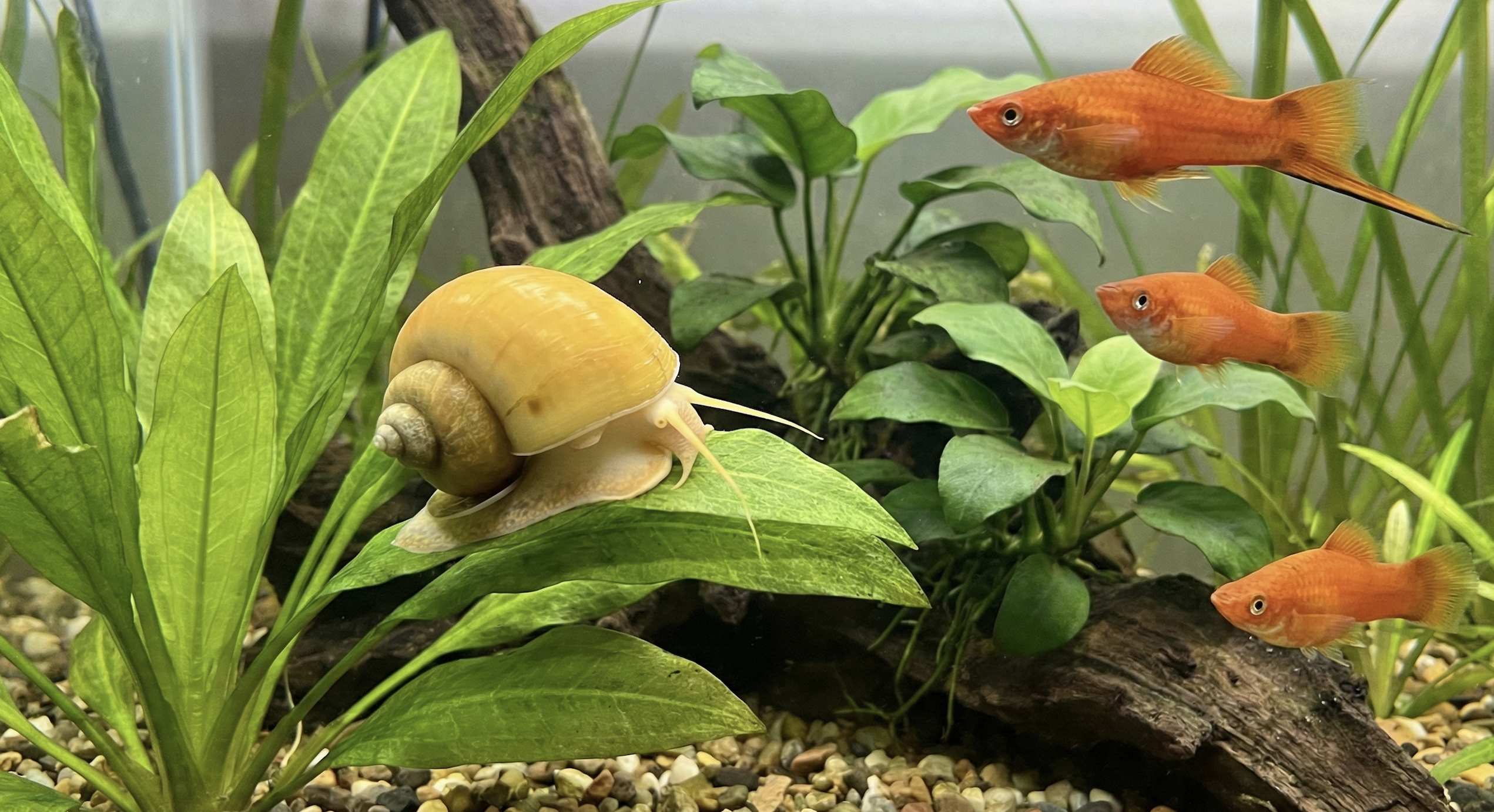
In a hobby where we often battle tiny “pest” snails that arrive uninvited, there is a special kind of joy in choosing a snail to be a true pet. For me, that snail has always been the Mystery Snails. I remember watching my first one, a brilliant golden specimen, as it methodically navigated the tank. It wasn’t a frantic cleaner like the smaller snails; it moved with a slow, deliberate grace, like a gentle submarine exploring its domain.
Its long, flowing tentacles would wave in the current, and it would extend its breathing siphon to the surface like a tiny periscope. It wasn’t just a janitor; it was a character, a peaceful and fascinating presence that brought a sense of calm to the entire aquarium.
The Mystery Snail (Pomacea diffusa) is one of the most popular and beloved invertebrates in the aquarium hobby. They are peaceful, beautiful, and full of quirky behaviors that make them a genuine pet. This guide will unravel all the “mysteries” of their care.
What is the biological distinction between Mystery Snails and Apple snails?
Understanding the taxonomy of Mystery Snails is critical for the safety of your aquatic plants. Specifically, the term “Apple Snail” is a broad family name that includes several invasive, plant-devouring species. Furthermore, the true mystery snail (Pomacea diffusa) is a specialized feeder that lacks the ability to eat healthy vegetation. Consequently, you must ensure you are not accidentally purchasing the Giant Apple Snail (P. canaliculata), which can grow to the size of a baseball. Therefore, verifying the species name is the first step in responsible husbandry. In fact, the true mystery variety is a highly desirable scavenger.
How do you identify the different color varieties and sexes of Mystery Snails?
Breeders have developed a stunning spectrum of colors, including Ivory, Jade, Magenta, and the classic Golden variety. Specifically, these colors are determined by the combination of shell pigment and the snail’s body color. Furthermore, unlike many other gastropods, these animals require both a male and a female for reproduction. Consequently, you can identify a male by looking for the penis sheath located above the right shoulder under the shell. Therefore, determining the sex is vital if you intend to breed them or avoid unwanted egg clutches.
What are the standards for Mystery Snails tank setup and water chemistry?
A single adult requires a significant water volume to manage its high bioload and metabolic waste. Specifically, a minimum of five gallons per snail is the modern recommendation for long-term health. Furthermore, you must maintain an alkaline pH between 7.2 and 8.4 to support their shell structure. Consequently, acidic or soft water will lead to rapid shell erosion and white pitting. Therefore, providing supplemental calcium via cuttlebone or crushed coral is a non-negotiable requirement. In fact, maintaining a stable temperature between 70–80∘F ensures they remain active and alert.
What constitutes a scientifically balanced diet for Mystery Snails?
While Mystery Snails are excellent scavengers, they cannot thrive on aquarium leftovers alone. Specifically, their diet must be supplemented with calcium-rich vegetables like kale, spinach, and blanched carrots. Furthermore, providing sinking algae wafers and high-protein bottom dweller pellets ensures they receive adequate nutrition. Consequently, a starving snail may attempt to nibble on very soft or dying plant tissue. Therefore, regular feeding sessions are necessary to prevent lethargy and shell thinning. As a result, a well-fed snail will display a vibrant, smooth carapace.
Why is a tight-fitting lid mandatory for Mystery Snails?
Mystery Snails are notorious for their exploratory behavior and will frequently attempt to leave the water. Specifically, females must climb above the waterline to deposit their honeycomb-like egg clutches. Furthermore, their use of a siphon to breathe atmospheric air often leads them to the very top of the enclosure. Consequently, an open-top tank poses a fatal risk of the snail falling and cracking its shell. Therefore, you must leave at least two to three inches of air space beneath a secure lid. In fact, this space provides the exact humidity required for their eggs to develop.
How do you troubleshoot common health and behavioral concerns?
A common source of panic for new owners is the “inactive” or floating Mystery Snail. Specifically, it is biologically normal for these animals to remain motionless for several days while they rest or digest. Furthermore, they may float if they have trapped air within their mantle cavity. However, a truly dead snail will emit a powerful and unmistakable foul odor. Consequently, you should perform a “smell test” before assuming your pet has passed away. Therefore, monitoring for shell fading or white spots allows you to address water chemistry issues before they become terminal.
What are the best methods for breeding and egg care?
Breeding occurs readily when a male and female are housed together in warm, well-filtered water. Specifically, the female will lay a distinctive pink or white clutch containing dozens of eggs. Furthermore, these eggs must remain moist through ambient humidity but will drown if they fall into the water. Consequently, they typically hatch within two to four weeks depending on the local temperature. Therefore, if you do not wish to raise hundreds of offspring, you should remove the clutch and freeze it humanely. In fact, managing the hatchling population is essential to prevent an ammonia spike.
Mystery Snails FAQ
Mystery Snail (Pomacea diffusa) is a specific species within the broader Apple Snail family. The true Mystery Snail cannot eat healthy plants. The Giant Apple Snail (P. canaliculata) can grow to the size of a baseball and will systematically destroy a planted tank. Always verify the scientific name before purchasing — “Apple Snail” alone tells you nothing about the species you are getting.
Two reasons. First, they are escape artists that will climb out of open tanks and fall, cracking their shells fatally. Second, females must climb above the waterline to deposit their egg clutches. A secure lid with 2–3 inches of air space beneath it is mandatory — that air gap also provides the humidity their eggs need to develop.
Floating is usually caused by trapped air inside the mantle cavity — not a death sentence. It is also biologically normal for Mystery Snails to remain completely motionless for several days while resting or digesting. A truly dead snail emits a powerful, unmistakable foul odour. When in doubt, perform a smell test before assuming the worst.
This is caused by acidic or soft water dissolving the shell. Mystery Snails require a pH between 7.2 and 8.4 and need supplemental calcium to maintain shell integrity. Add cuttlebone or crushed coral to the tank — this is a non-negotiable requirement, not an optional extra.
They require both a male and female to reproduce — unlike bladder or ramshorn snails, they cannot self-fertilise. The female lays a distinctive pink or white egg clutch above the waterline that hatches in 2–4 weeks. If you do not want hundreds of hatchlings, remove the clutch and freeze it humanely before it hatches.
Sources
- University of Florida
https://entnemdept.ufl.edu/creatures/MISC/GASTROPODS/apple_snails.htm - Seriously Fish
https://www.seriouslyfish.com/species/pomacea-diffusa/ - Aquarium Source
https://www.aquariumsource.com/mystery-snail-care/ - Aquarium Science
https://aquariumscience.org/index.php/17-5-snails/ - Aquatic Arts
https://aquaticarts.com/pages/mystery-snail-care-guide


Leave a Reply