
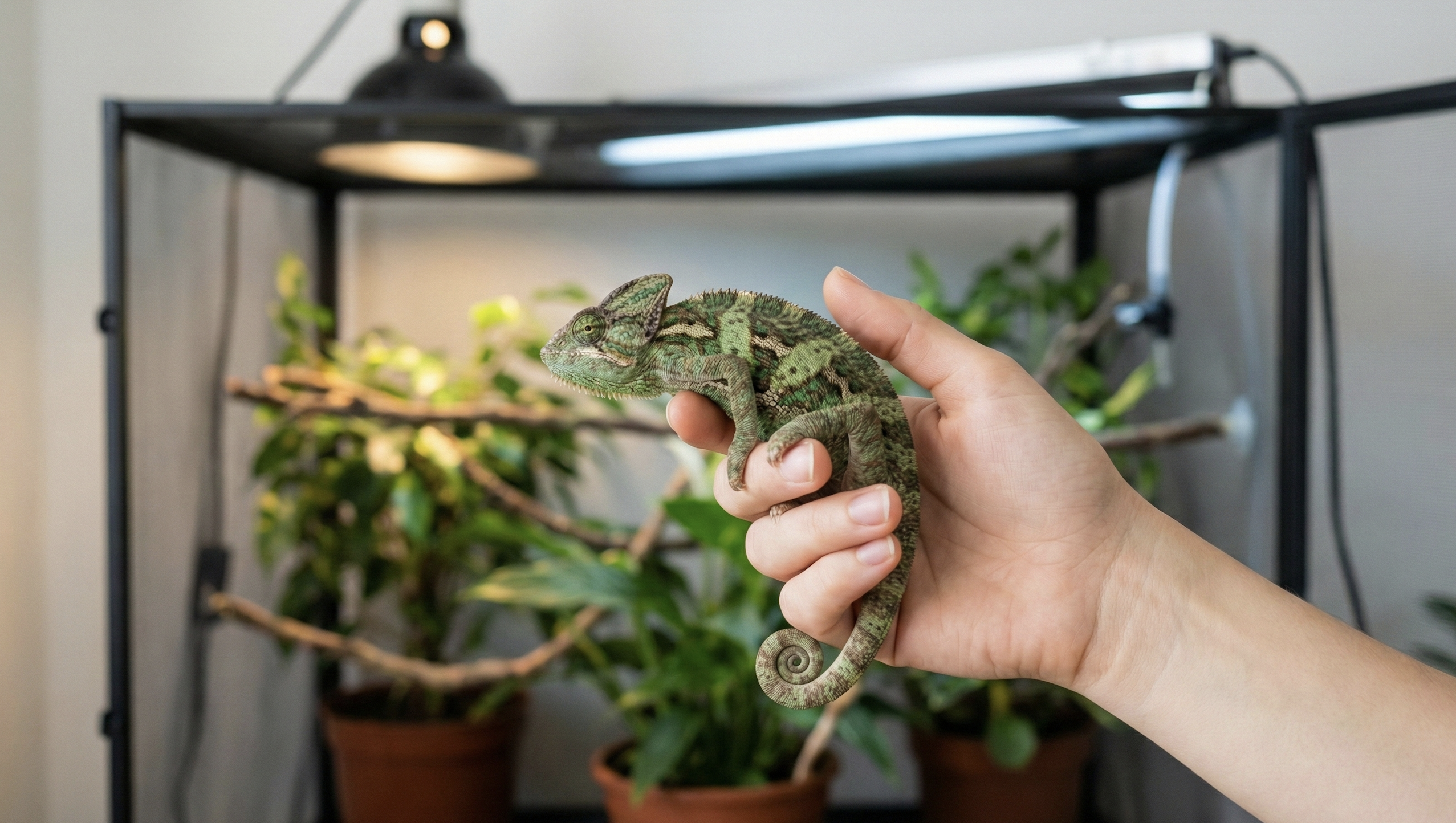
It is the chameleon that started it all, the original species from which the entire family gets its name. The Common Chameleon (Chamaeleo chamaeleon) is a widespread and adaptable lizard, a true icon of the Mediterranean and North Africa. While not as flashy as a Panther or as crested as a Veiled, its subtle beauty and classic chameleon charm make it a fascinating subject. However, its specific needs and the prevalence of stressed, wild-caught individuals in the trade make it a challenging pet. This guide is your in depth look at the responsible care of this foundational species.
Author’s Note: The Granddaddy of Grumpy
I’ve dedicated a significant part of my hobby life to understanding the mind of a chameleon, mostly through my daily diplomatic negotiations with my grumpy African Chameleon, Cosmo. I thought I knew the chameleon experience.
But then I started researching the Common Chameleon, the literal “OG” of the family. It’s like studying the great-great-granddaddy of my own grumpy pet. Their needs are so fundamentally chameleon—the need for high ventilation, the specific hydration, the quiet observation. It’s a profound reminder that these traits aren’t just quirks; they are an ancient blueprint for survival. I admire this species for being the original, the classic, the blueprint from which all my other chameleon obsessions have sprung.
Is the Common Chameleon a suitable choice for a beginning reptile keeper?
The Common Chameleon is an advanced level pet that is strictly unsuitable for beginning hobbyists due to its physiological sensitivity. Specifically, their low tolerance for environmental fluctuations makes them unforgiving of foundational husbandry errors. Furthermore, the high prevalence of wild-caught individuals in the trade introduces complex challenges like internal parasites and chronic dehydration. Consequently, I reject the assumption that these are manageable “starter” lizards for the average person. Therefore, only those who have mastered the care of more resilient arboreal species should consider this Mediterranean specialist. In fact, foundational mistakes often lead to a rapid decline in their health.
What are the non negotiable standards for a “Mediterranean Rainforest” habitat?
Housing a Common Chameleon requires a vertical environment that prioritizes high-volume ventilation and thermal stability. Specifically, a full-screen enclosure measuring at least 18 inches by 18 inches by 36 inches is the analytical minimum. Furthermore, you must avoid glass terrariums because they trap stagnant air, which leads directly to fatal respiratory infections. Consequently, the habitat must be filled with a dense network of branches and live foliage to provide security. Therefore, I prioritize the use of natural plants like Ficus or Pothos to facilitate a natural micro climate. As a result, providing a “living jungle” within the mesh walls is critical for their psychological health.
How to manage the balance of temperature and humidity for a Common Chameleon?
Replicating the coastal Mediterranean climate requires a precise daily cycle of heat spikes and moisture levels. Specifically, the basking spot should reach a gentle maximum of 85–88∘F (29–31∘C) to support digestion. Furthermore, daytime ambient temperatures must remain in the mid-to-high 70s to prevent systemic heat stress. Consequently, you must implement a daily humidity cycle that peaks at 80% during misting and dries to 40% between sessions. Therefore, I recommend the use of automated misting systems to ensure consistency in their hydration. In fact, a constant, wet environment is just as dangerous as one that is too dry.
What kind of lighting and hydration systems are essential for survival?
The Common Chameleon possesses an intense biological demand for ultraviolet radiation and specific drinking behaviors. Specifically, a linear T5 HO 6% UVB bulb is mandatory to prevent the onset of Metabolic Bone Disease. Furthermore, you must provide water through a dripper or misting system because these animals do not recognize standing water in bowls. Consequently, they rely on the movement of water droplets on leaves to trigger their drinking response. Therefore, I prioritize the “gold standard” of combined misting and dripping for total hydration. As a result, their health is entirely dependent on the technical accuracy of your equipment.
What constitutes a scientifically balanced diet for a Common Chameleon?
Maintaining the high metabolism of a Common Chameleon requires a diverse rotation of high-quality, gut-loaded invertebrates. Specifically, staple insects like crickets and dubia roaches must be fed a nutritious diet before being offered to the lizard. Furthermore, you should include silkworms and black soldier fly larvae to provide essential calcium and protein. Consequently, you must dust these feeders with plain calcium at most feedings and multivitamins twice per month. Therefore, I recommend feeding adults every other day to prevent the development of obesity. In fact, a varied diet is the best defense against long-term nutritional deficiencies.
How can you identify the primary indicators of health or illness?
A Common Chameleon displays its internal physiological state through its external coloration and physical posturing. Specifically, a stressed or ill animal will often display dark, drab, or mottled colors as a warning sign. Furthermore, sunken eyes are a critical analytical indicator of severe dehydration that requires immediate medical intervention. Consequently, you must monitor for signs of Metabolic Bone Disease, such as rubbery limbs or a curved spine. Therefore, I prioritize the use of a “bare bottom” enclosure to easily inspect the animal’s droppings for parasites. As a result, constant observation is your most powerful tool in maintaining their welfare.
How do you distinguish between males and females for breeding?
Distinguishing the sex of a Common Chameleon involves analyzing specific anatomical markers located at the base of the tail. Specifically, males possess a visible hemipenal bulge that becomes more prominent as they reach sexual maturity. Furthermore, while both sexes have a casque on their head, the male’s helmet is typically more developed and robust. Consequently, a gravid female requires a deep laying bin filled with moist sand and soil to lay her eggs safely. Therefore, I reject the assumption that females can be housed without a nesting site. In fact, failure to provide this will result in fatal egg binding.
Sources
- Smithsonian’s National Zoo
https://nationalzoo.si.edu/animals/common-chameleon - Animal Diversity Web
https://animaldiversity.org/accounts/Chamaeleo_chamaeleon/ - Reptiles Magazine
https://reptilesmagazine.com/common-chameleon-care-and-information/ - Natural History Museum
https://www.nhm.ac.uk/discover/chameleons-the-quick-change-artists.html - Chameleon Academy
https://chameleonacademy.com/common-chameleon-care/ - ReptiFiles
https://reptifiles.com/common-chameleon-care-sheet/ - Advancing Herpetological Husbandry
https://www.facebook.com/groups/AdvancingHerpetologicalHusbandry/


Leave a Reply