
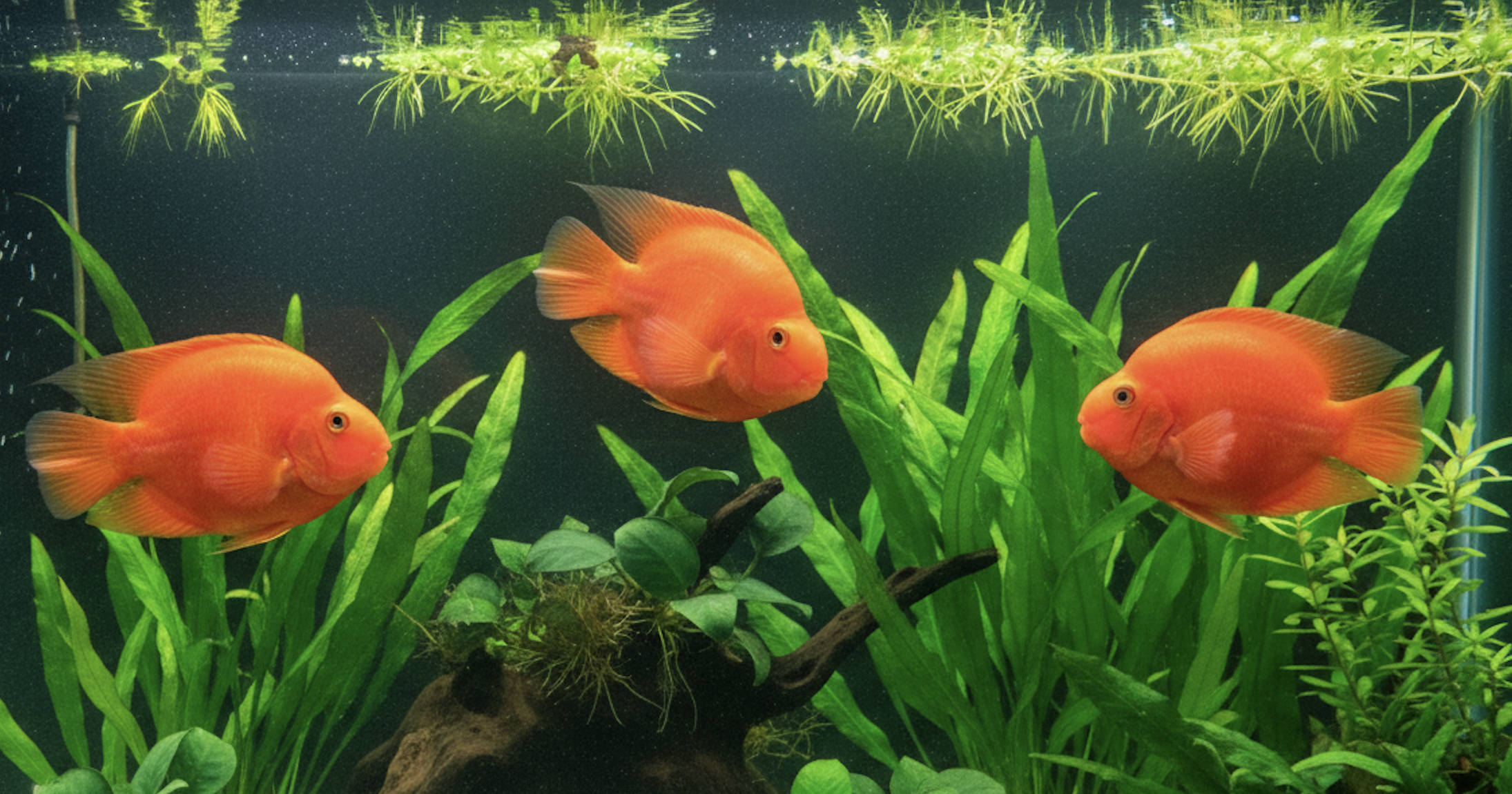
The first time I saw Blood Parrot Cichlids (a hybrid, typically Amphilophus citrinellus × Vieja melanurus or Herosspecies). I was genuinely baffled. It was a lumpy, bright orange fish with big, expressive eyes and a mouth that seemed permanently fixed in a small, comical “o.” I saw it swim with a distinctive, almost clumsy wobble. It didn’t have the natural grace of a wild-type fish. And yet, I couldn’t tear my eyes away. I watched as it interacted with its owner, excitedly greeting them at the glass, pushing a small ball along the sand, and displaying a level of interactive intelligence I had only ever seen in big Oscars.
That fish was a profound lesson: beauty and charm in the animal world aren’t always about perfect, natural forms. Sometimes, it’s the quirky, the awkward, and the undeniably charismatic characters that capture our hearts most completely. The Blood Parrot Cichlid is a man made hybrid fish, and its very existence sparks debate in the hobby. But for the thousands of aquarists who have fallen in love with them, they offer one of the most interactive and personal “wet pet” experiences available.
Are Blood Parrot Cichlids good pets for beginners?
This question requires a nuanced answer regarding technical infrastructure. Specifically, Blood Parrot Cichlids are biologically tough and can tolerate minor water parameter errors. However, their adult size and massive waste production demand intermediate level experience. Furthermore, you must provide powerful filtration to handle their bioload. In fact, they are a great “first large cichlid” for a committed beginner. Consequently, they require a significant investment in equipment. Therefore, I prioritize technical readiness as the foundation for their care.
How intelligent are Blood Parrot Cichlids and how do they interact?
Blood Parrot Cichlids high intelligence is their defining feature and the primary reason for their global popularity. Specifically, they are incredibly interactive and are analytically categorized as “water dogs.” Furthermore, they will quickly learn to recognize their owners and perform “happy dances” at the glass. In fact, they can be trained to eat from your hand or play with specific toys. Consequently, they require environmental enrichment to maintain their psychological health. Therefore, I recommend consistent interaction to support their social development.
Are Blood Parrot Cichlids aggressive or territorial?
Blood Parrot Cichlids are territorial cichlids that will claim specific caves and areas as their own. Specifically, they can exhibit bullying behaviors toward smaller or more timid tank mates. Furthermore, their unique mouth shape makes them very ineffective fighters in lethal combat. In fact, they are more likely to push and posture than to inflict serious bite damage. Consequently, this “clumsy aggression” is a key part of their behavioral profile. Therefore, I prioritize providing multiple hiding spots to reduce social friction.
What is the hybrid controversy and origin?
The exact genetic recipe remains a well guarded secret from Taiwanese breeders in the 1980s. Specifically, researchers agree they are a cross between a Midas Cichlid and a Redhead Cichlid. Furthermore, many purists in the hobby dislike man made hybrids as they are unnatural. In fact, hybridization has led to unethical practices like dyeing and cosmetic mutilation. Consequently, varieties like “Jelly Bean Parrots” are cruel and should be avoided. Therefore, I only advocate for the care of the standard hybrid variety.
What is the minimum tank size and proper setup?
A single adult requires a 75 gallon aquarium to maintain stable water parameters long-term. Specifically, a pair requires at least a 100 gallon system to establish separate territories. Furthermore, providing secure caves is absolutely crucial for their sense of security. In fact, they will feel stressed and reclusive without a safe place to retreat. Consequently, terracotta pots and smooth rockwork are excellent choices for their setup. Therefore, I prioritize horizontal swimming space over vertical height.
Are Blood Parrot Cichlids safe for planted aquariums?
Generally, Blood Parrot Cichlids are not suitable for planted tanks because they are enthusiastic diggers. Specifically, they will uproot and redecorate your substrate to their own liking. Furthermore, a planted aquascape often becomes a frustrating endeavor for the keeper. In fact, the only plants with a chance are tough species like Anubias attached to decor. Consequently, you must accept that the fish will dictate the layout of the tank. Therefore, I recommend hardscaping with driftwood and boulders instead.
What are the ideal water parameters?
Blood Parrot Cichlids are very hardy but need clean and warm water to thrive. Specifically, you must keep the temperature between 78–84∘F at all times. Furthermore, a pH range of 6.5 to 8.0 is perfectly acceptable for their health. In fact, they are very messy fish that require large weekly water changes of 50%. Consequently, maintaining zero ammonia and low nitrates is a mandatory part of their care. Therefore, I prioritize water stability as the primary health metric.
What should I feed my Blood Parrot Cichlids?
Blood Parrot Cichlids unique mouth shape makes it difficult for them to pick up floating flakes effectively. Specifically, the best staple diet is a high-quality, protein-rich sinking pellet. Furthermore, this allows them to forage comfortably on the sandy substrate. In fact, you should look for foods containing natural color enhancers like astaxanthin. Consequently, a varied diet supports their brilliant orange and red coloration. Therefore, I recommend feeding them small amounts twice daily to prevent waste buildup.
Why is my Blood Parrot Cichlids turning black and what about the mouth?
Black splotches on their body are common signals of environmental or social stress. Specifically, this reaction often occurs after a move or a sudden change in water quality. Furthermore, their small, “o-shaped” mouth is a permanent characteristic deformity of the hybrid. In fact, this physical trait is what necessitates a sinking-pellet diet for easy consumption. Consequently, you must monitor their skin color as a primary diagnostic tool. Therefore, I prioritize water testing whenever black splotches appear.
Are Blood Parrots sterile and can they breed?
Male Blood Parrot Cichlids are almost always sterile due to their hybrid genetics. Specifically, females remain perfectly fertile and will frequently lay eggs in caves. Furthermore, the female will guard these eggs fiercely even if they cannot hatch. In fact, they only hatch if fertilized by a non-sterile male of a different species. Consequently, breeding is not a realistic goal for a standard pair of hybrids. Therefore, I recommend enjoying them as pets rather than expecting a brood of fry.
Which tank mates are compatible with Blood Parrot Cichlids?
You must choose tank mates that are robust enough to handle their clumsy bullying. Specifically, Severums and larger peaceful tetras like Silver Dollars are excellent choices. Furthermore, you should avoid hyper-aggressive cichlids like Flowerhorns that will harm the Parrot. In fact, small and timid fish will likely be bullied by the larger hybrid. Consequently, choosing semi-aggressive residents of a similar size ensures social harmony. Therefore, I recommend avoiding any species that can fit in their mouths.
What is the significance of the “Swim Bladder” in this hybrid?
Specifically, the compressed and rounded spinal structure of this hybrid often displaces the swim bladder from its natural position. Furthermore, this anatomical shift makes them highly susceptible to buoyancy disorders if their diet lacks sufficient fiber. In fact, many specimens exhibit “tipping” or difficulty staying submerged after consuming air-filled floating foods. Consequently, you must prioritize high-density sinking pellets to prevent gas from becoming trapped in their digestive tract. Therefore, I monitor their swimming orientation as a primary indicator of internal health. As a result, you avoid chronic swim bladder inflammation.
How does the “Nuchal Hump” develop in Blood Parrots?
The nuchal hump is a localized deposit of fat tissue situated above the skull. Specifically, this trait is inherited from the Amphilophus citrinellus parentage. Furthermore, the size of the hump often fluctuates based on the fish’s social standing and hormonal levels. In fact, dominant males may develop a more pronounced hump during spawning attempts with females. However, it rarely reaches the massive proportions seen in Flowerhorns or pure Midas cichlids. Consequently, you should view a plump hump as a sign of high nutritional status. Therefore, I recommend a diet rich in healthy fats to support this growth.
What is the function of the “Pharyngeal Teeth” in hybrids?
Since Blood Parrot Cichlids primary mouth is often deformed and cannot close, they rely heavily on their pharyngeal teeth located in the throat. Specifically, these specialized teeth crush and grind food before it enters the stomach. Furthermore, this secondary chewing mechanism is what allows them to process hard pellets despite their “clumsy” exterior bite. In fact, you can often hear a faint “clicking” sound when a large parrot is eating. Consequently, the texture of the food is just as important as the nutrient profile. Therefore, I prioritize pellets with a firm consistency that triggers this natural grinding behavior.
Are Blood Parrot Cichlids sensitive to “Hole-in-the-Head” disease?
Like many large Neotropical cichlids, tBlood Parrot Cichlids are highly susceptible to Sensory Line Erosion or Hole-in-the-Head (HITH) disease. Specifically, chronic exposure to nitrates above 40 ppm serves as the primary environmental trigger for this ailment. Furthermore, carbon filtration that is not thoroughly rinsed can also contribute to the erosion of their sensory pits. In fact, the first signs are small, white, pin-sized holes appearing around the eyes and snout. Consequently, you must perform massive water changes to reverse the early stages of tissue decay. Therefore, I prioritize water hygiene over all other forms of medical intervention.
Blood Parrot Cichlid Fish FAQ
A single adult Blood Parrot Cichlid requires a minimum of 75 gallons to thrive. These fish produce a significant bioload and reach up to 8 inches in length, requiring stable water parameters that small tanks cannot provide. If you plan to keep a pair, a 100-gallon system is recommended to allow each fish to establish its own territory and reduce social stress.
The best diet for Blood Parrot Cichlids consists of high-quality sinking pellets formulated for cichlids. Because their “o-shaped” mouths often cannot close completely, they struggle to eat floating flakes or large surface foods. Sinking pellets allow them to forage naturally on the substrate, ensuring they receive proper nutrition and color-enhancing ingredients like astaxanthin.
Blood Parrot Cichlids are territorial and can be “clumsy” bullies, but they are generally less dangerous than other large cichlids. Their deformed mouths prevent them from delivering lethal bites, so they often resort to pushing or posturing to defend their space. House them with robust tank mates like Silver Dollars or Severums that can handle their boisterous personality without being harmed.
Black splotches on a Blood Parrot Cichlid are typically a sign of environmental or social stress. This often occurs after moving the fish to a new tank or during a sudden spike in ammonia or nitrites. Check your water parameters immediately and ensure the fish has plenty of hiding spots; the black markings usually fade once the environment stabilizes and the fish feels secure.
While female Blood Parrot Cichlids are often fertile and will lay eggs, the males are almost always sterile due to their hybrid genetics. This means that a pair of Blood Parrots will rarely produce viable fry. If you see your female guarding a nest, the eggs will likely turn white and fungus over unless they are fertilized by a non-sterile male of a different cichlid species.
Sources
- Seriously Fish
https://www.seriouslyfish.com/species/amphilophus-citrinellus/ - Aquarium Source
https://www.aquariumsource.com/blood-parrot-cichlid/ - FishBase
https://www.fishbase.se/summary/Vieja-melanurus.html - Veterinary Partner
https://veterinarypartner.vin.com/default.aspx?pid=19239&id=4952044


Leave a Reply