
للغة العربية اضغط هنا
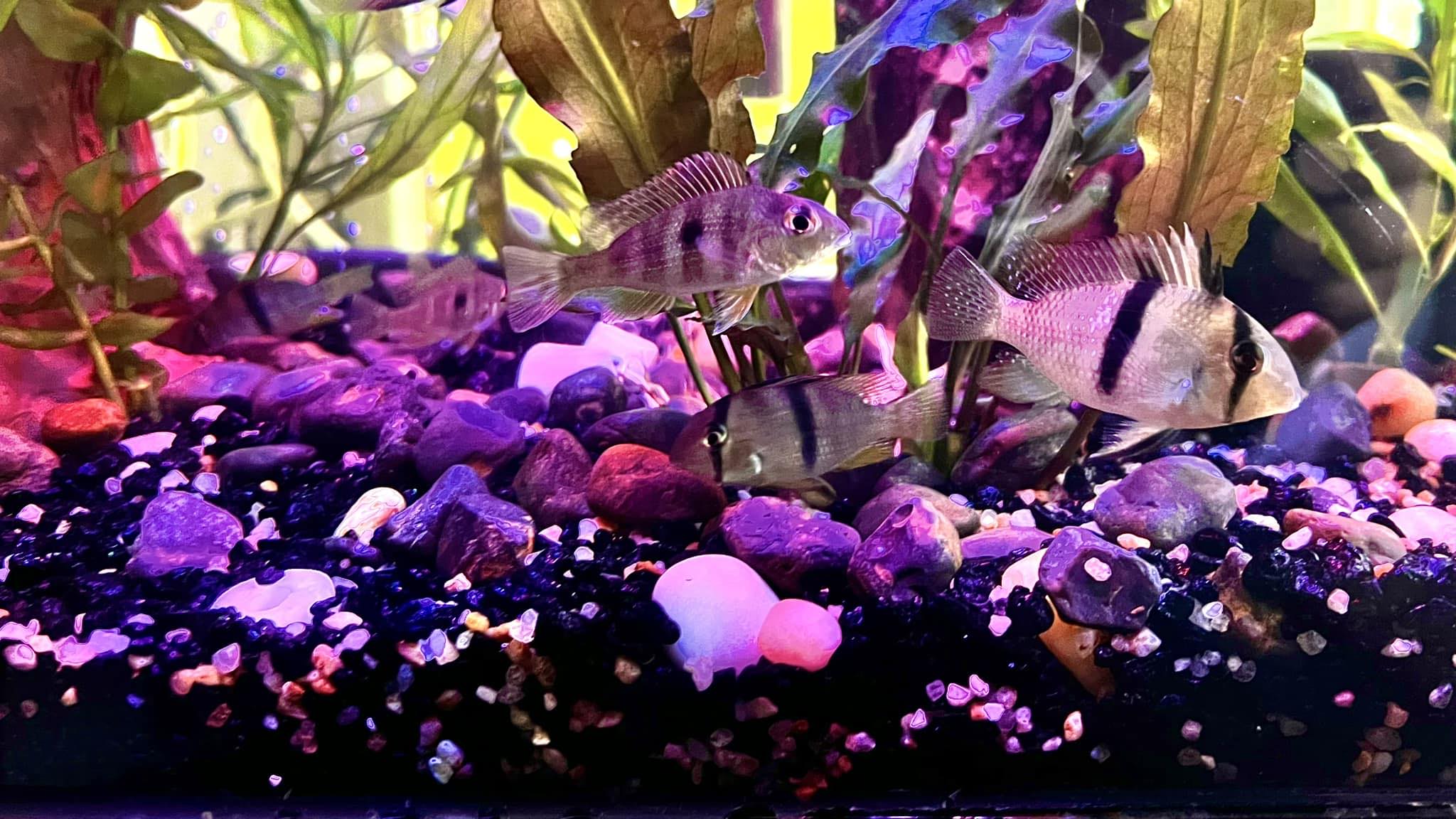
In the vast world of South American cichlids, the Guianacara genus stands out not for boisterous aggression. Rather, it is known for its quiet confidence and subtle beauty. Often called the intriguing “Bandit Cichlid,” these earth-eaters are perfect for hobbyists because they help create a peaceful and engaging community of larger fish. Consequently, this guide will answer all your questions, from their complex taxonomy to their specific care needs.
The Quiet Sheriffs of My Cichlid Tank
My large South American cichlid tank was a bustling community of gentle giants. It housed a vibrant group of Red Head Tapajos along with some majestic Red Spotted Severums. However, in the midst of all that color and activity, my group of Guianacara weren’t the flashiest fish, but they had an undeniable presence and would meticulously sift the sand. Furthermore, they interacted with each other in complex ways. They held their own without ever being the source of trouble and, crucially, taught me that in the cichlid world, “peaceful” doesn’t mean boring. It means a quiet, intelligent confidence. Therefore, this guide is built on my experience with these wonderfully understated fish.
What’s in a Name? The “Bandit Cichlid” Mystery
One of the first points of confusion for newcomers is the name.
The common name “Bandit Cichlid” or “Banded Cichlid” is often applied to the entire genus. Naturally, this name refers to the dark vertical or diagonal band that often runs through the eye.
However, it’s important to recognize that the fish commonly sold in the hobby under this name are often mislabeled. Specifically, what many people think of as Guianacara owroewefi is frequently another similar species, such as Guianacara sphenozona. The good news is that this presents an exciting opportunity for hobbyists! The care requirements for most species within this genus are quite similar, making it easier than ever to enjoy the experience of keeping these beautiful fish.
What is the Ideal Tank Setup for Guianacara?
- Tank Size: A single pair can be kept in a 40-gallon (150-liter) tank. To see their best behavior, a group should be housed in a 75-gallon (284-liter) tank or larger.
- Water Parameters: They prefer soft, acidic water that mimics their native rivers. Aim for a pH of 6.0-7.0 and a stable temperature between 76-82°F (24-28°C).
- Substrate is Key: As earth-eaters, a soft sand substrate is absolutely mandatory. They spend their entire day sifting sand through their gills to find food particles. Gravel will injure them and prevent this natural behavior.
- Aquascape: Create an aquascape with plenty of driftwood branches, caves, and rockwork to form distinct territories. Secure all decor firmly on the bottom glass before adding sand, as their digging can topple unstable structures.
Are Guianacara Aggressive?
For a cichlid, they are remarkably peaceful companions. They are gentle plant-eaters and tend to ignore any fish that isn’t a direct threat. As a result, aggression is usually just minor squabbles over territory among their own kind. It’s truly wonderful to see how a bonded breeding pair becomes very protective of their eggs and fry, showcasing their strong nurturing instincts.
What Are Good Tank Mates for Guianacara?
Best Choices: Other peaceful, medium-to-large South American cichlids are perfect. For instance, in my own experience, they do wonderfully with Geophagus species, such as Red Head Tapajos. Likewise, they also pair well with Severums. Furthermore, other calm cichlids, like Blue Acaras, are also excellent companions.
Dither Fish: To help the Guianacara feel secure, larger, peaceful schooling fish like Silver Dollars or robust Tetra species can make excellent dither fish.
What Should I Feed My Guianacara?
Diet: They are wonderful omnivores that delight in sifting through their environment! To keep them thriving, their diet should include a high quality, fine grained sinking cichlid pellet that they can easily sift from the sand, ensuring they’re always happy and healthy.
Supplements: To ensure optimal health and color, supplement their diet with frozen foods like bloodworms, brine shrimp, and daphnia.
Frequency: As for feeding schedule, feed small amounts once or twice a day.

How Do Guianacara Breed?
The breeding process of Guianacara is a remarkable display of cooperative parenting. The journey begins when a pair bonds and meticulously cleans a flat surface. The female lays her eggs in rows, with the male following closely behind to fertilize them. While they do clean a surface, Guianacara are distinct among Earth-eaters because they are Cave Spawners. They almost exclusively prefer to lay their eggs inside a cave, overturned flower pot, or tight crevice, rather than on an open flat stone like an Angelfish or Geophagus would. providing caves (like PVC pipes or coconut shells) is essential for breeding success.
Once the eggs are laid, their incredible teamwork begins. One parent, generally the female, will hover over the eggs, fanning them with her fins to provide oxygen and prevent fungus. In contrast, the other parent acts as a sentry, aggressively guarding the perimeter and chasing away any other fish.
Subsequently, the eggs hatch into “wigglers.” The parents will carefully move this wriggling mass to a pre-dug pit in the sand for safety. After that, once the fry absorb their yolk sacs and become free-swimming, the parents’ job continues as they shepherd the tiny cloud of babies around the tank, protecting them fiercely. Indeed, this dedicated biparental care is what makes witnessing Guianacara breeding such a special experience.
How Can I Tell Guianacara Species Apart?
Differentiating between the various Guianacara species is a challenge that can stump even experienced hobbyists. The confusion arises from several factors: widespread mislabeling in the commercial trade, the fact that juveniles of many species look nearly identical, and the subtle, often overlapping characteristics of adults.
However, by looking at a combination of key features, much like a detective you can make a very educated guess. Here are the main clues ichthyologists and expert keepers use:
1. The Mid-Lateral Spot: The Most Important Clue
This is the dark spot located in the middle of the Guianacara’s body. As the key identifying feature, its shape, size, and position are the most critical identifiers.
Shape: For instance, is it a perfectly round dot? An oval? A vertical bar? Or is it a distinct wedge or parallelogram shape?
Position: You should also check where it sits: Does the spot sit mostly above the upper lateral line, on the lateral line, or below it?
Presence: Finally, observe its permanence: In some species, the spot is bold and present throughout their life. Conversely, in others, it fades significantly as the fish matures, sometimes disappearing completely in dominant adults.
Example:
G. stergiosi is known for a very round, high-placed spot that sits almost entirely above the lateral line.
G. owroewefi (the “true” bandit) often has a more elongated, wedge-shaped spot.
2. The Eye Band: The “Bandit’s Mask”
This is the dark band that runs through or near the eye. To assess this feature, consider the following:
Angle: First, look at its orientation: Is the band almost perfectly vertical, or is it at a distinct diagonal angle?
Continuity: Next, examine its structure: Is it a solid, unbroken line? Alternatively, is it broken up into splotches, especially near the top of the head?
Connection: Finally, observe its endpoint: Does the band connect to the dorsal fin, or does it fade out before reaching it?
Example:
G. sphenozona (often sold as G. owroewefi) has a band that is often described as a “zone” or a wide, sometimes broken bar, rather than a thin, precise line.
3. The Caudal Peduncle Spot: The Tail Spot
The caudal peduncle is the fleshy part of the fish just before the tail fin. Occasionally, some species have a distinct spot here.
Presence: To determine this, ask yourself: Is there a spot present at all?
Connection: Furthermore, in certain species, you might notice a delicate horizontal line gently linking the Mid-Lateral Spot to the tail spot, particularly in younger or more stressed fish, reminding you of the subtle complexity of their markings.g us of the fragile connections we share in life.
4. Coloration and Finnage (Subtle but Important)
While base color can change with mood and water conditions, specific color highlights can be a good clue.
Iridescence: Look for the color of the iridescent flecks on the cheeks and body. Are they gold, green, or bright blue?
Red Markings: Does the fish have a distinct red patch on its “cheek” (operculum)? This is a key feature of G. geayi.
Fin Color: Note the coloration in the dorsal and caudal fins. Many species have beautiful red, blue, or yellow seams and patterns that develop with maturity.
5. Body Shape (An Advanced Clue)
This is harder to judge without a side-by-side comparison, but it can be a giveaway.
Head Profile: Is the snout long and pointed, or short and blunt? Does the forehead have a steep or a gradual slope?
Overall Shape: Is the body relatively deep and round, or is it more elongated and slender?
G. geayi, for example, is known for being a more slender, torpedo-shaped species compared to the deeper-bodied ones.
Quick Comparison of Common Species
| Species | Mid-Lateral Spot (MLS) | Eye Band | Distinguishing Feature |
| G. owroewefi | Elongated wedge/bar, often on the lateral line. | Clear, relatively solid band. | The “classic” textbook bandit look. |
| G. sphenozona | Wider, parallelogram-shaped “zone.” | Often wider and less defined than owroewefi. | This is the species most often mislabeled and sold as owroewefi. |
| G. geayi | Often smaller, fades significantly in adults. | Strong, clear band. | Distinctive red coloration on the cheek/ operculum. |
| G. stergiosi | Very round, dark spot located high on the body. | Clear, dark band. | The high, round spot is a key giveaway. |
The Most Reliable Method: Collection Point
For experts, the only truly guaranteed way to know the species is to know the collection point, the specific river system in South America where the fish (or its ancestors) were originally collected. Different species inhabit different river drainages. This information is usually only available when buying directly from a specialized importer or a highly reputable breeder who documents their lines.
For the average hobbyist, the best you can do is observe these key features as your fish mature and make your best guess. Thankfully, the general care requirements for nearly all Guianacara species are virtually identical.
Sources
- Cichlid Room Companion
https://cichlidae.com/genus.php?id=97 - Seriously Fish
https://www.seriouslyfish.com/species/guianacara-owroewefi/ - American Cichlid Association
https://cichlid.org/articles/guianacara-stegiosi/ - Cichlidae (Identification Article)
https://www.cichlidae.com/article.php?id=124 - Aquarium Glaser
https://www.aquariumglaser.de/en/10-south-american-cichlids/guianacara-owroewefi-2/


Leave a Reply